Explore Their Life · Pearson Edexcel International GCSE revision on Incandio
Carl Remigius Fresenius: A Life in Five Chapters
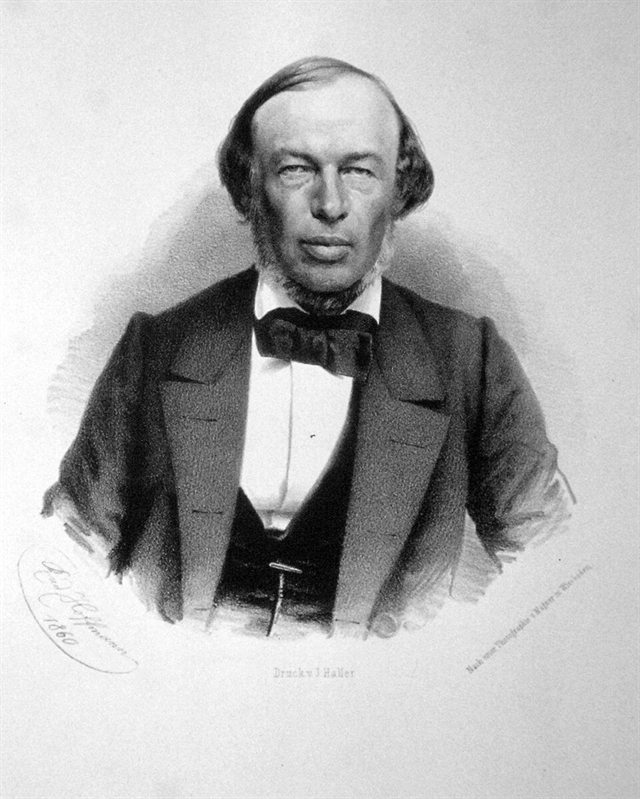
1818–1897
The student who noticed that his classmates kept finding whatever substance they expected to find, wrote out an order of tests to stop it, and published the book while still an undergraduate.
Fresenius's insight was that the individual chemical tests were already known and the *procedure* was not. His principle — remove what could be mistaken for a thing before you test for it — outlived every particular test in his scheme. These five chapters follow a book written by a student that taught chemistry to Europe for a century.
The five chapters
- Finding What You Expected — Giessen, and a problem nobody had named
- Separate Before You Identify — The governing principle
- Published as a Student — The Anleitung, 1841
- No Explanation Anywhere in It — A hundred facts and no theory
- What Outlived the Tests — Instruments replaced the scheme; the discipline stayed
Chapter 1 · Finding What You Expected
Giessen, and a problem nobody had named
1818 – 1840 · Frankfurt · Bonn · Giessen
Carl Remigius Fresenius was born at Frankfurt am Main in December 1818, into a family of lawyers and physicians, and was apprenticed to an apothecary. He studied at Bonn and then went to Giessen to work under Liebig.
Giessen was the only place in Europe where a chemistry student was trained by doing analyses with his own hands. Fresenius arrived and found something wrong with how it was done.
The individual *tests* were mostly known and reliable. Add this reagent to a solution containing that substance and you get a precipitate of a characteristic colour. There were hundreds of such tests in the literature.
What did not exist was a *procedure*. A student handed an unknown substance would apply tests more or less in whatever order occurred to them, and would stop when they got a result that looked like something.
The problem is that many tests are not specific. A white precipitate with hydrochloric acid could be silver, lead or mercury(I). A black precipitate with hydrogen sulphide could be several different metals. If you test for lead and get a positive-looking result, you have not shown lead is present. You have shown that *something* is present that behaves that way in this test.
So students found whatever they happened to expect, and had no way of showing that something else had not produced the same appearance. Two students with the same sample could reach different answers and neither could be shown wrong.
Fresenius wrote out a scheme for his own use, setting the tests in an *order*.
“Before you ask what is present, remove what could be mistaken for it.”
— Carl Remigius Fresenius, Anleitung zur qualitativen chemischen Analyse (1841)
Why this matters
The problem Fresenius identified is that a positive result in a non-specific test proves nothing on its own, and students were routinely finding whatever they expected.
You have the students finding what they expected. What would you ask?
Ask Fresenius
- “Why is a positive test result not proof?”
- “What could a white precipitate actually be?”
- “Why did the tests exist without a procedure?”
- “What did Giessen do well and badly?”
- “How do you notice a problem everybody else has accepted?”
Chapter 2 · Separate Before You Identify
The governing principle
1841 · Giessen
The scheme rests on one idea: *separation before identification*.
Rather than testing directly for a particular substance, you first add a reagent that precipitates a whole *group* of substances at once, and filter that group off. Then you work within the group, subdividing it. Only when everything that could imitate the thing you are looking for has already been physically removed do you apply the specific test.
So the classical scheme proceeds by groups. Add dilute hydrochloric acid: silver, lead and mercury(I) come down as chlorides and are filtered off. To the filtrate add hydrogen sulphide in acid: copper, cadmium, bismuth, arsenic, antimony and tin come down as sulphides. Filter. Make alkaline and add hydrogen sulphide again: iron, nickel, cobalt, manganese and zinc come down. Filter. Add ammonium carbonate: calcium, strontium and barium. Filter. What remains in solution is sodium, potassium, magnesium and ammonium, tested individually at the end.
Each filtration *removes an entire class of possible confusions permanently*.
By the time you test the final solution for potassium, you know it contains none of the twenty or so substances removed earlier, because you took them out and can see them on the filter papers.
The underlying discipline is more general than the chemistry, and it is the part worth taking away: *of every observation, ask what else could have produced it, and eliminate that before concluding*.
That is the structure of a control in any experiment, of differential diagnosis in medicine, and of a well-constructed argument.
Why this matters
Separation before identification means eliminating every possible confusion physically before testing, which is the structure of a control in any experiment.
You have the groups and the filter papers. What is your question?
Ask Fresenius
- “Why separate a whole group before testing for one thing?”
- “Walk me through the first two groups.”
- “What do the filter papers prove?”
- “Does this discipline apply outside chemistry?”
- “How did you decide which substances form a group?”
Chapter 3 · Published as a Student
The Anleitung, 1841
1841 – 1845 · Giessen
Fresenius wrote the scheme out for his own use. Liebig read the manuscript, told him to publish it, and wrote a preface.
The *Anleitung zur qualitativen chemischen Analyse* — Guide to Qualitative Chemical Analysis — appeared in 1841, while its author was still a student.
It succeeded because of *how* it was written. It is not a discussion of analysis. It is a set of instructions: do this, then this, then observe, then do this. A student can follow it without understanding why, and produce a correct answer. And then, having produced correct answers, they begin to see why the order is what it is.
A quantitative companion, on determining *how much* rather than *what*, followed in 1845.
Both ran through edition after edition — the qualitative volume reached seventeen — and were translated into English, French, Italian, Russian, Spanish, Dutch and Hungarian. For the better part of a century, in most of the world, learning practical chemistry meant working through Fresenius.
He was appointed at Wiesbaden in 1848 and founded there a *private* laboratory and teaching institute, independent of any university. It trained analysts for generations and still exists, still bearing his name.
In 1862 he founded the *Zeitschrift für analytische Chemie*, the first journal devoted to analysis alone, and edited it for thirty-five years — establishing analytical chemistry as a discipline with its own literature rather than a service function.
His own analytical work was the practical kind that pays for a laboratory: mineral waters, wines, foodstuffs, soils, and materials in legal disputes. His analyses of the Wiesbaden springs were so exact that the town quoted them as a selling point.
Why this matters
The Anleitung succeeded because it is a set of instructions a student can follow before understanding them, and understanding follows from doing it correctly.
You have the book written by a student. What would you ask him?
Ask Fresenius
- “Why write instructions rather than explanations?”
- “What did Liebig say when he read the manuscript?”
- “Why found a private laboratory rather than take a chair?”
- “Why does analysis need a journal of its own?”
- “Can you understand a procedure before you can do it?”
Chapter 4 · No Explanation Anywhere in It
A hundred facts and no theory
1841 – 1884 · Wiesbaden
The remarkable thing about the *Anleitung* is what is not in it.
Fresenius can tell you that iron(II) gives a dirty green precipitate with alkali and iron(III) a red-brown one, and he can tabulate a hundred such observations with great accuracy. He cannot tell you *why*.
He does not know what a precipitate is, in any deep sense. He has no concept of an *ion*. When his scheme adds hydrochloric acid and precipitates silver chloride, he understands this as one substance reacting with another to form a third — not as silver ions in solution encountering chloride ions and forming an insoluble lattice.
He tests for *chlorides*, *sulphates* and *carbonates* as substances, not as ions. He has no notion of solubility product, of why some combinations are insoluble and others are not, of complex formation, or of why a precipitate sometimes dissolves in excess reagent.
He does not pretend otherwise, which is to his credit. The book states what to do and what will be observed, and stops.
Svante Arrhenius proposed the theory of ionic dissociation in 1884 — that salts in solution exist as separate charged particles — and it was itself controversial for years. That is *forty-three years* after the *Anleitung* was first published.
So for over four decades the standard analytical procedure of European chemistry worked reliably, was taught everywhere, and rested on no explanation whatever.
That is a useful thing to know. A procedure can be correct, teachable and productive while the theory that accounts for it is entirely absent — and it can go on being correct after the theory arrives.
Why this matters
The analytical scheme worked reliably for forty-three years before the ionic theory that explains it existed, which shows a procedure can be right without an explanation.
You have a hundred reliable facts and no theory. What is your question?
Ask Fresenius
- “Why does iron(III) give a red-brown precipitate?”
- “What is actually happening when a precipitate forms?”
- “Is it acceptable to teach a procedure you cannot explain?”
- “Did the ionic theory change your scheme?”
- “What would you most have wanted to understand?”
Chapter 5 · What Outlived the Tests
Instruments replaced the scheme; the discipline stayed
1897 – present · Wiesbaden
Fresenius died at Wiesbaden in June 1897, aged seventy-eight. His son Heinrich continued the laboratory, and it has continued through the family and beyond; the Fresenius institutes still exist.
The scheme itself has been largely displaced. Atomic absorption spectroscopy, X-ray fluorescence, mass spectrometry and inductively coupled plasma methods will identify and quantify dozens of elements in a sample in minutes, at concentrations far below anything a precipitate could reveal, without wet chemistry at all.
A modern analytical laboratory does not do group separations.
So what survived?
The *discipline*. Every qualitative analysis a student has ever done — divide the sample, acidify first, test the portions separately, record what you observe rather than what you expect — is Fresenius's order of operations. It is still taught, partly because it is a good exercise and partly because the habit it builds is the point.
And the habit is general. *Of every observation, ask what else could have produced it, and eliminate that before you conclude.*
That is a control in an experiment. It is differential diagnosis in medicine, where a physician rules out the dangerous alternatives before settling on the likely one. It is the structure of a properly constructed argument, in which you deal with the objections before stating the conclusion.
Fresenius did not invent a chemical test. He invented an *order*, and argued that the order is where the reliability comes from — not the individual test.
That claim is right, and it applies well beyond a bench of test tubes.
Why this matters
Instruments replaced Fresenius's tests entirely, and the discipline he built them around — eliminate what could be mistaken for a thing before concluding — did not go anywhere.
You have the scheme replaced and the habit that stayed. What would you ask?
Ask Fresenius
- “Should the scheme still be taught now that instruments exist?”
- “What does a student learn from doing it by hand?”
- “How does your principle apply to a doctor?”
- “Is the order really where the reliability comes from?”
- “Does it bother you to be remembered as a textbook?”
What Fresenius changed
Every qualitative analysis a student has ever done — divide the sample, acidify first, test the portions separately — is Fresenius's order of operations, and the discipline of asking what else could have produced an observation outlived the particular tests by a long way. The Anleitung ran to seventeen editions and taught practical chemistry to most of Europe and America for a century. The laboratory he founded at Wiesbaden still exists.
A debate that continues
Fresenius's scheme worked reliably for forty-three years before Arrhenius proposed the ionic theory that explains it, and it remained unchanged afterwards — which raises a real question about how much a working procedure owes to the theory behind it.
Keep exploring — ask Fresenius
- “Which of your tests was least reliable?”
- “What else could have produced that observation?”
- “Should a scheme change when its explanation arrives?”
Related lives
- Justus von Liebig — Who Weighed What Burned Away
- Svante Arrhenius — Whose Thesis Nearly Failed
- Robert Bunsen — Who Gave the Flame a Collar
- Mikhail Tsvet — Whose Bands Nobody Believed
Related themes
Qualitative analysis · Precipitation and solubility · Reliability in measurement
Continue on Incandio
- Talk to Fresenius — every question on this page is one tap from being asked, and the same page carries the Historical Brief, the achievements and the timeline
- All 280 figures · Incandio — learn every idea, teach it, then defend it