Historical figure · Pearson Edexcel International GCSE revision on Incandio
Carl von Clausewitz
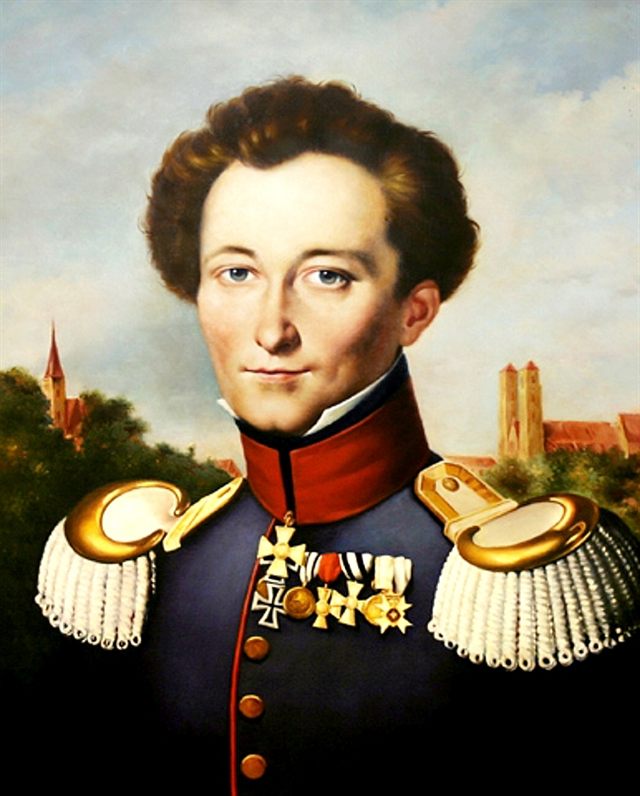
Who Called War a Continuation of Policy · Soldier & Military Theorist · 1780 – 1831
The Prussian officer who entered the army at twelve, was captured at Jena, resigned rather than serve alongside Napoleon, and wrote the book that says moderation in war is a contradiction in terms.
Defend these ideas against Clausewitz
Incandio is a free revision platform for the Pearson Edexcel International GCSE, and on it a topic counts as mastered only once you have learned it, proved it in questions, taught it back and defended it against the person with the strongest claim on it. Carl von Clausewitz is that person for 4 topics on the course:
- Conflict and war — Religious Studies · Sikhism
- Conflict and war — Religious Studies · Judaism
- Conflict and war — Religious Studies · Islam
- Conflict and war — Religious Studies · Christianity
Who was Clausewitz?
Clausewitz was born in 1780 near Magdeburg into a family with a shaky claim to nobility, and entered the Prussian army as a cadet at twelve. He was under fire at thirteen. He was taken prisoner in the catastrophe of 1806, when Prussia was destroyed in a fortnight at Jena and Auerstedt, and spent two years in France as a prisoner of war, thinking about why a professional army had collapsed against a national one. He came back to the reform party around Scharnhorst and Gneisenau and helped rebuild the Prussian officer corps. In 1812, when Prussia was forced into alliance with France, he resigned his commission rather than march on Russia beside Napoleon, and took service with the Tsar; it was treated as close to treason, cost him years of career, and he never apologised for it. He negotiated the Convention of Tauroggen that took the Prussian corps out of the French alliance. He fought again in 1815 and afterwards became administrative director of the War College, a post that gave him little to do and time to write. On War was unfinished at his death from cholera in 1831 and was published by his widow Marie the following year. Its argument is that war is not an autonomous thing with its own rules but the continuation of policy by other means; that it is an act of force to compel an enemy to do your will; and that force has no logical limit, so that introducing a principle of moderation into the philosophy of war is an absurdity. He also invented the idea of friction — the reason everything in war is simple and the simplest thing is difficult — and he insisted that real war is always dragged back from its own logic by politics, chance and exhaustion.
Major achievements
- On War, published posthumously in 1832 and never out of use since
- The formulation that war is the continuation of policy by other means
- The concept of friction, which explains why plans do not survive contact
- Negotiated the Convention of Tauroggen in 1812
Life in brief
- 1780 — Born near Magdeburg: Into a family with a contested claim to nobility.
- 1792 — Enters the army at twelve: Under fire the following year.
- 1806 — Captured at Jena–Auerstedt: Prussia destroyed in a fortnight; two years a prisoner in France.
- 1812 — Resigns his commission: Rather than march on Russia beside Napoleon; takes Russian service.
- 1812 — The Convention of Tauroggen: Which he helped negotiate, detaching a Prussian corps from France.
- 1818 — Director of the War College: An administrative post, and the time in which he wrote.
- 1831 — Dies of cholera: On War unfinished; his wife publishes it in 1832.
Explore the life of Clausewitz — five chapters
- Under Fire at Thirteen — A shaky claim to nobility and an army that took him anyway
- A Fortnight of Ruin — Jena, Auerstedt, and two years a prisoner
- The Resignation of 1812 — Refusing to march on Russia
- An Act of Force with No Logical Limit — What the book actually argues
- The Book His Widow Published — Cholera, a sealed packet, and 1832
Read the five-chapter life of Carl von Clausewitz →
Begin
- Start a conversation with Clausewitz — a dramatised, historically grounded AI portrayal
- Read the Historical Brief
- Explore the life of Clausewitz — five chapters
- Find your course · Meet all 280 figures