Explore Their Life · Pearson Edexcel International GCSE revision on Incandio
Edward Jenner: A Life in Five Chapters
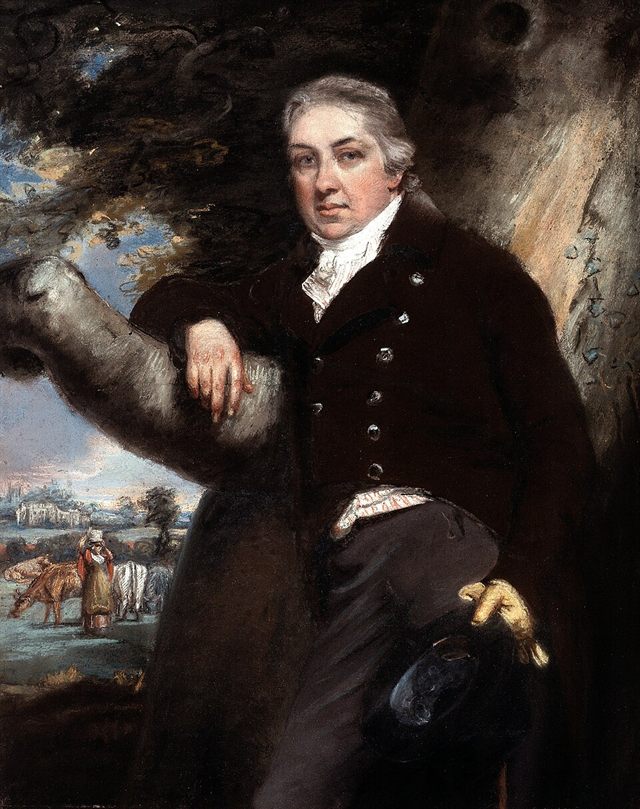
1749–1823
A country doctor who took seriously what milkmaids had been saying for generations, tested it on an eight-year-old boy in a way no ethics committee would ever permit, and started the only campaign that has driven a human disease to extinction.
Jenner did not discover that cowpox protects against smallpox; farm workers knew it and at least one man had acted on it before him. What he did was test it, write it up, and give it away. These five chapters include the experiment on James Phipps, which was indefensible by modern standards and which worked.
The five chapters
- Don't Think — Try — John Hunter's pupil goes home to Gloucestershire
- What the Dairymaids Knew — Taking country knowledge seriously
- James Phipps — 14 May 1796, and an experiment that could not be done today
- Rejected, Then Printed at His Own Expense — The Inquiry, the cartoonists, and the word 'vaccine'
- The Only Disease Ever Eliminated — What he did not know, and what followed anyway
Chapter 1 · Don't Think — Try
John Hunter's pupil goes home to Gloucestershire
1749 – 1773 · Berkeley · Sodbury · London
Edward Jenner was born in May 1749 at Berkeley in Gloucestershire, the eighth of nine children of the vicar. Both his parents died when he was five, and he was brought up by an elder brother.
At around eight he was *variolated* — deliberately infected with a small dose of live smallpox, the standard preventive of the age. The preparation was brutal: weeks of bleeding, purging and starvation diet, then inoculation, then isolation in a stable with other inoculated boys. It gave lifelong immunity in most cases. It also killed perhaps one or two in a hundred, and every person inoculated was infectious and could start an epidemic. Jenner remembered the experience with horror for the rest of his life, and it is not incidental to what he did later.
He was apprenticed to a country surgeon at thirteen, and at twenty-one went to London to study under John Hunter at St George's — the most important surgeon and experimental anatomist in Britain. They became close, and corresponded for over twenty years.
Hunter's advice, in a letter, is the sentence Jenner lived by: why think, why not try the experiment?
Hunter wanted him to stay in London. Jenner went home to Berkeley in 1773 to practise among the farming families of the Vale, and stayed there. That decision is why the discovery happened: the knowledge he needed was local, oral, and belonged to people who milked cows.
“I shall endeavour still further to prosecute this inquiry.”
— Edward Jenner, An Inquiry into the Causes and Effects of the Variolae Vaccinae (1798)
Why this matters
Jenner had been variolated as a child and remembered it with horror — the man who replaced the procedure knew exactly what he was replacing.
You have the orphan, the stable and Hunter's letter. What would you ask?
Ask Jenner
- “What was being variolated as a boy actually like?”
- “What did Hunter mean by 'don't think, try'?”
- “Why go home to Berkeley rather than stay in London?”
- “How dangerous was variolation really?”
- “What did losing both parents at five do to you?”
Chapter 2 · What the Dairymaids Knew
Taking country knowledge seriously
1770s – 1796 · The Vale of Berkeley · Gloucestershire
In the dairy country of Gloucestershire there was a piece of common knowledge: people who had caught cowpox from the udders of infected cows — a mild illness, a few sores on the hands, some fever, over in a fortnight — did not take the smallpox. It was so well established locally that dairymaids were said to be sought after as servants in households afraid of infection, and Jenner reported hearing it from a young countrywoman while he was still an apprentice.
Medical men knew about it too and had mostly disregarded it as rustic folklore. It also had a complication: the belief was not reliably true, because several different diseases of cattle produced sores on the hands and only one of them conferred protection.
Jenner spent roughly twenty years on this before he acted. He collected cases. He interviewed people who had had cowpox and later been variolated, and found that the inoculation would not take on them. He distinguished what he called true cowpox from the spurious kinds, and worked out that the matter had to be taken at a particular stage of the sore to work.
He was not, in the meantime, only doing this. He was a working country doctor. He was also a naturalist of real quality: his study of the cuckoo — establishing that the newly hatched cuckoo chick itself ejects the eggs and nestlings of its host, using a hollow in its back — was the paper that got him elected to the Royal Society in 1788. His observation was disbelieved for a century and confirmed by photography in 1921.
Why this matters
Jenner's contribution was to treat the knowledge of dairy workers as evidence worth testing, and then to do twenty years of work distinguishing the cases where it held.
You have twenty years of listening to farm workers. What is your question?
Ask Jenner
- “Why did you take the dairymaids seriously when physicians did not?”
- “How did you tell true cowpox from the spurious kinds?”
- “Why did it take twenty years before you acted?”
- “Tell me about the cuckoo chick.”
- “How did you test whether someone was already protected?”
Chapter 3 · James Phipps
14 May 1796, and an experiment that could not be done today
1796 · Berkeley
On 14 May 1796 Jenner took matter from a cowpox sore on the hand of Sarah Nelmes, a dairymaid who had caught it from a cow called Blossom, and inserted it into two small cuts in the arm of James Phipps, the eight-year-old son of Jenner's gardener.
The boy developed a mild fever and a sore at the site, felt unwell for a day or two, and recovered.
Then, on 1 July, Jenner *variolated* him — deliberately inoculated him with live smallpox matter. If the cowpox had not protected him, the boy would have contracted smallpox, and might have died.
Nothing happened. No disease developed. Jenner repeated the challenge later, with the same result.
This must be stated plainly: by any modern standard the experiment was indefensible. A child too young to consent, the son of an employee and therefore in no position to refuse, was deliberately exposed to a disease that killed roughly a third of those it infected, to test a hypothesis. No ethics committee in the world would approve it. That it worked does not make it right, and Jenner's own confidence — he had twenty years of case evidence — does not transfer to the boy, who had none of it.
Jenner did not abandon Phipps. He gave him a cottage rent-free for life and planted roses in the garden himself. Phipps lived to about sixty-five and attended Jenner's funeral.
Both things are true at once, and the reader has to hold them.
Why this matters
The founding experiment of vaccination deliberately exposed a child who could not consent to a disease that killed a third of its victims — a fact the achievement does not cancel.
You have the boy, the two cuts and the challenge in July. What would you ask?
Ask Jenner
- “How do you defend infecting a child who could not refuse you?”
- “How certain were you before you challenged him with smallpox?”
- “What would you have done if Phipps had caught it?”
- “Why did you look after Phipps for the rest of his life?”
- “How should such a thing be tested now?”
Chapter 4 · Rejected, Then Printed at His Own Expense
The Inquiry, the cartoonists, and the word 'vaccine'
1797 – 1802 · Berkeley · London
Jenner sent a paper to the Royal Society in 1797. It was rejected, with advice that he should not risk his reputation by presenting anything so at variance with established knowledge on such slender evidence — which, with one case, was a fair criticism.
He went and did more. By 1798 he had a series of cases, and published *An Inquiry into the Causes and Effects of the Variolae Vaccinae* privately, at his own expense, in an edition of about seventy-five copies. He named the practice after *vacca*, the Latin for cow. That is where the word *vaccine* comes from, and it is now applied to preparations that have nothing to do with cattle.
The reception was fierce. Physicians who made a good living from variolation had an obvious interest. Others objected on genuinely scientific grounds — early practitioners often used contaminated matter or the wrong stage of sore, and got failures Jenner had warned against. Some objected on religious grounds, that putting a beast's disease into a human was against nature. James Gillray's cartoon of 1802 shows Jenner's patients sprouting small cows from their arms, noses and buttocks.
Jenner never patented it. He gave the method away, published the technique in full, and sent matter free to anybody who asked — including, during the Napoleonic Wars, to France, and Napoleon released British prisoners at his request.
Parliament voted him £10,000 in 1802 and a further £20,000 in 1807, partly because promoting vaccination had consumed his practice and his income.
Why this matters
Jenner refused to patent vaccination and published the method in full, which is why it spread across the world within a decade.
You have the rejected paper, the cartoons and the free gift. What is your question?
Ask Jenner
- “Was the Royal Society right to reject your first paper?”
- “Why give the method away rather than patent it?”
- “What did the honest scientific objectors get right?”
- “How did you feel about Gillray's cartoon?”
- “Why did Napoleon release prisoners at your request?”
Chapter 5 · The Only Disease Ever Eliminated
What he did not know, and what followed anyway
1823 – 1980 · Berkeley · Somalia · Geneva
Jenner had no idea why vaccination worked. Germ theory was sixty years away; the concept of immunity did not exist; viruses were not identified until the 1890s. He had a procedure, a great deal of case evidence, and no mechanism whatsoever.
He also got some things wrong. He believed a single vaccination gave lifelong protection, and defended that position; it does not, and revaccination proved necessary. And he was not first: Benjamin Jesty, a Dorset farmer, had inoculated his wife and two sons with cowpox in 1774, twenty-two years earlier, using a darning needle. Jesty told almost nobody and published nothing, and the practice went nowhere. Several others had done similar things.
The difference is entirely in what Jenner did next. He tested it systematically, wrote it up, published it, refused to profit from it, and spent the rest of his life promoting it — running a free vaccination clinic in a hut in his garden at Berkeley, which he called the Temple of Vaccinia, for the local poor.
His wife Catherine died of tuberculosis in 1815. He died of a stroke at Berkeley in January 1823, aged seventy-three, still practising among the same country people.
The World Health Organization launched an intensified eradication programme in 1967. The last natural case of smallpox occurred in Somalia in October 1977. Eradication was certified in 1980.
Smallpox had been killing people for at least three thousand years, and killed perhaps three hundred million in the twentieth century alone before it stopped. It is the only human disease ever eliminated.
Why this matters
Jenner was not the first to use cowpox, and it did not matter: the difference was testing it, publishing it, and refusing to own it.
You have the free clinic in the garden and the disease that no longer exists. What would you ask?
Ask Jenner
- “Benjamin Jesty was twenty-two years ahead of you — why are you the one remembered?”
- “You had no idea why it worked — did that worry you?”
- “Why run a free clinic in a hut in your own garden?”
- “What did you get wrong about how long protection lasts?”
- “What would you say to someone who refuses a vaccine today?”
What Jenner changed
Vaccination is the most effective medical intervention ever devised, and smallpox — which killed perhaps three hundred million people in the twentieth century alone — remains the only human disease driven to extinction, certified in 1980. The word itself is Jenner's, from the Latin for a cow. He refused to patent the method and gave it away, which is why it spread worldwide within a decade of publication.
A debate that continues
Benjamin Jesty and probably others used cowpox inoculation before Jenner, and the founding experiment on James Phipps would be prohibited under any modern research-ethics framework; both facts sit alongside the achievement rather than cancelling it.
Keep exploring — ask Jenner
- “Which disease would you go after next?”
- “Can a discovery be right and the experiment still be wrong?”
- “What should a doctor do when the evidence is not yet enough?”
Related lives
- Louis Pasteur — Father of Germ Theory
- Élie Metchnikoff — Discoverer of the Phagocyte
- James Lind — The Man Who Ran the First Fair Trial
- Richard Doll — The Man Who Proved Smoking Kills
Related themes
Immunity and vaccination · Infectious disease · Ethics in medical research
Where Jenner appears in your course
Edward Jenner has a genuine claim on 1 lesson of the Pearson Edexcel International GCSE science course built into Incandio:
- Immunity and Clotting — Biology: Jenner performed the first vaccination and gave the practice its name, sixty years before anyone had a germ theory and a century before anyone could explain an antibody. He is the proof that this lesson's mechanism was discovered backwards — the protection was established, tested and used to save millions of lives long before a single word of the explanation existed.
Continue on Incandio
- Talk to Jenner — every question on this page is one tap from being asked, and the same page carries the Historical Brief, the achievements and the timeline
- All 280 figures · Incandio — learn every idea, teach it, then defend it