Explore Their Life · Pearson Edexcel International GCSE revision on Incandio
Hermann von Helmholtz: A Life in Five Chapters
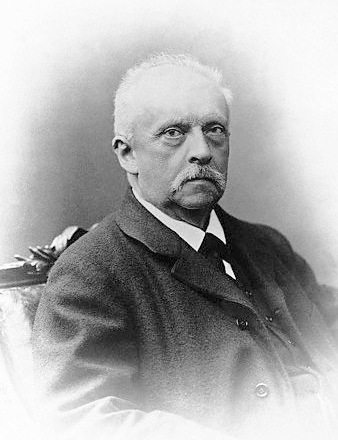
1821–1894
The army surgeon who stated the conservation of energy at twenty-six and had the paper rejected, then measured the speed of a nerve impulse his own teacher had declared unmeasurable, and then invented the instrument that lets a doctor look inside a living eye.
Helmholtz trained as a military surgeon because his family could not afford to send him to study physics, and spent his life doing physics anyway — across mechanics, physiology, optics, acoustics and electromagnetism. His governing conviction was that living things obey the same physics as everything else. These five chapters follow the range.
The five chapters
- An Army Surgeon by Necessity — A schoolmaster's son who could not afford physics
- On the Conservation of Force — 1847, rejected by the leading journal
- The Speed of a Nerve Impulse — Measuring what his teacher said could not be measured
- Looking Into a Living Eye — The ophthalmoscope, 1851
- The Sensations of Tone — Why a violin and a flute playing the same note sound different
Chapter 1 · An Army Surgeon by Necessity
A schoolmaster's son who could not afford physics
1821 – 1847 · Potsdam · Berlin
Hermann Ludwig Ferdinand Helmholtz was born at Potsdam in August 1821. His father Ferdinand taught philology and philosophy at the Gymnasium; his mother was a descendant of William Penn.
He was a sickly child, and he wanted to study *physics*.
His father could not afford it. The solution was the *Royal Friedrich-Wilhelm Institute* in Berlin, which trained army surgeons: the state paid for the medical education in exchange for eight years' service afterwards.
So Helmholtz became a physician because it was free, and spent his whole life doing physics anyway.
In Berlin he studied under *Johannes Müller*, the leading physiologist in Germany, and fell in with a remarkable group of Müller's students — Emil du Bois-Reymond, Ernst Brücke and Carl Ludwig.
The four of them made what amounts to a manifesto. Müller himself, though a great experimentalist, retained a form of *vitalism*: he held that living things possess a *Lebenskraft*, a vital force, not reducible to physics and chemistry. His students rejected it entirely, and are said to have pledged themselves to the proposition that no forces other than the common physical and chemical ones are active within the organism.
That is a programme, and Helmholtz spent his career executing it.
He served his eight years as an *army surgeon* at Potsdam, doing research in his spare time in a small laboratory he set up himself.
And in 1847, at twenty-six, still a serving military surgeon, he read a paper to the Berlin Physical Society: *Über die Erhaltung der Kraft* — On the Conservation of Force.
“Whoever, in the pursuit of science, seeks after immediate practical utility, may generally rest assured that he will seek in vain.”
— Hermann von Helmholtz, academic address
Why this matters
Helmholtz's programme — that no forces beyond the ordinary physical and chemical ones operate in a living body — was a deliberate rejection of his own teacher's vitalism.
You have the free medical education and the manifesto. What would you ask?
Ask Helmholtz
- “Why did you train as an army surgeon?”
- “What did you and Müller's other students pledge?”
- “Was it awkward rejecting your own teacher's position?”
- “How do you do research as a serving army surgeon?”
- “What did you want to study instead?”
Chapter 2 · On the Conservation of Force
1847, rejected by the leading journal
1847 · Berlin
Helmholtz's 1847 paper does something Joule's experiments did not: it states the conservation of energy as a *general principle* covering every branch of physics, and argues it mathematically.
His starting point is the impossibility of *perpetual motion*. If no machine can produce work from nothing, then in any closed system the total quantity of something must be constant. He takes that as an axiom and works out its consequences.
He then shows the principle applies across mechanics — where kinetic and potential energy exchange — and to heat, to electricity and magnetism, to chemical reactions, and to physiological processes. Muscle contraction, animal heat, the energy of food: all of it is the same accounting.
He explicitly rejects any *vital force*. If an organism could generate energy from nothing it would be a perpetual motion machine, and there are none.
The paper was *rejected* by *Annalen der Physik*, the leading German physics journal, whose editor Johann Christian Poggendorff considered it too speculative and insufficiently supported by new experiments. Helmholtz published it as a pamphlet at his own expense.
It is worth being clear about priority. *Julius Robert von Mayer* published the equivalence of heat and work in 1842, and *Joule* was doing the measurements from 1843. Helmholtz did not know of Mayer's work when he wrote, and knew little of Joule's.
What Helmholtz added was *generality and mathematical form* — Mayer had the idea with little support, Joule had the measurements without the mathematics, and Helmholtz had the general principle stated so that it could be applied to any system.
The three arrived by three different routes, which is itself an argument that the principle was there to be found.
Why this matters
Helmholtz argued conservation of energy from the impossibility of perpetual motion, and extended it to physiology — so a living body cannot create energy either.
You have the rejected pamphlet and the general principle. What is your question?
Ask Helmholtz
- “Why start from the impossibility of perpetual motion?”
- “Why was the paper rejected?”
- “What does conservation rule out in a living body?”
- “How should credit be divided with Mayer and Joule?”
- “Does three independent discoveries mean the idea was ready?”
Chapter 3 · The Speed of a Nerve Impulse
Measuring what his teacher said could not be measured
1850 · Königsberg
Johannes Müller had stated that the speed of the nerve impulse could *never* be measured. His reasoning was that it must be enormously fast — comparable to light or electricity — and that the distances available in a body are far too short for any conceivable timing.
Helmholtz measured it in 1850, and the result was a considerable surprise.
His method used a frog's nerve–muscle preparation and a *myograph*: a device in which the muscle's contraction is recorded as a trace on a rotating smoked drum, so the *timing* can be read off the trace.
The key is *differential* measurement. Stimulate the nerve at a point *close* to the muscle and record the delay before contraction. Then stimulate at a point *further away* and record again. The *difference* between the two delays is the time taken for the impulse to travel the known distance between the two points.
That cancels out everything else — the delay in the stimulating apparatus, the time for the muscle itself to respond, the recording lag — because all of it is identical in both cases.
The answer came out at something like *twenty-seven metres per second* in a frog. Not comparable to light. Not comparable to electricity in a wire. Comparable to a fast bird.
He later measured it in humans by having subjects press a button when they felt a stimulus at different points on the body, obtaining figures in the range of tens of metres per second.
The implications are considerable. A nerve impulse is not an instantaneous electrical transmission; it is an *active process*, propagated by the nerve fibre itself, taking measurable time. That is why there is a real, measurable delay between a stimulus and a response — the basis of reaction-time studies and of experimental psychology.
And Müller had declared the question closed.
Why this matters
A nerve impulse travels at tens of metres per second, not at the speed of electricity, which means it is an active biological process rather than a passive transmission.
You have the frog, the drum and the difference of two delays. What would you ask?
Ask Helmholtz
- “Why measure the difference between two stimulations?”
- “Why was the answer so surprising?”
- “What does a slow impulse tell you about a nerve?”
- “What did Müller say when you did it?”
- “How often is 'unmeasurable' just 'not yet attempted'?”
Chapter 4 · Looking Into a Living Eye
The ophthalmoscope, 1851
1851 – 1867 · Königsberg · Bonn · Heidelberg
In 1851 Helmholtz invented the *ophthalmoscope*, and became the first person to see the inside of a living human eye.
The problem is subtle and it had defeated everyone. Look into someone's pupil and you see *black*. The interior is not dark — light gets in — but the light that comes back out returns almost exactly along the path it came in, because the eye's optics focus it that way. So your own head blocks the light source, and if you get your eye in the returning beam you also block the light going in.
Helmholtz's solution: use a *partially reflecting* surface — an angled piece of glass — placed between the observer and the patient's eye. Light from a lamp at the side reflects off the glass into the patient's eye. The light returning from the retina passes *through* the same glass to the observer, who is looking along the axis without blocking anything.
A lens corrects the focus.
Suddenly the *retina* is visible in a living person: the blood vessels, the optic disc, the macula.
This is a genuine revolution in medicine. It is the only place in the body where blood vessels and nerve tissue can be *seen directly, without surgery*, in a living patient. Diabetic damage, hypertensive changes, raised pressure inside the skull, glaucoma and retinal detachment all became diagnosable.
Every eye examination since uses the descendant of it.
He went on to write the *Handbook of Physiological Optics*, which took over a decade and is one of the great scientific books of the century. In it he explained *accommodation* — how the eye focuses at different distances — showing that the ciliary muscle contracts, which *slackens* the suspensory ligaments and allows the elastic lens to become more sharply curved. That is counter-intuitive: the muscle contracts to *relax* the tension.
He also developed the Young–Helmholtz *three-colour* theory of vision, proposing three kinds of receptor sensitive to different parts of the spectrum. It was disputed for decades by Hering, and both turned out to be partly right — three cone types, and opponent processing further along.
Why this matters
The eye is the only place where blood vessels and nerve tissue can be seen directly in a living person, and the ophthalmoscope made that possible.
You have the angled glass and the visible retina. What is your question?
Ask Helmholtz
- “Why does a pupil look black if light gets in?”
- “How does the angled glass solve it?”
- “What can a doctor diagnose by looking at a retina?”
- “Why does a muscle contract to relax the lens?”
- “Were you right about three kinds of colour receptor?”
Chapter 5 · The Sensations of Tone
Why a violin and a flute playing the same note sound different
1863 – 1894 · Heidelberg · Berlin
*On the Sensations of Tone* (1863) is Helmholtz's book on hearing and music, and it answers a question everybody has and nobody could previously answer.
A violin and a flute play the same note — the same *pitch*, the same fundamental frequency. They sound completely different. Why?
The answer is *overtones*. A vibrating string or air column does not produce a single frequency. It vibrates at its fundamental *and* at a series of higher frequencies — harmonics — simultaneously. What differs between instruments is *which* overtones are present and *how strong* each is.
That pattern is the *timbre*, or tone quality.
Helmholtz proved it by isolating them. He built *Helmholtz resonators*: hollow spheres of glass or brass, each tuned to one frequency, with a small opening to hold to the ear. Hold one to your ear while an instrument plays, and if that particular frequency is present in the sound, the resonator sounds loudly and everything else is suppressed.
With a set of them he could *analyse* a complex sound into its components, one by one.
And then he *synthesised* — building sounds from tuning forks driven electromagnetically, adding overtones in chosen proportions, and reproducing the characteristic quality of different vowels and instruments.
Analysis and synthesis together are a proof. Take it apart, put it back together, get the same thing.
He also proposed a mechanism: that the *cochlea* contains structures of graded size which resonate at different frequencies, so the ear performs the analysis mechanically. That is broadly right in outline — the basilar membrane does respond at different places to different frequencies — though the detail was substantially corrected by Georg von Békésy in the twentieth century.
In 1871 he finally obtained what he had wanted since he was a boy: the chair of *physics* at Berlin. His students there included *Heinrich Hertz*, who in 1887 produced and detected the electromagnetic waves Maxwell had predicted — and Max Planck.
He died at Charlottenburg in September 1894, aged seventy-three, after a fall.
Why this matters
Timbre is the pattern of overtones accompanying a fundamental, and Helmholtz proved it by taking sounds apart with resonators and building them back up from tuning forks.
You have the resonators, the synthesised vowels and the chair at last. What would you ask?
Ask Helmholtz
- “Why do a violin and a flute sound different on the same note?”
- “How does a resonator pick out one frequency?”
- “Why does building a sound back up prove anything?”
- “How does the ear separate frequencies?”
- “What was it like finally getting a chair in physics?”
What Helmholtz changed
Helmholtz is a large part of the reason physiology became a physical science. The conservation of energy in its general form, the ophthalmoscope still used in every eye examination, the measurement of nerve conduction speed, and the analysis of timbre into overtones that underlies all acoustics are his — and his students, notably Hertz and Planck, carried the method into the next century.
A debate that continues
Conservation of energy was reached independently by Mayer, Joule and Helmholtz by three different routes, and the division of credit is genuinely three-way; and the Young–Helmholtz theory of colour vision was contested for decades by Hering, with both turning out to be partly right.
Keep exploring — ask Helmholtz
- “Which of your fields did you love most?”
- “What else has been declared unmeasurable?”
- “What did Hertz take from you?”
Related lives
- James Prescott Joule — Who Weighed Heat Against Work
- Gustav Kirchhoff — Who Read The Sun's Chemistry
- James Clerk Maxwell — Who Bound Light to Electromagnetism
- Émilie du Châtelet — Who Proved It Goes as the Square
Related themes
Conservation of energy · Sound and hearing · The eye and vision
Where Helmholtz appears in your course
Hermann von Helmholtz has a genuine claim on 3 lessons of the Pearson Edexcel International GCSE science course built into Incandio:
- Oscilloscopes, Pitch and Loudness — Physics: This page reduces sound to two quantities, pitch and loudness, and Helmholtz is the person who showed that a real note contains far more than that. In On the Sensations of Tone he established that an instrument produces a fundamental frequency together with a series of quieter overtones at multiples of it, and that the particular mixture is what makes a violin sound like a violin. He built resonators tuned to individual overtones to pick them out one at a time, decades before an oscilloscope could display the whole trace at once.
- Energy Stores and Transfers — Physics: Joule measured; Helmholtz generalised. In 1847, at twenty-six, he argued that the conservation of force — energy, in modern terms — must hold universally, that no machine can produce work from nothing, and crucially that this applies to living organisms as much as to engines. That last claim was contentious: many respected physiologists held that life involved forces exempt from ordinary physics. His paper was rejected by the leading physics journal of the day and he published it himself.
- Star Colour and Temperature — Physics: This page asks a learner to trust that a star LOOKS blue because it IS emitting mostly short wavelengths, and Helmholtz is the person who established how much of a colour is in the light and how much is in the observer. He showed that the eye has a small number of receptor types and that every perceived colour is a combination of their responses — so two quite different mixtures of wavelengths can look identical. That is exactly why astronomers measure a star's brightness through coloured filters and compute a number rather than trusting anyone's eye.
Continue on Incandio
- Talk to Helmholtz — every question on this page is one tap from being asked, and the same page carries the Historical Brief, the achievements and the timeline
- All 280 figures · Incandio — learn every idea, teach it, then defend it