Explore Their Life · Pearson Edexcel International GCSE revision on Incandio
J. B. Priestley: A Life in Five Chapters
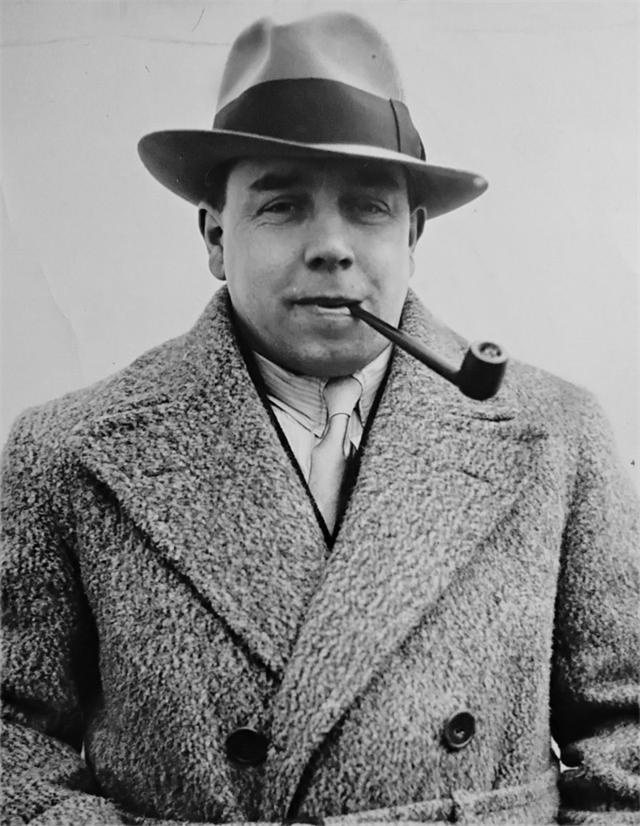
1894–1984
The Bradford clerk who survived the trenches, broadcast to sixteen million people during the Blitz, and wrote a play about a family's responsibility for one girl's death.
Priestley wrote around fifty plays and thirty novels, helped shape the mood that produced the 1945 Labour landslide, and launched the campaign for nuclear disarmament with a single article. *An Inspector Calls* has become one of the most studied plays in English schools. These five chapters explain where it came from.
The five chapters
- The Wool Office — Bradford, a socialist father, and a deliberate refusal of university
- The Trenches — Buried alive, gassed, and permanently angry
- English Journey — Three Englands, and the Depression seen at ground level
- The Postscripts — Sixteen million listeners, and then taken off the air
- An Inspector Calls — One family, one girl, and a telephone that rings at the end
Chapter 1 · The Wool Office
Bradford, a socialist father, and a deliberate refusal of university
1894 – 1914 · Bradford
John Boynton Priestley was born in Bradford on 13 September 1894. His mother died when he was an infant. His father Jonathan was a headmaster and a committed socialist, and the house was full of teachers, trade unionists and argument.
Bradford in Priestley's youth was a wool city of enormous wealth and considerable poverty, with a strong nonconformist and radical tradition, a German-Jewish merchant community that gave it a cosmopolitan flavour, and a vigorous cultural life of concerts, theatres and debating societies. He wrote about it for the rest of his life as the place that formed him.
He left Belle Vue Grammar School at sixteen and went to work as a junior clerk in a wool office — a decision he made himself. His view was that a university would have made him respectable and conventional, and that if he wanted to write he should go and live among people rather than among books.
He read enormously in the evenings, wrote for local newspapers, and observed the world of the office: the confident employers, the deference expected, and the assumption that a man's worth could be read from his position.
That world went straight into *An Inspector Calls* thirty years later. Arthur Birling — a self-satisfied northern manufacturer certain of his own judgement and contemptuous of anything that might interfere with profit — is a type Priestley had spent four years watching at close range.
Why this matters
Priestley chose a clerk's office over university deliberately, and the class world he observed there supplied the Birlings and the moral argument of his most-taught play.
You have the Bradford years. What would you ask him?
Ask Priestley
- “Why refuse university for a wool office?”
- “What did you learn watching employers at work?”
- “What did your father's socialism give you?”
- “What was Bradford like before the war?”
- “How much of Arthur Birling did you meet in real life?”
Chapter 2 · The Trenches
Buried alive, gassed, and permanently angry
1914 – 1922 · The Western Front · Cambridge
Priestley enlisted in September 1914, aged nineteen, in the Duke of Wellington's West Riding Regiment. He served as an infantryman for over two years before being commissioned.
In June 1916 he was buried alive by a trench mortar explosion and dug out with serious injuries. In 1917 he was gassed. He survived the war; most of the young men he enlisted with did not.
He said almost nothing about it publicly for over forty years. When he finally wrote about it, in *Margin Released* (1962), the anger had not diminished. He described a war in which men of his generation were used up by a system that regarded them as expendable, and he was contemptuous of the officer class and of the sentimental commemorations that followed. He wrote that he was ordered into a war by men who could not have organised a school outing, and that the survivors returned to a country that had promised them everything and delivered very little.
That is the root of his politics. The men who came home to unemployment in the 1920s and 1930s, and the country that let it happen, are behind everything he wrote about social responsibility.
He took a place at Trinity Hall, Cambridge, in 1919 on an ex-officer grant, read modern history and political science, and found the undergraduates who had not served intolerable. He left in 1922 for London and freelance journalism, with a wife, a baby and no money.
Why this matters
Priestley's forty-year silence about the trenches, and the fury when it broke, is characteristic of his generation — and it is the emotional source of his insistence on collective responsibility.
You have the trenches and the long silence after them. What would you ask him?
Ask Priestley
- “What happened when you were buried alive?”
- “Why did you say nothing about the war for forty years?”
- “What did the survivors come home to?”
- “Why did you find Cambridge so difficult?”
- “How did the war shape your politics?”
Chapter 3 · English Journey
Three Englands, and the Depression seen at ground level
1929 – 1939 · England · London
*The Good Companions* (1929), a long, warm novel about a travelling concert party, made Priestley famous and prosperous. *Angel Pavement* (1930), a much darker book about a London office and the people ruined when a swindler passes through it, showed what he could do when he was not being genial.
*English Journey* (1934) is the book that mattered politically. Priestley travelled the country in the depths of the Depression — Southampton, Bristol, the Cotswolds, Birmingham, the Potteries, Lancashire, Tyneside, Norwich — and reported what he saw.
He described three Englands. The first was old England of cathedrals and manor houses, pleasant and largely irrelevant. The second was nineteenth-century industrial England of factories, back-to-back housing and chapels — grim, but with its own dignity and community. The third was the new England of arterial roads, cinemas, factory girls looking like actresses, cocktail bars and Woolworths — cheap, democratic, and, he thought, thinner.
His account of the north-east is the most damning. In Stockton-on-Tees and Jarrow he found towns where nearly every working man was unemployed, industries closed, and a generation of young men who had never had a job and probably never would. He wrote that the England of the industrial north had been used and thrown away, and asked why a country that could organise itself for war could not organise itself for peace.
Historians of the 1945 election regularly cite the book as part of the shift in national mood that produced a Labour landslide.
Why this matters
English Journey is one of the most influential pieces of Depression-era reportage in Britain and helped make the case that mass unemployment was a political failure rather than a natural event.
You have the country in the 1930s. What would you ask him?
Ask Priestley
- “What were your three Englands?”
- “What did you find on Tyneside?”
- “Why could Britain organise for war but not for peace?”
- “What did you think of the new England of cinemas and cafés?”
- “Did the book change anything?”
Chapter 4 · The Postscripts
Sixteen million listeners, and then taken off the air
1940 – 1945 · London · Broadcasting House
In June 1940, after Dunkirk, the BBC gave Priestley a short talk after the Sunday nine o'clock news. The *Postscripts* ran through that summer and again in early 1941, and drew audiences of around sixteen million — a third of the adult population, second in popularity only to Churchill.
His method was to take one small thing and open it out. His most famous broadcast is about the little ships at Dunkirk, and specifically about the *Gracie Fields*, a paddle steamer that had carried holidaymakers to the Isle of Wight and was sunk carrying soldiers home. He describes her cheerful pre-war passengers and then her end, and turns it into an argument about a country capable of that kind of improvised collective effort.
He did not stop at consolation. He argued repeatedly that Britain was fighting not to restore the 1939 world but to build a better one — that the pre-war order of dole queues and slum housing should not return, and that a country able to organise for war could organise for decent housing and health.
He was taken off the air in October 1940 and again in March 1941. Priestley believed he had been silenced for being too left-wing; the surviving BBC and government correspondence shows complaints from Conservative politicians and unease at the Ministry of Information, alongside claims that the slot had simply run its course. The exact mix is still argued over.
He helped found the Common Wealth Party in 1942, which won by-elections against the wartime electoral truce on a platform of common ownership and morality in politics, and whose voters largely went to Labour in 1945.
“We're not fighting to restore the past; it was the past that brought us to this heavy hour.”
— J. B. Priestley, BBC Postscript broadcast, 21 July 1940
Why this matters
Priestley's broadcasts helped establish the wartime expectation that victory should bring social reform — the mood that produced the Beveridge Report's reception and the 1945 election result.
You have the broadcasts. What would you ask him?
Ask Priestley
- “Why talk about a pleasure steamer to explain Dunkirk?”
- “Why insist that the pre-war world should not return?”
- “Why were you taken off the air?”
- “What was the Common Wealth Party for?”
- “How do you talk to a frightened country without lying to it?”
Chapter 5 · An Inspector Calls
One family, one girl, and a telephone that rings at the end
1945 – 1984 and after · Moscow · London
Priestley wrote *An Inspector Calls* in about a week in the autumn of 1944. No London theatre was free, so it had its premiere in Moscow in 1945, running in two theatres simultaneously, before opening at the Old Vic in October 1946 with Ralph Richardson as the Inspector.
The setting is deliberate. The Birlings are celebrating an engagement in 1912; the play was written in 1945. Arthur Birling assures everyone that the Titanic is unsinkable, that talk of war is nonsense, and that a man has to look after himself and his own. The audience knows what is coming and he does not, which makes every complacent statement an indictment.
Inspector Goole arrives to investigate the suicide of a young working-class woman, and establishes that each member of the family contributed to her destruction: a sacking for asking for a small pay rise, a complaint that cost her a shop job, an exploitative affair, a refusal of charity. None of them broke a law. All of them treated her as though she did not fully count.
The Inspector's final speech — that we are members of one body, that we are responsible for each other, and that if men will not learn that lesson they will be taught it in fire and blood and anguish — is delivered by a man who may not be a policeman at all. When the family discover no such inspector exists and begin to relax, the telephone rings: a girl has just died, and an inspector is on his way.
Priestley's other lasting act came in 1957, when a *New Statesman* article he wrote on Britain and the nuclear bomb produced such a response that the Campaign for Nuclear Disarmament was founded from the meeting it prompted.
He refused a knighthood and a peerage, accepted the Order of Merit in 1977, and died on 14 August 1984, aged eighty-nine.
Why this matters
An Inspector Calls is among the most taught plays in British schools, and its argument — that private choices have social consequences — is the clearest dramatic statement of the collective ethic that produced the welfare state.
You have the play. What would you ask him?
Ask Priestley
- “Why set a 1945 play in 1912?”
- “Who or what is Inspector Goole?”
- “Why does the telephone ring at the end?”
- “Why are the younger Birlings treated differently?”
- “How did one article start the anti-nuclear campaign?”
What Priestley changed
Priestley's wartime Postscripts helped shape the expectation of post-war social reform, English Journey documented Depression Britain for a mass readership, and An Inspector Calls became one of the most widely studied plays in British education. His 1957 article on nuclear weapons led directly to the founding of CND.
A debate that continues
The reasons for the BBC ending his Postscripts are still disputed between political pressure and scheduling, and critics differ over whether An Inspector Calls is a subtle moral drama or a piece of well-made political instruction.
Keep exploring — ask Priestley
- “What did you want the audience to feel when the phone rings?”
- “How much responsibility does one person carry for a stranger?”
- “What did England look like to you in 1933?”
Related lives
- George Orwell — Chronicler of the Total State
- Arthur Miller — Conscience of the American Stage
- Winston Churchill — Prime Minister of Great Britain
Related themes
An Inspector Calls and social responsibility · Britain in the Second World War · The welfare state
Debate Priestley in the Agora
Reading is the start. On Incandio an idea counts as mastered only once you have argued it against the person with the strongest claim on it, in structured rounds marked against published descriptors.
- A Chain of Small Decisions — “The Birlings are collectively responsible for Eva Smith's death.”
- Question the Playwright — “The Inspector is a mouthpiece, not a character — and the play is weaker for it.”
- Fire and Blood and Anguish — “An Inspector Calls is a play about capitalism, and every other reading is a smaller version of that one.”
Continue on Incandio
- Talk to Priestley — every question on this page is one tap from being asked, and the same page carries the Historical Brief, the achievements and the timeline
- All 280 figures · Incandio — learn every idea, teach it, then defend it