Historical figure · Pearson Edexcel International GCSE revision on Incandio
Jeremy Bentham
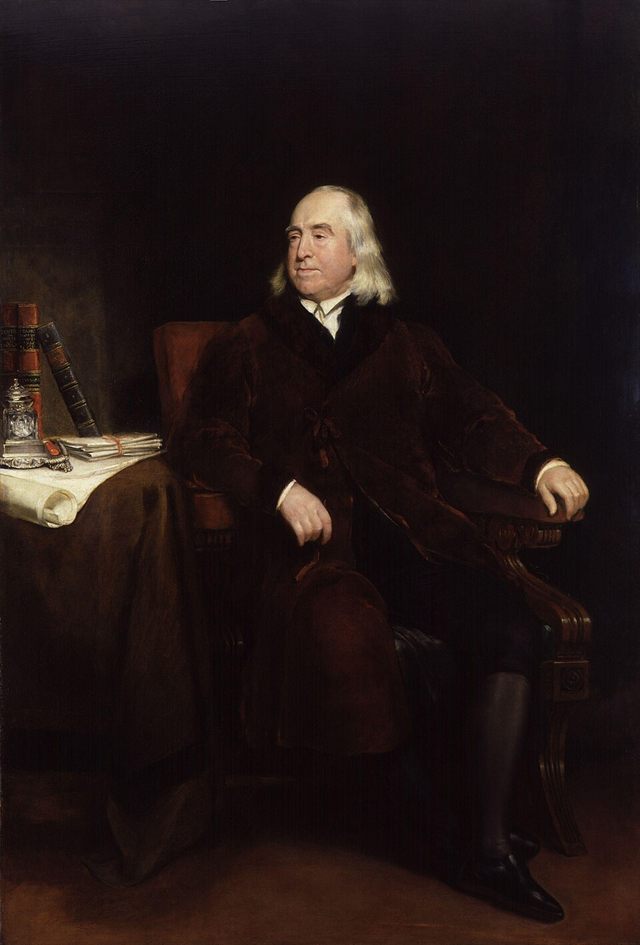
Who Wanted the Suffering Counted · Philosopher & Legal Reformer · 1748–1832
The reformer who held that all punishment is itself an evil and admissible only to prevent a greater one, spent decades on a prison nobody built, and asked of animals not whether they can reason but whether they can suffer.
Defend these ideas against Jeremy
Incandio is a free revision platform for the Pearson Edexcel International GCSE, and on it a topic counts as mastered only once you have learned it, proved it in questions, taught it back and defended it against the person with the strongest claim on it. Jeremy Bentham is that person for 6 topics on the course:
- Punishment — Religious Studies · Sikhism
- Punishment — Religious Studies · Judaism
- Punishment — Religious Studies · Islam
- Punishment — Religious Studies · Hinduism
- Punishment — Religious Studies · Christianity
- Punishment — Religious Studies · Buddhism
Who was Jeremy?
Jeremy Bentham was born in Houndsditch in London in 1748, a prodigy who went up to Queen's College, Oxford at twelve and took his degree at fifteen. He trained for the bar at Lincoln's Inn and never practised, having concluded that what the law needed was not another lawyer but a reason for existing. A Fragment on Government appeared anonymously in 1776, attacking Blackstone's complacency about the English constitution and announcing the measure Bentham would spend his life applying: that the greatest happiness of the greatest number is the measure of right and wrong. An Introduction to the Principles of Morals and Legislation followed in 1789, opening with the claim that nature has placed mankind under two sovereign masters, pain and pleasure, and setting out a method for weighing them. From 1787 — the idea reached him through his brother Samuel, an engineer working in Russia — he pursued the Panopticon, a prison built so that inmates could always be observed and never know when. He spent a quarter of a century on it, sank his own money into it, and it was never built; Parliament compensated him in 1813. He was scathing about the language of natural rights, calling it nonsense upon stilts. In a footnote of 1789 he wrote that the question about animals is not whether they can reason, nor whether they can talk, but whether they can suffer — a sentence that has outlived most of his system. He also wrote, and did not publish, an argument against punishing men for what they did with one another. He died in 1832 leaving an enormous quantity of unfinished manuscript.
Major achievements
- A Fragment on Government (1776), written against Blackstone
- An Introduction to the Principles of Morals and Legislation (1789)
- The argument that punishment is itself an evil, admissible only to prevent a greater one
- The 1789 footnote on animals: the question is whether they can suffer
Life in brief
- 1748 — Born in Houndsditch: At Oxford by twelve; a degree at fifteen.
- 1776 — A Fragment on Government: Published anonymously, against Blackstone.
- 1787 — The Panopticon: The idea reaches him through his brother in Russia.
- 1789 — The Principles of Morals and Legislation: Including the footnote on animals.
- 1813 — Compensated by Parliament: For twenty-five years spent on a prison never built.
- 1832 — Dies in Westminster: Leaving an enormous quantity of unfinished manuscript.
Explore the life of Jeremy — five chapters
- A Lawyer Who Would Not Practise — Oxford at twelve, and then a refusal
- Two Sovereign Masters — Making suffering the unit of account
- Twenty-Five Years on a Building — Watched without knowing when
- The Arguments He Put in a Drawer — What the principle produced when nobody was ready
- All Punishment Is an Evil — And admissible only to prevent a greater one
Read the five-chapter life of Jeremy Bentham →
Begin
- Start a conversation with Jeremy — a dramatised, historically grounded AI portrayal
- Read the Historical Brief
- Explore the life of Jeremy — five chapters
- Find your course · Meet all 280 figures