Explore Their Life · Pearson Edexcel International GCSE revision on Incandio
Jöns Jacob Berzelius: A Life in Five Chapters
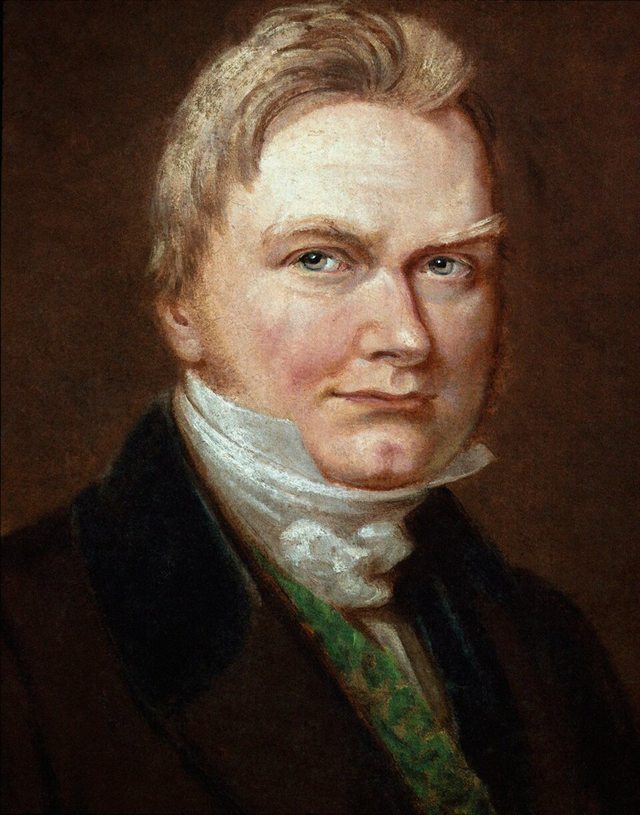
1779–1848
The orphan who analysed two thousand compounds, gave chemistry the alphabet every formula in the world is still written in, and spent his last fourteen years defending a theory an experiment had already destroyed.
Berzelius weighed better than anybody had, corrected Dalton's numbers wherever they disagreed with his balance, and invented the notation. He was also the most authoritative chemist in Europe, which meant his errors held parts of the subject back. These five chapters follow the weighing and the long defeat.
The five chapters
- Orphaned Twice, and a Talent for Weighing — Linköping to Stockholm
- The Alphabet — 1813, and the notation everybody still uses
- New Elements, and Two New Words — Cerium, selenium, thorium, silicon — and isomerism and catalysis
- Electrochemical Dualism — A theory that was right about salts and wrong about carbon
- What He Left Behind Him — Wöhler, Mitscherlich, and a marriage at fifty-six
Chapter 1 · Orphaned Twice, and a Talent for Weighing
Linköping to Stockholm
1779 – 1807 · Väversunda · Linköping · Uppsala · Stockholm
Jöns Jacob Berzelius was born in August 1779 near Linköping in Sweden. His father, a schoolmaster, died when he was four. His mother remarried and died when he was eight. His stepfather remarried and the boy was passed to an uncle, in a household where he was not particularly wanted, and where a report described him as a young man of good parts but not to be recommended.
He worked as a tutor and then as an apprentice to an apothecary, which is where he learned laboratory practice, and studied medicine at Uppsala on very little money. He qualified in 1802.
His gift was analysis, and it was a gift for *patience* rather than for insight. Determining the composition of a compound by gravimetric analysis means converting each element into a compound of known composition, precipitating it, filtering it, drying it to constant weight, and weighing it — with every step a possible source of loss or contamination. Doing it once is laborious. Doing it accurately requires doing it repeatedly and finding out why the results differ.
Berzelius did it for about twenty years, on roughly two thousand compounds.
He made much of his own apparatus, including rubber tubing — which he introduced into laboratories — and improved filtration, washing and drying methods throughout.
In 1807 he was appointed professor at the Karolinska Institute in Stockholm, and by 1810 he was president of the Swedish Academy of Sciences.
“I shall use the initial letter of the Latin name of each element.”
— Jöns Jacob Berzelius, on his 1813 system of chemical symbols
Why this matters
Berzelius's contribution rests on doing an extremely laborious analytical procedure two thousand times with unprecedented care, which is a kind of scientific talent rarely celebrated.
You have the orphan and the balance. What would you ask him?
Ask Berzelius
- “What does gravimetric analysis actually involve?”
- “How do you find out why two results disagree?”
- “What was it like being passed between households?”
- “Why did you make your own apparatus?”
- “Is patience a scientific talent?”
Chapter 2 · The Alphabet
1813, and the notation everybody still uses
1813 – 1818 · Stockholm
Before 1813, chemical symbols were a mess. Alchemical signs — a crescent for silver, a circle with an arrow for iron — were still in partial use. Dalton had proposed circles with dots, lines and initials inside them. Others had their own systems. A formula written in Manchester was often unreadable in Stockholm, and the symbols could not be typeset without special blocks.
Berzelius proposed something so simple it now looks inevitable. Take the *first letter of the element's Latin name*. Where two elements share a first letter, add a second distinguishing letter. Write numbers to show how many atoms of each are present.
So: O for oxygen, H for hydrogen, C for carbon, N for nitrogen, S for sulphur. Fe for iron, from *ferrum*. Na for sodium, from *natrium*. K for potassium, from *kalium*. Ag for silver, from *argentum*. Pb for lead, from *plumbum*. Au for gold, from *aurum*.
Those Latin abbreviations are why the symbols of several common metals bear no resemblance to their English names, and why every school pupil has to learn them separately.
The advantages are immediate: it can be typeset with ordinary letters, written by hand quickly, read across every language barrier, and extended indefinitely as new elements are found.
Berzelius wrote the numbers as superscripts; subscripts became standard later. Otherwise the system is unchanged.
With it he published atomic weight tables — some forty-five elements, weighed and re-weighed against oxygen, and correcting Dalton's values wherever the balance disagreed with them, which was frequently. Most of Berzelius's values are close to the modern ones.
Why this matters
Every chemical formula written anywhere in the world uses Berzelius's letters, and the odd symbols for iron, sodium and lead are fossils of the Latin names he chose.
You have the letters and the tables. What is your question?
Ask Berzelius
- “Why use Latin names rather than each country's own?”
- “Why is sodium Na and potassium K?”
- “What was wrong with Dalton's circles?”
- “How did you know Dalton's weights were wrong?”
- “What makes a good notation?”
Chapter 3 · New Elements, and Two New Words
Cerium, selenium, thorium, silicon — and isomerism and catalysis
1803 – 1836 · Stockholm
Berzelius discovered cerium in 1803 with Wilhelm Hisinger, selenium in 1817 — named after the moon, because it accompanied tellurium, named after the earth — and thorium in 1828, named for the Norse god. He was the first to isolate silicon in 1824 and zirconium in 1824, and his students found several more under his direction.
He also gave chemistry two words for phenomena he was the first to describe properly.
*Isomerism* — from the Greek for equal parts. Wöhler and Liebig had found that silver cyanate and silver fulminate contain exactly the same elements in exactly the same proportions and are entirely different substances: one is inert, the other detonates. Berzelius named the phenomenon in 1830 and stated its significance: composition alone cannot identify a compound, because the same atoms can be *arranged* differently.
That single observation is why organic chemistry had to become a study of structure. Berzelius named it and could not explain it — he had no structural theory and no way of representing an arrangement.
*Catalysis* — from the Greek for loosening down. He coined it in 1836 for the phenomenon in which a substance accelerates a reaction without being consumed by it: platinum causing hydrogen and oxygen to combine, acids speeding the conversion of starch to sugar, ferment acting on sugar. He grouped a set of apparently unrelated observations under one name and proposed a *catalytic force*.
That is a name rather than an explanation, and he said so, which was honest. Catalysis was not properly understood until the twentieth century.
Why this matters
Isomerism proves that a molecular formula cannot identify a compound, which is why organic chemistry had to become a study of arrangement rather than composition.
You have the two words and the phenomena behind them. What would you ask?
Ask Berzelius
- “What does isomerism prove about a chemical formula?”
- “Could you say what the difference between two isomers was?”
- “Is a 'catalytic force' an explanation or a label?”
- “How do you know a new mineral holds a new element?”
- “Why name selenium after the moon?”
Chapter 4 · Electrochemical Dualism
A theory that was right about salts and wrong about carbon
1819 – 1834 · Stockholm
Berzelius published his theory of chemical combination in 1819. Every compound, he held, consists of an *electropositive* constituent joined to an *electronegative* one, and it is their opposite electrical characters that hold them together. He ranked all the elements on a scale from most electropositive — potassium — to most electronegative — oxygen.
For salts this is very nearly right. Sodium chloride really is a positively charged sodium and a negatively charged chloride held by electrostatic attraction. What a student now learns as *ionic bonding* is Berzelius's dualism with a century of physics added.
He extended it to everything, including organic compounds, treating them as compound radicals joined electrically.
And there it broke.
In 1834 Jean-Baptiste Dumas showed that *chlorine can replace hydrogen* in an organic compound. Take acetic acid, substitute chlorine atoms for hydrogen atoms, and you get trichloroacetic acid — which is still an acid, still behaves broadly like acetic acid, and is still recognisably the same kind of substance.
Dualism cannot allow this. Hydrogen is strongly electropositive; chlorine is strongly electronegative. On Berzelius's account, swapping one for the other should destroy the compound's character entirely. It does not.
Berzelius fought it for fourteen years. He denied Dumas's results, then reinterpreted them, then attacked Dumas personally, and never conceded. He was the most authoritative chemist in Europe and his authority delayed the acceptance of substitution and of the structural chemistry that grew out of it.
He died in Stockholm in August 1848, aged sixty-eight, still arguing.
Why this matters
Berzelius's dualism is what a student now meets as ionic bonding, and it failed because carbon chemistry does not work that way at all.
You have the theory and the experiment that broke it. What is your question?
Ask Berzelius
- “What does dualism say holds a compound together?”
- “Why does substituting chlorine for hydrogen destroy your theory?”
- “Why fight it for fourteen years?”
- “Which part of dualism survived?”
- “Did your authority hold chemistry back?”
Chapter 5 · What He Left Behind Him
Wöhler, Mitscherlich, and a marriage at fifty-six
1820 – 1848 and after · Stockholm · Europe
Berzelius's laboratory in Stockholm trained a remarkable set of chemists. Friedrich Wöhler came in 1823 and learned the analytical methods he took back to Germany. Eilhard Mitscherlich discovered isomorphism — that compounds of similar composition adopt the same crystal form, which became a powerful tool for determining atomic weights. Gustav Rose, Heinrich Rose and others passed through.
He also wrote an annual review of the progress of chemistry — the *Jahresbericht* — for twenty-seven years, summarising and assessing everything published in the subject worldwide. It was translated across Europe and was, effectively, the discipline's central nervous system. His judgement in those reviews could establish or destroy a reputation, which is part of why his opposition to substitution mattered so much.
He was ennobled in 1818 and made a baron in 1835, on the day of his marriage.
He married at fifty-six. Elisabeth Poppius was twenty-four, the daughter of a colleague. By all accounts the marriage was happy, and he had refused earlier matches on the grounds that he had no time.
He suffered from severe migraines and periods of depression throughout his life, and in his last years from gout and paralysis.
He died on 7 August 1848.
His notation outlived every theory he held. Dualism is gone; the atomic weights were superseded; the catalytic force explained nothing. The letters remain, in every laboratory and every classroom in the world, and almost nobody who writes H₂O knows whose idea it was.
Why this matters
Berzelius's annual review of world chemistry made him the discipline's central authority for twenty-seven years, which is why his refusal to accept substitution had so much weight.
You have the students, the reviews and the letters that outlived it all. What would you ask?
Ask Berzelius
- “What did writing a yearly review of all chemistry do to you?”
- “What did you teach Wöhler?”
- “Why did you not marry until fifty-six?”
- “Which of your theories did you most expect to last?”
- “Does it matter that nobody knows the letters are yours?”
What Berzelius changed
Every chemical formula written anywhere in the world is written in Berzelius's notation, and his atomic weights stood for a generation. He discovered cerium, selenium and thorium, first isolated silicon and zirconium, and coined the terms isomerism and catalysis for phenomena he was the first to describe properly. Dualism is gone, but the half of it that held a salt together is what a student now learns as ionic bonding.
A debate that continues
Berzelius rejected Avogadro's hypothesis and fought Dumas's substitution results for fourteen years, and his authority — reinforced by his annual review of world chemistry — measurably delayed the acceptance of structural organic chemistry.
Keep exploring — ask Berzelius
- “Which of your two thousand analyses was hardest?”
- “How do you know when to abandon a theory?”
- “What would you have made of the electron?”
Related lives
- John Dalton — Who Got Atoms Out of the Weather
- Friedrich Wöhler — Who Made Urea Without A Kidney
- Jean-Baptiste Dumas — Who Swapped One Atom for Another
- Dmitri Mendeleev — Author of the Periodic Table
Related themes
Chemical symbols and formulae · Atomic weights · Bonding
Continue on Incandio
- Talk to Berzelius — every question on this page is one tap from being asked, and the same page carries the Historical Brief, the achievements and the timeline
- All 280 figures · Incandio — learn every idea, teach it, then defend it