Explore Their Life · Pearson Edexcel International GCSE revision on Incandio
Maximilien Robespierre: A Life in Five Chapters
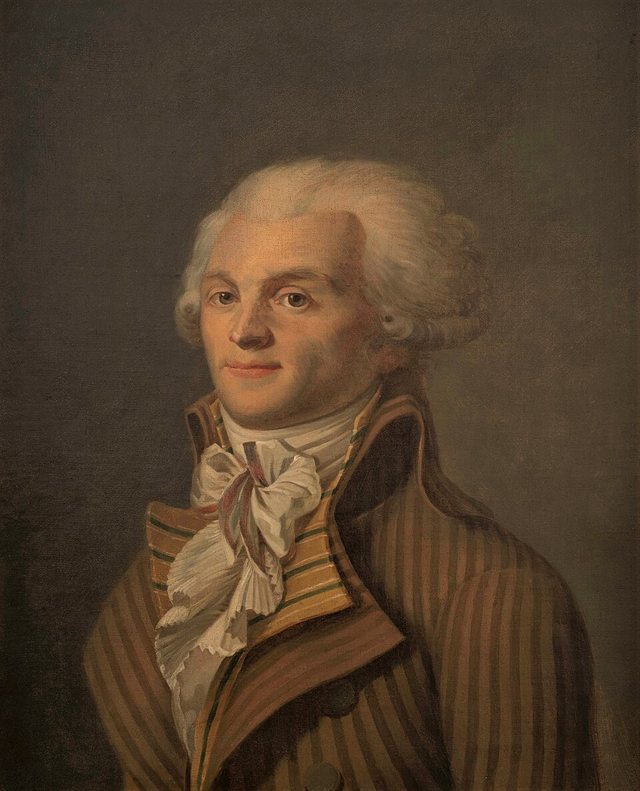
1758–1794
A provincial lawyer who opposed the death penalty, then presided over a revolutionary government that executed thousands — and was executed by it.
Robespierre is the hardest figure of the French Revolution to think about clearly, because he became its symbol of terror while also being one of its most consistent democrats. These five chapters follow the evidence: what he argued for, what he authorised, what he was blamed for afterwards, and what historians still cannot agree on.
The five chapters
- The Orphan from Arras — A scholarship, a courtroom and a set of principles
- The Incorruptible — Building a reputation out of refusing things
- The King's Death and the Committee — How an emergency became a government
- The Terror — Virtue, fear, and the guillotine
- Thermidor — Twenty-four hours from accuser to accused
Chapter 1 · The Orphan from Arras
A scholarship, a courtroom and a set of principles
1758 – 1789 · Arras · Paris
Maximilien Robespierre was born in Arras on 6 May 1758. His mother died when he was six; his father, a lawyer, abandoned the family soon after and drifted around Europe. Maximilien and his siblings were raised by relatives, and he grew up with the precarious respectability of a boy whose family had fallen out of its expected place.
A scholarship took him to the elite Collège Louis-le-Grand in Paris, where he was a diligent, solitary and prize-winning student steeped in Roman republican history and, above all, in Rousseau — whose belief in the general will and in the natural virtue of ordinary people became the frame for everything Robespierre later argued.
Back in Arras from 1781 he practised law and made a modest name defending clients others would not take, including a man prosecuted for installing a lightning rod. He wrote essays against the practice of punishing a criminal's family, and argued publicly against the death penalty — a position he restated in the National Assembly in 1791.
His manner was already distinctive: precise, formal, immaculately dressed, personally austere, and utterly uninterested in money. Colleagues found him humourless. In 1789, elected to the Estates-General as a deputy of the Third Estate for Artois, he arrived in Versailles as an unknown thirty-one-year-old with a thin voice and no connections.
Why this matters
Understanding that Robespierre began as an opponent of capital punishment is essential: his later position was not the view he started with, and explaining that change is the central problem of his life.
You have met the young lawyer who argued against executions. What would you ask him about those beliefs?
Ask Robespierre
- “What did you take from Rousseau that you never abandoned?”
- “Why did you argue against the death penalty in 1791?”
- “How did losing your parents so early shape you?”
- “What kind of clients did you take on in Arras, and why?”
- “What did you expect to achieve when you arrived at the Estates-General?”
Chapter 2 · The Incorruptible
Building a reputation out of refusing things
1789 – 1792 · Versailles · Paris · Jacobin Club
In the National Assembly Robespierre spoke often and was frequently ignored. What he built instead was consistency. He argued for universal male suffrage against property qualifications, for the rights of Jews and Protestants, for the admission of Black men from the colonies to citizenship, for freedom of the press, and against the requirement that only wealthy men could vote or serve. He took no bribes and lived in rented rooms with the family of a carpenter, Maurice Duplay. Journalists began calling him 'the Incorruptible', and the nickname stuck because it was accurate.
His influence grew through the Jacobin Club rather than the Assembly floor. In 1791 he successfully proposed the 'self-denying ordinance' barring members of the Assembly from the next legislature — an act of principle that removed him from parliament and made him a full-time political organiser.
His most striking stand came in 1792, when the Girondin faction pushed for war against Austria, promising it would spread liberty across Europe. Robespierre opposed it almost alone, warning that no one loves armed missionaries, that war would enrich generals and endanger the Revolution at home, and that a defeated France would fall to a dictator. He lost the argument. The war came, went badly, and produced exactly the crisis atmosphere in which his own faction rose to power.
“No one loves armed missionaries.”
— Speech to the Jacobin Club, 2 January 1792, opposing war with Austria
Why this matters
Robespierre's opposition to the war of 1792 was a rare and prescient judgement — and the war he predicted would endanger the Revolution created the emergency used to justify the Terror.
You have seen a reputation built on refusals. What would you ask him about these years?
Ask Robespierre
- “Why did you oppose the war when almost everyone else wanted it?”
- “What did you mean by 'no one loves armed missionaries'?”
- “Why did you insist that poor men should have the vote?”
- “What did living simply actually get you politically?”
- “Why give up your own seat with the self-denying ordinance?”
Chapter 3 · The King's Death and the Committee
How an emergency became a government
1792 – 1793 · Paris · The Convention
The monarchy fell in August 1792, and Robespierre was elected to the National Convention. When it debated what to do with Louis XVI, he made the argument that defined the new phase: the king could not be tried as an ordinary citizen, because the Revolution's legitimacy already presumed his guilt — 'Louis must die so that the country may live'. The king was executed on 21 January 1793.
What followed was a genuine emergency and no exaggeration of one. France was at war with most of Europe, a royalist and Catholic revolt had erupted in the Vendée, cities were in federalist rebellion, the currency was collapsing and bread was scarce. In April 1793 the Convention created the Committee of Public Safety as an emergency executive; Robespierre joined it in July.
The Committee did stabilise the situation. It imposed the levée en masse, conscripting a national army; it fixed maximum prices on grain to feed the cities; it reorganised supply and command and turned back the invasions. It also assumed powers no previous French government had held, suspended the new democratic constitution of 1793 before it took effect, and declared that government would remain 'revolutionary until the peace'.
Robespierre was never a dictator in the legal sense — he was one of twelve members, elected monthly, answerable to the Convention. But he was the Committee's most authoritative public voice, and he chose to defend its severity rather than restrain it.
Why this matters
The Committee of Public Safety is a foundational case study in emergency government: it saved the Republic militarily while suspending the very liberties the Republic was created to protect.
You have seen an emergency turn into a system of rule. What would you ask him about those decisions?
Ask Robespierre
- “How did you justify executing the king without a normal trial?”
- “Was the emergency real enough to justify suspending the constitution?”
- “What did the Committee actually achieve militarily?”
- “How much power did you personally hold on the Committee?”
- “Why fix bread prices, and did it work?”
Chapter 4 · The Terror
Virtue, fear, and the guillotine
1793 – 1794 · Paris · Vendée · Lyon
The Terror was a policy, publicly defended. In February 1794 Robespierre told the Convention that the mainspring of popular government in revolution was virtue and terror together: virtue without terror is powerless, terror without virtue is murderous. The Law of Suspects of September 1793 made vague categories of people arrestable; revolutionary tribunals tried them at speed.
The official death toll of the tribunals was around seventeen thousand, with thousands more dying in prison without trial. Repression in the rebel regions was far worse: the campaign in the Vendée and the mass drownings at Nantes killed tens of thousands, and historians still argue over how far the Committee in Paris directed or merely tolerated the worst of it.
Robespierre also turned the machinery on the Revolution's own leaders. In March 1794 the radical Hébertists were executed; in April, Danton — once his ally — went to the guillotine after a trial engineered to prevent him defending himself.
He then attempted a moral reconstruction of France. Hostile to both Catholicism and the militant atheism of the Hébertists, he introduced the Cult of the Supreme Being, presiding over a vast festival on 8 June 1794 in a sky-blue coat carrying flowers — a performance many deputies found ominous. Two days later the Law of 22 Prairial stripped the accused of defence counsel and witnesses. In the seven weeks that followed, executions in Paris rose sharply, and no deputy could feel safe.
Why this matters
The Terror is the standard historical example of a government that used fear as an instrument of policy and could not switch it off — and of how revolutions come to consume their own leaders.
This is the hardest part of the story. What would you ask him about it?
Ask Robespierre
- “How did the man who opposed the death penalty come to defend the guillotine?”
- “What did you mean when you linked virtue and terror?”
- “Why did Danton have to die?”
- “Who bears responsibility for the killings in the Vendée?”
- “What was the Festival of the Supreme Being meant to achieve?”
Chapter 5 · Thermidor
Twenty-four hours from accuser to accused
July 1794 and after · Paris · Place de la Révolution
On 26 July 1794 Robespierre addressed the Convention and announced that a new conspiracy existed among its members — but refused to name them. It was a fatal miscalculation: every deputy with reason to fear him now had reason to act first, and they had one night to organise.
The next day, 9 Thermidor by the revolutionary calendar, he was shouted down, denounced and ordered arrested. The Paris Commune freed him and gathered forces at the Hôtel de Ville, but he hesitated to lead an insurrection against the Convention he claimed to serve. In the early hours troops loyal to the Convention broke in. Robespierre's jaw was shattered by a pistol shot — sources disagree over whether he shot himself or was shot by a gendarme. He spent the following hours in agony and, on 28 July 1794, was guillotined without trial along with Saint-Just and twenty others.
His victorious enemies then wrote the history. Loading responsibility for the entire Terror onto a dead man was convenient for men who had voted for its laws, and the image of a bloodthirsty fanatic hardened into legend.
Since then he has been claimed and condemned in turn: a hero of democratic and socialist traditions, a warning about ideological politics for liberal ones. What is not in dispute is the argument he left behind — that a government convinced of its own virtue may be the most dangerous kind, especially when it is sincere.
Why this matters
Thermidor shows how quickly revolutionary power can collapse — and how the winners of a political struggle shape the historical record that follows.
You have seen the fall and the version of history that followed. What would you ask him now?
Ask Robespierre
- “Why refuse to name the conspirators in your final speech?”
- “How fair is it that you were blamed for the whole Terror?”
- “Could the Republic have survived without the Terror?”
- “What would you say to the families of those executed on suspicion alone?”
- “Is there a safe way for a government to believe it is virtuous?”
What Robespierre changed
Robespierre's career gave the modern world its clearest case study of revolutionary government: emergency powers, political purges and the claim that extraordinary times permit extraordinary measures. His democratic arguments — universal male suffrage, religious toleration, opposition to war of conquest — were far ahead of most of his contemporaries, which is precisely why the Terror is so difficult to explain away.
A debate that continues
Historians remain sharply divided: some see Robespierre as a sincere democrat overwhelmed by genuine emergency and then scapegoated by his killers, others as a man whose belief in his own virtue made mass repression thinkable.
Keep exploring — ask Robespierre
- “At what point did you stop believing the Terror was temporary?”
- “How did the war with Europe change what was politically possible in France?”
- “What would you have built if the Republic had been at peace?”
Related lives
- Marie Antoinette — Queen of France and Navarre
- Napoleon Bonaparte — Emperor of the French
- Jean-Jacques Rousseau — The Citizen · Father of Romanticism
Related themes
The French Revolution · The Reign of Terror · Emergency powers and civil liberties
Continue on Incandio
- Talk to Robespierre — every question on this page is one tap from being asked, and the same page carries the Historical Brief, the achievements and the timeline
- All 280 figures · Incandio — learn every idea, teach it, then defend it