Explore Their Life · Pearson Edexcel International GCSE revision on Incandio
Subhas Chandra Bose: A Life in Five Chapters
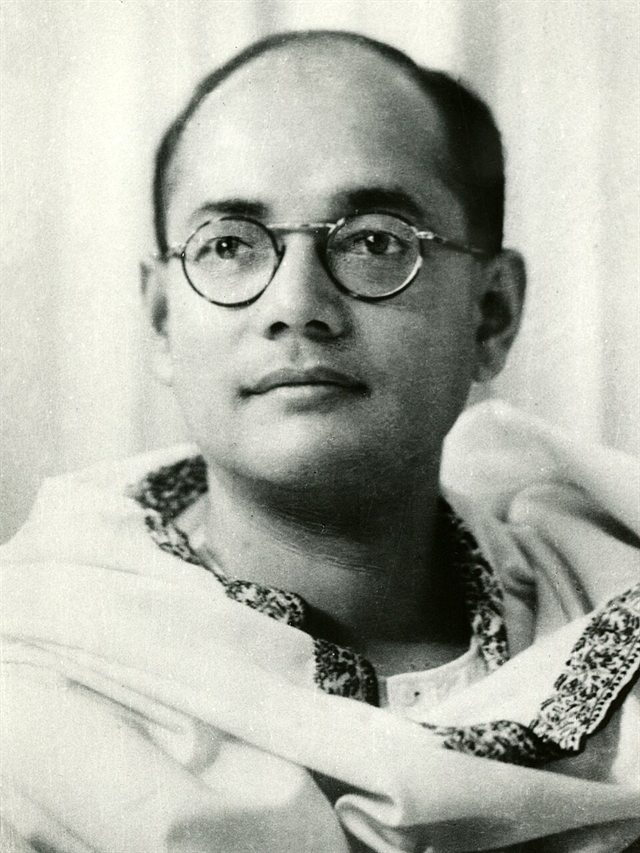
1897–1945
A man who passed the Indian Civil Service examination and resigned rather than serve, was elected Congress president against Gandhi's candidate, escaped India in disguise, and raised an army in alliance with the Axis powers.
Bose is the most divisive figure in the Indian national movement and the one whose choices are hardest to weigh. These five chapters follow the civil servant who resigned, the president Gandhi drove out, the escape across Asia, the Indian National Army and the alliance that made it possible, and the trials that followed his death.
The five chapters
- The Examination He Passed — Fourth in the Indian Civil Service, and a resignation
- Elected, and Forced Out — Congress president twice, and Gandhi's candidate beaten
- The Escape — Calcutta to Berlin, by way of Kabul
- The Indian National Army — Forty thousand men, and a women's regiment
- The Red Fort Trials — The army that lost, and the effect it had after it was over
Chapter 1 · The Examination He Passed
Fourth in the Indian Civil Service, and a resignation
1897 – 1921 · Cuttack · Calcutta · Cambridge
Subhas Chandra Bose was born in Cuttack in 1897, one of fourteen children of a prosperous Bengali lawyer. He was academically brilliant and temperamentally difficult. At Presidency College in Calcutta he was expelled after an incident involving a British professor accused of manhandling Indian students, which he neither started nor disowned.
His father sent him to Cambridge to sit the Indian Civil Service examination — the summit of Indian professional ambition, entry to the service that actually governed the country. He passed in 1920, placed fourth.
He then resigned before taking up the appointment. He wrote to his brother that he could not serve a government he intended to see removed, and that the only honourable place for a nationalist was outside its service.
It is worth pausing on what he gave up. The ICS was security, status and power for life, and very few Indians got in. Resigning it made him instantly credible with a generation of young nationalists who found the older leadership too comfortable.
He came home and attached himself to Chittaranjan Das, the Bengali Congress leader, and was in prison within a year.
Why this matters
Bose's authority with young nationalists began with a resignation from the service that governed India, before he had done anything else.
Fourth in the examination, and a letter of resignation. What would you ask him?
Ask Bose
- “What did resigning the ICS actually cost you?”
- “What happened at Presidency College?”
- “Did your father understand the decision?”
- “Why attach yourself to Chittaranjan Das?”
- “Could a nationalist have done more good inside the service?”
Chapter 2 · Elected, and Forced Out
Congress president twice, and Gandhi's candidate beaten
1938 – 1940 · Haripura · Tripuri · Calcutta
Bose became president of Congress in 1938 and pushed a programme Gandhi did not want: industrialisation, a national planning committee, and a far more confrontational line towards Britain, on the argument that a Europe drifting into war gave India leverage it should use.
In 1939 he stood for a second term against Pattabhi Sitaramayya, whom Gandhi supported. Bose won. Gandhi said publicly that the defeat was more his own than Sitaramayya's, and the members of the Congress working committee resigned, leaving a president with no executive. Bose resigned the presidency within months and founded the Forward Bloc.
The episode is usually told as a clash of personalities and it was a disagreement about strategy. Gandhi's position was that a movement that had won its authority by non-violence could not switch to a different method without becoming a different thing, and that exploiting Britain's difficulty would forfeit the moral position he had built for twenty years. Bose's position was that moral positions do not remove empires, that Britain would never leave voluntarily, and that a nationalist movement which declined to use the one moment of weakness its opponent had was not serious.
When war came he was arrested, went on hunger strike, and was placed under house arrest in Calcutta in 1940.
Why this matters
The Bose–Gandhi split is the clearest statement in the whole movement of the disagreement about whether Britain would leave for moral reasons or only for practical ones.
Elected president and left without an executive. What would you ask him?
Ask Bose
- “Why stand for a second term when Gandhi opposed you?”
- “What did you want Congress to do that it would not?”
- “Was non-violence a principle or a tactic?”
- “What did the working committee's resignation leave you with?”
- “Should a movement use its opponent's difficulty?”
Chapter 3 · The Escape
Calcutta to Berlin, by way of Kabul
1941 – 1943 · Calcutta · Peshawar · Kabul · Moscow · Berlin
In January 1941, under house arrest and watched, Bose left his Calcutta house at night in disguise, was driven out of the city, and travelled by train and on foot to Peshawar and across the frontier into Afghanistan. From Kabul he obtained an Italian passport in another name and travelled through Soviet territory to Moscow and on to Berlin. The police in Calcutta did not realise he had gone for days.
In Germany he tried to get a declaration from the Axis powers supporting Indian independence and never obtained one worth having. He raised the Indian Legion from Indian prisoners of war captured in North Africa — a few thousand men, who never saw significant action. He broadcast to India on Azad Hind Radio.
He met Hitler once, in May 1942. Accounts of the meeting agree that it was unproductive: Hitler was uninterested in Indian independence, was dismissive about Indians in ways Bose objected to in the room, and offered a submarine rather than a policy.
In 1943 Bose left Europe by submarine, transferred to a Japanese submarine in the Indian Ocean, and reached Japanese-held Asia.
His own justification was consistent and it should be stated: he argued that an enemy of the British Empire was an instrument available to Indians, that he had no illusions about the regimes he was dealing with, and that no Indian owed loyalty to a war declared on India's behalf without consulting a single Indian. Whether that reasoning survives what those regimes were doing is the question this chapter exists to raise rather than to close.
Why this matters
Bose's alliance with the Axis is the fact every assessment of him has to deal with, and his own reasoning for it is on the record.
Calcutta to Berlin, and a meeting that produced a submarine. What would you put to him?
Ask Bose
- “How did you actually get out of Calcutta?”
- “What did you expect Germany to give India?”
- “What happened in the meeting with Hitler?”
- “Does an enemy of your enemy have to be acceptable?”
- “Did you know what those governments were doing in Europe?”
Chapter 4 · The Indian National Army
Forty thousand men, and a women's regiment
1943 – 1945 · Singapore · Rangoon · Imphal · Kohima
Bose took command of the Indian National Army in Singapore in 1943. It had been formed from Indian prisoners of war captured when Singapore fell, and had almost collapsed before he arrived; under him it was rebuilt and expanded with recruits from the Indian communities of Malaya and Burma to something in the order of forty thousand.
He declared a provisional government of free India, Azad Hind, which several Axis and Axis-aligned states recognised. And he formed the Rani of Jhansi Regiment, an all-women combat unit under Lakshmi Sahgal — something no other force in the war attempted on the same basis, and a striking fact about a movement usually described as authoritarian.
The INA fought alongside the Japanese in the Imphal and Kohima campaign in 1944. It was a catastrophe: the offensive was under-supplied, the monsoon broke, disease and starvation did more damage than fighting, and the retreat destroyed the force as a fighting formation. The INA never entered India in strength.
Bose died on 18 August 1945 when an overloaded Japanese aircraft crashed shortly after take-off at Taihoku in Taiwan; he died of burns the same day. Multiple official inquiries have reached that conclusion. A belief that he survived has persisted in India for eighty years, has produced repeated commissions and freedom-of-information campaigns, and has never been substantiated.
Why this matters
The INA failed militarily and mattered politically, and the Rani of Jhansi Regiment is a fact about it that almost no account includes.
Forty thousand men, a women's regiment, and Imphal. What would you ask him?
Ask Bose
- “How did you rebuild an army that had already collapsed once?”
- “Why form the Rani of Jhansi Regiment?”
- “What went wrong at Imphal and Kohima?”
- “What did the men who joined the INA think they were joining?”
- “Why has the belief that you survived lasted eighty years?”
Chapter 5 · The Red Fort Trials
The army that lost, and the effect it had after it was over
1945 – now · Delhi · Bombay · India
In November 1945 the British put three INA officers on trial for treason at the Red Fort in Delhi — a Hindu, a Muslim and a Sikh, prosecuted together, which turned out to be an error of the first order.
The trials produced the largest political mobilisation in India since 1942. Congress, which had opposed everything Bose did, defended the accused; Nehru put on his barrister's gown for the first time in twenty-five years. There were strikes and demonstrations across the country, and in February 1946 a mutiny in the Royal Indian Navy at Bombay that spread to dozens of ships and shore establishments.
That is the point at which the calculation in London changed. British power in India had always rested on Indian soldiers, policemen and clerks, and the reaction to the trials suggested that their loyalty could not be assumed. The Commander-in-Chief advised that the army could not be relied on for internal security indefinitely. The convictions were handed down and the sentences remitted.
So Bose's military campaign failed completely and his defeated army produced, a year after his death, one of the pressures that convinced Britain to leave.
He remains contested. In India he is honoured widely and claimed by parties with nothing in common; the alliance with the Axis is generally treated as a tactic rather than a commitment. Outside India that reading is far less accepted. Both positions are argued by serious people, and a learner is entitled to weigh them rather than be handed one.
Why this matters
The INA's defeat mattered more than its campaign: the trials suggested the Indian Army's loyalty could not be assumed, and that was what British rule rested on.
An army defeated, and a mutiny a year later. What would you ask him?
Ask Bose
- “Why did prosecuting three officers together backfire so badly?”
- “What did the naval mutiny of 1946 show?”
- “Why did Congress defend men it had opposed?”
- “Did you achieve more by failing than by winning?”
- “How should the alliance with the Axis be weighed against the outcome?”
What Bose changed
Bose built an army of some forty thousand from prisoners of war and expatriate communities, including the only women's combat regiment raised by any force in the war, and it was destroyed at Imphal without reaching India. The trials of its officers then produced strikes, a naval mutiny and a British conclusion that the Indian Army's loyalty could no longer be assumed — which is a substantial part of why Britain decided to go.
A debate that continues
Was Bose's alliance with the Axis a defensible tactic against an occupying empire, or a commitment that his admirers have since minimised? The question is argued very differently inside and outside India.
Keep exploring — ask Bose
- “Is an enemy of your enemy an acceptable ally?”
- “Can a military failure be a political success?”
- “Why do countries need a version of a figure whose record is complicated?”
Related lives
- Mahatma Gandhi — Mahatma · Father of the Indian Nation
- Jawaharlal Nehru — One Press Conference, In July 1946
- Muhammad Ali Jinnah — The Ambassador Of Unity, Until He Was Not
Related themes
The Indian National Army · Quit India and the Second World War · The end of British rule
Continue on Incandio
- Talk to Bose — every question on this page is one tap from being asked, and the same page carries the Historical Brief, the achievements and the timeline
- All 280 figures · Incandio — learn every idea, teach it, then defend it