Explore Their Life · Pearson Edexcel International GCSE revision on Incandio
Alexander the Great: A Life in Five Chapters
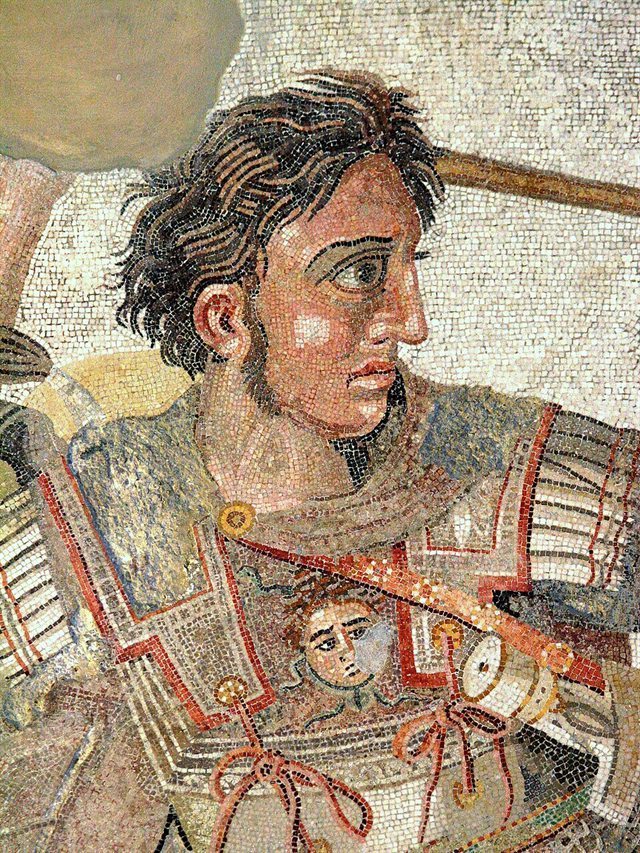
356–323 BC
The Macedonian king who conquered the mighty Persian Empire before the age of thirty and spread Greek culture across three continents.
In little more than a decade, Alexander led his army from Greece to the edge of India, defeating the largest empire the world had yet seen. He was never beaten in a major battle, yet died young with his conquests barely organised. These five chapters follow his rise, his extraordinary campaigns, and the debate over what his conquests really meant.
The five chapters
- A Prince of Macedon — Philip, Olympias and a warrior kingdom
- Taught by Aristotle — A conqueror's education
- The Conquest of Persia — An empire won in a decade
- To India — and No Further — The limits of conquest
- The Hellenistic World — What his conquests left behind
Chapter 1 · A Prince of Macedon
Philip, Olympias and a warrior kingdom
356 – 336 BC · Pella · Macedon
Alexander was born in 356 BC in Pella, the capital of Macedon, a kingdom on the northern edge of the Greek world that many southern Greeks looked down on as half-barbarian. His father, King Philip II, was a brilliant and ruthless ruler who transformed Macedon's army into the finest fighting force in Greece, built around a disciplined infantry formation called the phalanx armed with long pikes.
Alexander grew up watching his father conquer and outmanoeuvre the Greek city-states one by one. From his forceful mother, Olympias, he absorbed a sense of destiny and a belief in his own descent from heroes and gods. Ancient stories — some later embellished — describe the boy taming the wild horse Bucephalus when no one else could, a tale meant to show his courage and skill from an early age.
When Alexander was around twenty, Philip was assassinated, and the young man inherited both a powerful army and a plan his father had already begun: to invade the Persian Empire. He moved swiftly to crush challenges to his rule at home and in Greece. By securing his position with speed and force, he freed himself to turn eastward — toward the vast empire that had once threatened Greece itself.
Why this matters
Alexander inherited his father's superb army and his ambition to invade Persia — his conquests built on foundations Philip had already laid.
You have seen the warrior kingdom and driven parents that shaped young Alexander. What would you ask him about his early life?
Ask Alexander
- “How much of your success was built on the army your father created?”
- “What did the Macedonian phalanx do that made it so effective?”
- “How did your mother Olympias influence your sense of destiny?”
- “Why did southern Greeks look down on Macedon?”
- “How did you secure your throne after your father's assassination?”
Chapter 2 · Taught by Aristotle
A conqueror's education
343 – 340 BC · Mieza · Macedon
When Alexander was a teenager, his father hired the philosopher Aristotle to be his tutor. It is one of history's most remarkable pairings: the greatest thinker of the age teaching the boy who would become its greatest conqueror. Aristotle instructed Alexander and a group of noble companions at Mieza, away from the distractions of court.
We cannot know exactly what passed between them, and later writers filled the gaps with invention. But it is likely Alexander was taught literature, philosophy, science and medicine. He is famously said to have carried a copy of Homer's *Iliad* on campaign, seeing the warrior Achilles as a model for his own life. His curiosity about the natural world — sending specimens and observations back from Asia — may reflect Aristotle's influence.
Yet the relationship also had limits. Aristotle reportedly advised treating non-Greeks as inferiors, while Alexander, as he conquered Persia, increasingly adopted Persian customs and sought to blend the two cultures — a policy that troubled many of his Greek and Macedonian followers. The pupil, in other words, did not simply copy his teacher. The education gave Alexander a love of Greek culture that he carried across the known world, even as his own experience led him toward a broader and more controversial vision.
Why this matters
Alexander's education under Aristotle helped spread Greek learning across Asia — but he also broke from his tutor's views, showing he thought for himself.
You have seen how Aristotle shaped Alexander's mind. What would you ask him about his education and its influence?
Ask Alexander
- “What did Aristotle actually teach you at Mieza?”
- “Why did you carry Homer's Iliad with you on campaign?”
- “Why did you break from Aristotle's view of non-Greeks?”
- “How did your interest in science show up during your campaigns?”
- “How much of what we're told about your education is later legend?”
Chapter 3 · The Conquest of Persia
An empire won in a decade
334 – 330 BC · Asia Minor · Egypt · Mesopotamia · Persia
In 334 BC Alexander crossed into Asia and began the campaign that would define him. Facing the Persian Empire — a realm far larger and richer than his own — he won a series of stunning victories. At the Granicus, at Issus, and finally at Gaugamela in 331 BC, he defeated the armies of the Persian king Darius III, often against much larger numbers, through bold tactics and personal leadership from the front.
Along the way he took Egypt, where he was welcomed as a liberator from Persian rule and founded the city of Alexandria, which would become one of the great cities of the ancient world. After Gaugamela the heart of the Persian Empire lay open. Alexander occupied the royal cities, and at Persepolis, the Persian ceremonial capital, his army burned the great palace — whether by drunken accident or deliberate revenge for Persia's earlier invasion of Greece, the ancient sources dispute.
Darius was murdered by his own officers as he fled, and Alexander now claimed the Persian throne. In just a few years, a king from the edge of Greece had made himself master of the largest empire on earth. But conquering territory and governing it were different challenges, and holding together such a vast and varied realm would prove harder than winning it.
Why this matters
Alexander's defeat of Persia was one of the most rapid and complete conquests in history, ending an empire that had dominated the Near East for two centuries.
You have seen how Alexander toppled the Persian Empire in a single decade. What would you ask him about these campaigns?
Ask Alexander
- “How did you defeat Persian armies that were often far larger than yours?”
- “Why did you found the city of Alexandria in Egypt?”
- “Did your army burn Persepolis by accident or as revenge?”
- “How did leading from the front affect your soldiers?”
- “Why did you adopt Persian customs after conquering the empire?”
Chapter 4 · To India — and No Further
The limits of conquest
327 – 323 BC · India · Babylon
Alexander pushed on beyond Persia into the lands of Central Asia and then into India, fighting hard campaigns against determined enemies. At the Hydaspes River he defeated the Indian king Porus, in one of his most difficult battles, and afterwards — impressed by the king's dignity — reportedly restored him to his throne.
But here Alexander met a limit not on the battlefield but among his own men. Exhausted after years of marching and fighting thousands of miles from home, his soldiers refused to go any further. For the first time, the king who had never been stopped by an enemy was stopped by his own army. Reluctantly, he turned back, leading his men on a gruelling return march during which many died.
In 323 BC, back in Babylon and still only thirty-two years old, Alexander fell ill and died after several days of fever. The cause has never been settled — a natural illness such as malaria or typhoid is most likely, though some ancient writers suspected poison. He left no clear heir, and his generals soon carved his empire into rival kingdoms. The greatest conqueror of the ancient world had built an empire he did not live long enough to rule in peace.
Why this matters
Alexander's early death and lack of an heir meant his empire fractured almost immediately — a reminder that conquest alone does not build a lasting state.
You have seen how Alexander's advance ended and his empire outlived him only briefly. What would you ask him about these final years?
Ask Alexander
- “Why did your soldiers refuse to march any further into India?”
- “Why did you restore King Porus to his throne after defeating him?”
- “Why can't historians agree on what caused your death?”
- “Why did you leave no clear plan for who would succeed you?”
- “Could such a vast empire ever have held together?”
Chapter 5 · The Hellenistic World
What his conquests left behind
Although Alexander's empire shattered after his death, his conquests changed the ancient world permanently. His generals founded dynasties that ruled from Egypt to the borders of India, and Greek became the common language of trade, government and learning across this huge region for centuries. Historians call this the Hellenistic age — a period when Greek culture mixed with Egyptian, Persian and Indian traditions to produce new art, science and philosophy.
Cities modelled on the Greek pattern spread across Asia and North Africa, the greatest being Alexandria in Egypt, whose Library and Museum became the leading centre of learning in the world. Ideas, goods and beliefs flowed along routes Alexander's armies had opened.
His personal reputation became legendary. For centuries, ambitious rulers measured themselves against him, and stories of his deeds spread as far as Europe, the Middle East and South Asia. Yet his legacy is debated. Was he a visionary who united peoples and spread civilisation, or a destructive warlord whose campaigns caused enormous death and suffering and whose empire barely outlived him? Both views draw on real evidence. Alexander remains one of history's most studied figures precisely because his achievements and their costs were both so vast.
Why this matters
The spread of Greek culture across Asia and Africa after Alexander shaped the ancient world for centuries and influenced the later Roman and Islamic worlds.
You have seen how Alexander's conquests reshaped the ancient world. What would you ask him about his legacy?
Ask Alexander
- “How did Greek culture spread so widely after your death?”
- “Why did Alexandria become the greatest centre of learning?”
- “Should you be remembered as a unifier or as a destroyer?”
- “Why have so many later rulers tried to imitate you?”
- “What did your conquests cost the peoples you defeated?”
What Alexander changed
Alexander destroyed the Persian Empire and spread Greek language and culture from Egypt to India, opening the Hellenistic age that shaped the ancient world for centuries. His example of youthful, unbeaten conquest made him a legend that rulers measured themselves against for two thousand years.
A debate that continues
Historians disagree over whether Alexander was a visionary who brought peoples and cultures together, or a warlord whose brilliant campaigns caused immense suffering and left an empire too fragile to survive him.
Keep exploring — ask Alexander
- “How did Aristotle's teaching shape the way you saw the world?”
- “What did you hope to achieve by blending Greek and Persian customs?”
- “How does your reputation compare with that of later conquerors like Caesar?”
Related lives
- Aristotle — The Philosopher · Founder of the Lyceum
- Julius Caesar — Dictator Perpetuo of Rome
- Hannibal Barca — Supreme Commander of Carthage
Related themes
The spread of Greek culture · Empires of the ancient world · Leadership and conquest
Continue on Incandio
- Talk to Alexander — every question on this page is one tap from being asked, and the same page carries the Historical Brief, the achievements and the timeline
- All 280 figures · Incandio — learn every idea, teach it, then defend it