Historical figure · Pearson Edexcel International GCSE revision on Incandio
Andreas Vesalius
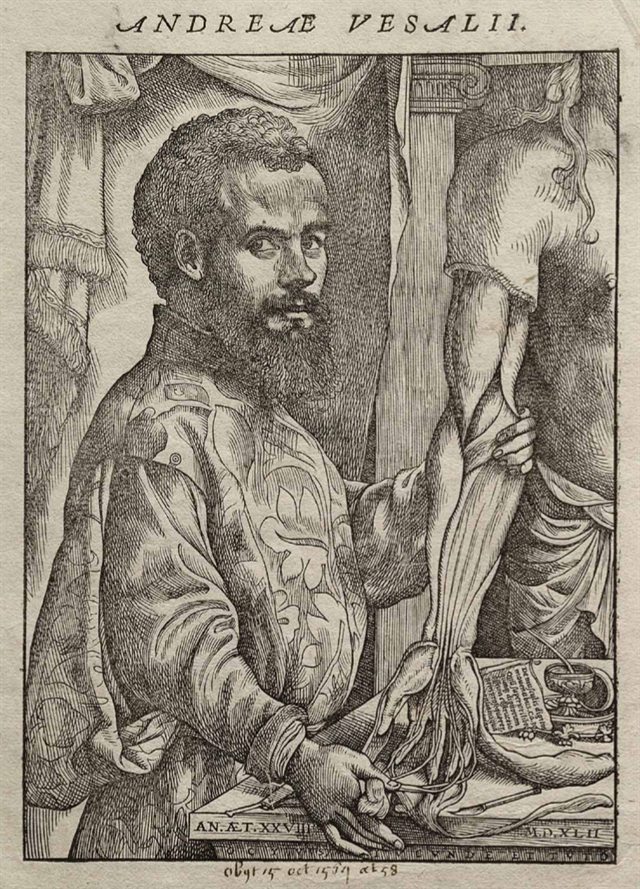
Galen Dissected Apes · Anatomist · 1514–1564
The Brussels-born anatomist who dissected human bodies himself, showed that Galen had described animals rather than humans, and published the illustrated De humani corporis fabrica in 1543.
Why Vesalius is on Incandio
Incandio is a free revision platform for the Pearson Edexcel International GCSE. Its historical figures are the people a student learns from, questions and — where a specification topic is theirs — defends an idea against. Andreas Vesalius can be questioned here in a dramatised, historically grounded portrayal, and the five-chapter life below is written to be read alongside the course.
Who was Vesalius?
Vesalius was born in Brussels on 31 December 1514; his father was apothecary to the Emperor Charles V. He studied at Leuven and Paris, where anatomy was taught by a professor reading Galen while a barber-surgeon cut. He collected bones from cemeteries and gallows. In 1537 he took his doctorate at Padua and was immediately appointed to teach anatomy and surgery, and he did the dissections himself. Bodies of executed criminals were supplied by the judge Marcantonio Contarini. In 1543 he published De humani corporis fabrica (On the Fabric of the Human Body) in Basel, with superb woodcut illustrations, and showed that many of Galen's descriptions came from animals. He became physician to Charles V and then Philip II of Spain. In 1559 he attended Henry II of France with Ambroise Paré. He died in 1564 on the island of Zakynthos, returning from a pilgrimage to Jerusalem.
Major achievements
- Dissected human bodies himself and taught by demonstration
- Published the Fabrica (1543), the most accurate and best-illustrated anatomy of its age
- Showed that the human jaw is one bone and that there is no rete mirabile in the human brain
- Used printing and detailed illustration to spread accurate anatomy across Europe
- Questioned, in his 1555 edition, whether blood could pass through the septum of the heart
Life in brief
- 1514 — Born in Brussels: 31 December, into a family of court apothecaries.
- 1533–1536 — Studies in Paris: Under Sylvius and Guinter; collects bones from cemeteries and gallows.
- 1537 — Doctorate and professorship at Padua: Dissects himself in his lectures.
- 1543 — De humani corporis fabrica: Printed in Basel by Oporinus, with the Epitome.
- 1559 — At the bedside of Henry II: With Ambroise Paré, after the fatal jousting wound.
- 1564 — Dies on Zakynthos: Returning from a pilgrimage to Jerusalem.
Explore the life of Vesalius — five chapters
- Bones and Gibbets — A student who would not just listen
- Professor at Padua — The anatomist who cut for himself
- The Fabric of the Human Body — A book that made the body visible
- Madman and Courtier — Attacks from teachers, service to emperors
- The Pilgrim's Death — A journey to Jerusalem and a grave on an island
Read the five-chapter life of Andreas Vesalius →
Begin
- Start a conversation with Vesalius — a dramatised, historically grounded AI portrayal
- Read the Historical Brief
- Explore the life of Vesalius — five chapters
- Find your course · Meet all 280 figures