Explore Their Life · Pearson Edexcel International GCSE revision on Incandio
Andreas Vesalius: A Life in Five Chapters
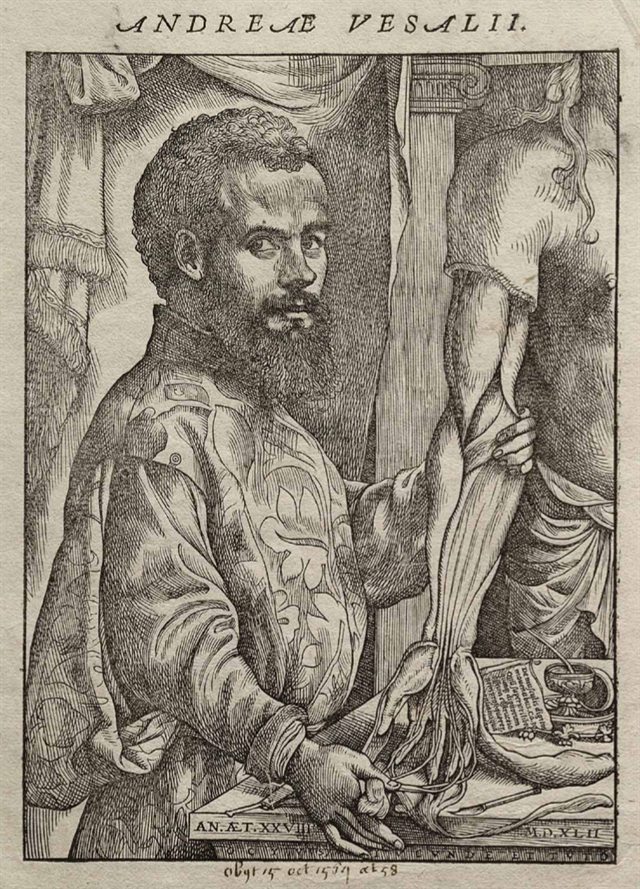
1514–1564
A Brussels apothecary's son who stole a skeleton from a gibbet, cut bodies with his own hands at Padua, and published at twenty-eight the book that showed Galen had described apes.
Vesalius is often said to have overthrown Galen. The truth is more interesting: he corrected Galen's anatomy by looking at human bodies himself, used the new technology of printing to make his findings impossible to ignore, and left much of Galen's physiology standing. These five chapters follow him from Brussels to Padua, Basel, the Spanish court and a lonely death on a Greek island.
The five chapters
- Bones and Gibbets — A student who would not just listen
- Professor at Padua — The anatomist who cut for himself
- The Fabric of the Human Body — A book that made the body visible
- Madman and Courtier — Attacks from teachers, service to emperors
- The Pilgrim's Death — A journey to Jerusalem and a grave on an island
Chapter 1 · Bones and Gibbets
A student who would not just listen
1514 – 1536 · Brussels · Leuven · Paris
Andreas Vesalius was born in Brussels on 31 December 1514 into a family of physicians and apothecaries who served the Habsburg emperors. His father was apothecary to Charles V, the most powerful ruler in Europe.
He studied at the University of Leuven and then, from 1533, at the University of Paris. Anatomy teaching in Paris followed the medieval pattern: a professor sat in a high chair reading from Galen, while a barber-surgeon below did the cutting and an assistant pointed to the parts. If the body did not match the book, the body was usually assumed to be unusual. Vesalius' teachers, Jacobus Sylvius and Johann Guinter, were respected Galen scholars.
Vesalius was impatient with this. He wanted to handle bodies himself. He and fellow students hunted for bones in the Cemetery of the Innocents and near the gallows at Montfaucon, where the bodies of executed criminals were left to decay. Back near Leuven in 1536, according to his own later account, he and a friend took down a skeleton from a roadside gibbet at night and smuggled it home piece by piece to assemble.
This may sound grim, and it was. But it reflects a hard fact: there was no lawful, regular supply of bodies for study. Students who wanted to learn real anatomy had to find their own.
Why this matters
Vesalius' frustration with book-based anatomy in Paris shows how much medical teaching still depended on Galen's authority in the 1530s.
A professor reading Galen from a chair, and a skeleton from a gibbet. What would you ask him?
Ask Vesalius
- “What was wrong with the way anatomy was taught in Paris?”
- “Why did you take a skeleton down from a gibbet outside Leuven?”
- “What did Jacobus Sylvius think when a body did not match Galen's description?”
- “Did being the son of the Emperor's apothecary help your career?”
- “How did people at the time feel about students taking bones from cemeteries?”
Chapter 2 · Professor at Padua
The anatomist who cut for himself
1537 – 1542 · Padua · Venice
In December 1537 Vesalius was awarded his medical doctorate at the University of Padua, in the Republic of Venice, and the next day he was appointed to teach surgery and anatomy. He was twenty-three.
Padua was one of the most open universities in Europe, attracting students from many countries. Vesalius changed the way anatomy was taught there. Instead of reading from a chair, he came down and did the dissecting himself, explaining as he went, with students crowded round. He used drawings and charts to help them follow.
He needed bodies, and he got them from the courts. The Paduan judge Marcantonio Contarini became interested in his work and supplied the bodies of executed criminals, sometimes arranging the timing of executions to suit the lectures. These were real people, mostly poor, whose bodies were used without their consent — a common practice in Europe for centuries, and one that should be remembered rather than passed over.
In 1538 Vesalius published six large anatomical sheets, the Tabulae anatomicae sex. They still repeated some of Galen's errors, including the rete mirabile, a network of blood vessels at the base of the brain. But as he dissected more human bodies, he became certain that Galen had described the anatomy of animals, especially apes, rather than humans. He prepared to say so in public.
Why this matters
Repeated hands-on human dissection at Padua is what allowed Vesalius to see where Galen's descriptions failed.
A young professor, a judge and the bodies of the condemned. What would you ask him?
Ask Vesalius
- “What changed when you came down from the chair to dissect yourself?”
- “How did Marcantonio Contarini help you obtain bodies?”
- “Did you ever think about the people whose bodies you dissected?”
- “Why did your 1538 charts still include Galen's rete mirabile?”
- “When did you first become sure that Galen had dissected apes?”
Chapter 3 · The Fabric of the Human Body
A book that made the body visible
1543 · Padua · Venice · Basel
In 1543 Vesalius published De humani corporis fabrica libri septem — Seven Books on the Fabric of the Human Body — in Basel, printed by Johannes Oporinus. He was twenty-eight. He also produced a shorter version, the Epitome, for students.
The Fabrica is famous above all for its pictures. More than two hundred woodcut illustrations showed skeletons and muscle-men posed in Italian landscapes, organs in careful detail and letters keyed to the text. The artists are not certainly known; Jan Steven van Calcar, a pupil of Titian, probably drew some of them, and others from Titian's workshop may have been involved. The woodblocks were carried over the Alps by mule to Basel.
Printing mattered enormously. Hundreds of identical copies, with identical pictures, could be studied across Europe. Readers could compare the drawings with bodies they dissected themselves.
In the Fabrica Vesalius corrected many of Galen's errors. The human lower jaw is one bone, not two. The breastbone has three parts, not seven. There is no rete mirabile in the human brain. The liver does not have five lobes. He said plainly that Galen had been misled by animals.
But he did not reject Galen altogether. His explanation of how the body worked remained largely Galenic. On the septum of the heart he was cautious in 1543, and only in the 1555 second edition did he state that he could not see how blood passed through it.
Why this matters
The Fabrica combined human dissection, superb illustration and printing to challenge Galen's anatomy — a central example of Renaissance change in medicine.
Two hundred woodcuts carried over the Alps by mule. What would you ask him?
Ask Vesalius
- “Why did the Fabrica need such detailed pictures to make its case?”
- “Why print in Basel rather than in Venice, closer to Padua?”
- “Which of Galen's mistakes about the jaw and breastbone did you correct?”
- “Who actually drew the woodcuts for your book?”
- “Why were you so cautious about the septum of the heart in 1543?”
Chapter 4 · Madman and Courtier
Attacks from teachers, service to emperors
1543 – 1559 · Spanish Netherlands · Madrid · Paris
The Fabrica brought Vesalius fame and fury. His old Paris teacher Jacobus Sylvius attacked him viciously, playing on his name to call him 'Vesanus' — madman — and arguing that if human bodies now differed from Galen's descriptions, it was because humans had changed since ancient times. Realdo Colombo, Vesalius' former assistant and successor at Padua, also criticised him.
Vesalius did not stay to fight in the universities. In 1543 he presented the Fabrica to the Emperor Charles V and soon entered his service as a court physician. It was a prestigious and well-paid post, but it largely ended his research: at court there was little opportunity to dissect. He travelled with the emperor's household, treated his illnesses and wrote on practical matters, such as the use of China root for the emperor's gout.
When Charles V abdicated in 1556, Vesalius served his son, Philip II of Spain. In 1555 he published the revised second edition of the Fabrica.
In 1559 he was sent to Paris to help treat King Henry II of France, whose eye and head had been pierced by a lance splinter in a jousting tournament. There he worked alongside the French surgeon Ambroise Paré. They could not save the king, who died about ten days later. The episode shows that even the best anatomist and the best surgeon in Europe could do little against such an injury.
Why this matters
The attacks on Vesalius show how strongly Galen's authority was defended, and his move to court shows how individual careers shaped the pace of change.
Called a madman by his teacher, physician to an emperor. What would you ask him?
Ask Vesalius
- “What did you make of Sylvius' claim that human bodies had changed since Galen's time?”
- “Why did you leave Padua to serve Charles V?”
- “Did you miss dissection while you were a court physician?”
- “What could you and Ambroise Paré do for Henry II after the lance wound?”
- “What did you change in the 1555 edition of the Fabrica?”
Chapter 5 · The Pilgrim's Death
A journey to Jerusalem and a grave on an island
1559 – 1564 · Madrid · Jerusalem · Zakynthos
Vesalius was not happy at the Spanish court in Madrid. Spanish physicians were suspicious of him, and he had few chances to dissect. In 1564 he left on a pilgrimage to Jerusalem.
Why he went is uncertain. A story spread after his death that he had been condemned by the Inquisition for dissecting a Spanish nobleman whose heart was still beating, and that the pilgrimage was his punishment. This story comes from a letter written years later and has no reliable evidence behind it; historians generally reject it. Other suggestions are that he wanted to escape the court, that he had been offered his old post at Padua and needed an excuse to leave Spain, or simply that he was devout.
On the voyage home from the Holy Land his ship was caught in storms. He fell ill and was landed on the Greek island of Zakynthos, where he died in October 1564, aged forty-nine. The exact place of his grave is unknown.
Vesalius did not change how ordinary patients were treated; doctors continued to rely on the four humours and bloodletting long after the Fabrica. What he changed was the method of anatomy. He showed that the human body itself, carefully observed, was the true authority, and that even Galen could be wrong. William Harvey, working in the same tradition at Padua, would build on that to explain the circulation of the blood in 1628.
Why this matters
Vesalius changed knowledge of anatomy more than treatment — an important distinction when judging the Renaissance in medicine.
A pilgrimage with no certain reason, and a death far from home. What would you ask him?
Ask Vesalius
- “Why did you set out on the pilgrimage to Jerusalem in 1564?”
- “What would you say to the story that the Inquisition punished you?”
- “Why did physicians keep bleeding patients after your book appeared?”
- “Were the Spanish physicians at Madrid hostile to your methods?”
- “Did you ever suspect that blood moves round the body in a circle?”
What Vesalius changed
Vesalius made human dissection and careful observation the foundation of anatomy, and through the printed, illustrated Fabrica he spread accurate knowledge of the human body across Europe. He corrected many of Galen's errors and encouraged others to challenge ancient authority. His work changed medical knowledge far more quickly than it changed everyday treatment.
A debate that continues
Was Vesalius a revolutionary who broke Galen's authority, or a reformer working within the Galenic tradition who corrected its anatomy while keeping its physiology? Historians increasingly stress the second view while recognising the force of the first.
Keep exploring — ask Vesalius
- “Why can new knowledge spread without changing how people are treated?”
- “How much did printing matter compared with Vesalius' own skill?”
- “Should the use of executed criminals' bodies change how we judge his achievement?”
Related lives
- Galen — The Physician Who Ruled for Fourteen Centuries
- Ambroise Paré — I Dressed Him, God Healed Him
- William Harvey — Discoverer of the Circulation
- Leonardo da Vinci — Painter · Engineer · Philosopher of Nature
Related themes
The Renaissance in medicine · Printing and the spread of knowledge · Anatomy and dissection
Continue on Incandio
- Talk to Vesalius — every question on this page is one tap from being asked, and the same page carries the Historical Brief, the achievements and the timeline
- All 280 figures · Incandio — learn every idea, teach it, then defend it