Historical figure · Pearson Edexcel International GCSE revision on Incandio
Baruch Spinoza
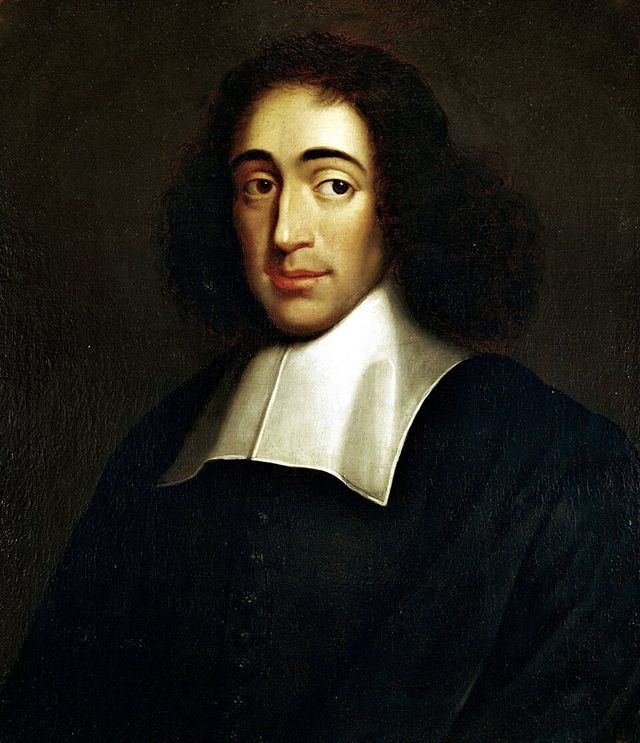
Who Was Cast Out and Kept Working · Philosopher & Lens-Grinder · 1632 – 1677
The Amsterdam philosopher expelled from his own community at twenty-three, who ground optical lenses for a living, refused a professor's chair to keep his freedom, and argued that free will is ignorance of causes.
Defend these ideas against Spinoza
Incandio is a free revision platform for the Pearson Edexcel International GCSE, and on it a topic counts as mastered only once you have learned it, proved it in questions, taught it back and defended it against the person with the strongest claim on it. Baruch Spinoza is that person for 4 topics on the course:
- Free will, determinism and predestination — Religious Studies · Sikhism
- Free will, determinism and predestination — Religious Studies · Islam
- Free will, determinism and predestination — Religious Studies · Hinduism
- Free will, determinism and predestination — Religious Studies · Buddhism
Who was Spinoza?
Spinoza was born in Amsterdam in 1632 into a family of Portuguese Jewish merchants who had fled the Inquisition. He was educated in the community's school, learned Hebrew and the commentators, and took over the family business on his father's death. In July 1656, when he was twenty-three, the Amsterdam congregation issued a cherem against him in the harshest language it ever used, and the document does not say what he had said to deserve it. He never sought readmission and never converted to anything else. He changed his name to Benedict, learned lens-grinding, and lived on it — first at Rijnsburg, then at Voorburg, then at The Hague — refusing the offers that would have made him comfortable, including a chair at Heidelberg in 1673, on the ground that a salary carries conditions. He published almost nothing under his own name. The Theological-Political Treatise appeared anonymously in 1670 with a false imprint, argued that the Bible must be read as a historical document written by human beings in particular circumstances, and was banned; it was described by one contemporary as forged in hell. The Ethics, his major work, is written in the form of a geometry — definitions, axioms, propositions, proofs — and was held back and published only after he died. Its argument is that there is one substance, which may be called God or Nature; that everything follows from it by necessity; and that human freedom as ordinarily imagined does not exist. Men think themselves free, he wrote, only because they are conscious of their volitions and ignorant of the causes that determine them; a stone in mid-air, if it were conscious, would believe it was flying of its own accord. He drew a further conclusion that most determinists avoid: understanding why a person acted removes hatred without removing the need to restrain them. He died at The Hague in 1677, at forty-four, probably of a lung disease made worse by glass dust.
Major achievements
- The Ethics, written in geometrical form and published after his death in 1677
- The Theological-Political Treatise (1670), a founding text of critical Bible scholarship
- The clearest statement in philosophy of the argument that free will is an illusion of ignorance
- Refused a chair at Heidelberg in 1673 to keep his freedom to write
Life in brief
- 1632 — Born in Amsterdam: Into a Portuguese Jewish merchant family.
- 1654 — Takes over the family business: On his father's death.
- 1656 — The cherem: Expelled from the Amsterdam congregation at twenty-three.
- 1661 — Moves to Rijnsburg: Living by grinding optical lenses.
- 1670 — The Theological-Political Treatise: Published anonymously; banned within three years.
- 1673 — Refuses the Heidelberg chair: On the ground that a salary carries conditions.
- 1677 — Dies at The Hague: At forty-four; the Ethics appears months later.
Explore the life of Spinoza — five chapters
- A Merchant's Son in Amsterdam — Portuguese exiles, and a very good school
- The Cherem — July 1656, and words the community used only once
- The Lens Bench — A trade chosen, and a chair refused
- A Book Forged in Hell — The Treatise of 1670, and reading scripture as a document
- The Stone That Thinks It Flies — The Ethics, written like a geometry
Read the five-chapter life of Baruch Spinoza →
Begin
- Start a conversation with Spinoza — a dramatised, historically grounded AI portrayal
- Read the Historical Brief
- Explore the life of Spinoza — five chapters
- Find your course · Meet all 280 figures