Explore Their Life · Pearson Edexcel International GCSE revision on Incandio
Baruch Spinoza: A Life in Five Chapters
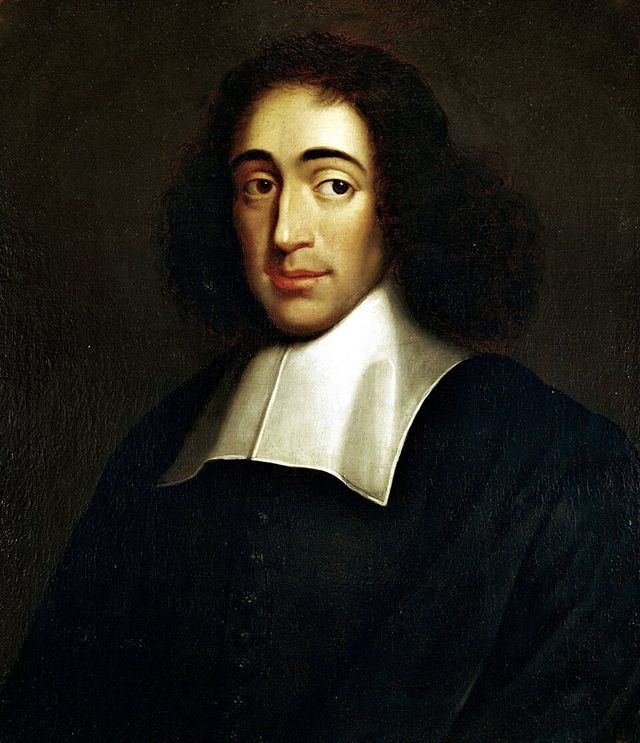
1632 – 1677
Expelled by his own community at twenty-three in the harshest words it ever used, he ground lenses for a living, refused a professor's chair, and wrote a book he knew could not be published while he lived.
He is the philosopher who argued that free will is ignorance of causes, and he did it from outside every community that might have protected him. These five chapters follow the merchant's son in Amsterdam, the expulsion of 1656, the trade he chose over a salary, the book that was called forged in hell, and the geometry of the Ethics.
The five chapters
- A Merchant's Son in Amsterdam — Portuguese exiles, and a very good school
- The Cherem — July 1656, and words the community used only once
- The Lens Bench — A trade chosen, and a chair refused
- A Book Forged in Hell — The Treatise of 1670, and reading scripture as a document
- The Stone That Thinks It Flies — The Ethics, written like a geometry
Chapter 1 · A Merchant's Son in Amsterdam
Portuguese exiles, and a very good school
1632 – 1654 · Amsterdam
Spinoza was born in Amsterdam in 1632, into a community of Portuguese Jews whose families had fled the Inquisition — many of them had been forced converts in Iberia and had returned openly to Judaism only after reaching the Dutch Republic. That history matters: it was a community that had rebuilt itself at great cost and had reason to be watchful about what its members said in public.
His father Michael was a merchant and an official of the community. Spinoza went through its school, learning Hebrew, the Bible and the commentators — Maimonides, Ibn Ezra, Gersonides — and he learned them well enough that the arguments he later made against the tradition are made from inside its own literature.
His mother died when he was six. His elder brother died, then his father in 1654, and at twenty-one he found himself running the family import business with his brother Gabriel. It was not going well: his father had left more debt than the estate could cover, and Spinoza went to court to have himself declared an orphan under Dutch law so that he could refuse the inheritance. It worked.
Somewhere in these years he began studying Latin with Franciscus van den Enden, an ex-Jesuit with radical politics, and reading Descartes. What he thought and said as a result is not recorded. What is recorded is what happened next.
Why this matters
His objections to religion come from a full training inside a religious tradition, which is why they cannot be dismissed as the complaints of an outsider who never understood it.
What would you ask him about the community that educated him?
Ask Spinoza
- “What did your community's history in Portugal make it afraid of?”
- “Which of the Jewish commentators taught you the most?”
- “Why did you go to court to refuse your father's estate?”
- “What did Descartes give you, and where did you leave him?”
- “What was van den Enden teaching besides Latin?”
Chapter 2 · The Cherem
July 1656, and words the community used only once
1656 · Amsterdam
On 27 July 1656 the Amsterdam congregation issued a cherem against Baruch de Spinoza. He was twenty-three.
The document is preserved, and the first thing to notice is what it does not contain. It does not say what he had said or written. It refers to his 'evil opinions' and 'abominable heresies' and says that these had been established by witnesses, and then it curses him at extraordinary length — by day and by night, lying down and rising up — and forbids anyone to communicate with him, to be within four cubits of him, or to read anything he wrote.
Expulsions were not rare in that community, and most were temporary, imposed for commercial or personal disputes and lifted on apology. This one was permanent and the language is unlike any other in the register.
What he had actually said is not recorded, and honest accounts say so. The reconstruction usually offered from his later work is that he had denied the immortality of the soul, denied that the Torah was literally dictated by God, and held that God has no will or purposes distinct from nature.
He did not appeal. He did not convert to anything else — Christianity was available and would have made his life much easier. He took the Latin form of his name, Benedict, and left. As far as the record shows, he never spoke about it again.
Why this matters
It is the clearest example on this course of a religious community defending itself by exclusion, and of a thinker who accepted the cost rather than modifying the argument.
What would you ask him about a document that never says what he did?
Ask Spinoza
- “What do you think you were actually expelled for?”
- “Why did you never convert to Christianity?”
- “Was the community wrong to protect itself?”
- “Did you ever try to have it lifted?”
- “Why change your name to Benedict?”
Chapter 3 · The Lens Bench
A trade chosen, and a chair refused
1656 – 1673 · Rijnsburg · Voorburg · The Hague
Spinoza learned to grind optical lenses and lived by it for the rest of his life — first at Rijnsburg near Leiden, then at Voorburg, then in lodgings at The Hague. It was skilled work; his lenses were good enough that Christiaan Huygens, who made the best telescopes in Europe, discussed them seriously.
He lived very plainly and refused money he could have had. Friends offered pensions and he cut them down. When a benefactor's family tried to leave him an estate he declined it and let it pass elsewhere.
In 1673 the Elector Palatine offered him a professorship at Heidelberg, with an assurance of the fullest freedom to philosophise, provided he did not disturb the established religion. He refused, and the letter is worth reading. He points out that nobody has told him where the limits of that freedom would lie, and that a chair would consume the time he uses for thinking. What he was protecting was not comfort. It was the absence of a condition.
The cost is visible in how he died. He had a lung complaint for years and it killed him in February 1677, at forty-four, and glass dust from the trade very probably made it worse.
He kept working. The room was small, the possessions were few, and the manuscript in the desk was the most dangerous book in Europe.
“I do not know within what limits that freedom of philosophising must be confined.”
— Spinoza, letter declining the chair at Heidelberg, 1673
Why this matters
A philosopher who arranged his entire life so that nobody could impose a condition on what he wrote is the strongest possible witness for taking his conclusions at face value.
What would you ask him about turning down a professor's chair?
Ask Spinoza
- “What exactly were you protecting by staying poor?”
- “Why refuse Heidelberg when they promised you freedom?”
- “Did the glass dust worry you?”
- “What did Huygens think of your lenses?”
- “Do you need to be poor to think freely?”
Chapter 4 · A Book Forged in Hell
The Treatise of 1670, and reading scripture as a document
1670 – 1674 · Voorburg · Amsterdam
In 1670 the Theological-Political Treatise appeared anonymously, with a false publisher and a false place of printing. Everybody knew who had written it within months.
Its argument has two halves. The first is about how scripture should be read: as a set of documents written by particular people, in particular languages, at particular times, for particular audiences — so that the first question about any passage is what its author meant by it, not what doctrine can be extracted from it. He examines the Hebrew text closely, argues that Moses cannot have written the whole Pentateuch, and treats prophecy as vivid imagination rather than as superior knowledge.
The second half is political, and it is why he wrote it. He argues that a state should not police belief, because it cannot; that freedom to philosophise is compatible with public order and in fact protects it; and that the clergy's involvement in politics is dangerous to both.
The reaction was immediate and enormous. It was banned by the Dutch authorities in 1674, condemned by synods, and one contemporary described it as a book forged in hell by a renegade Jew and the devil. It became the standard byword for atheism for a century, and being called a Spinozist was a serious accusation long after almost nobody had read him.
In 1672 the de Witt brothers, whose party had protected the climate he wrote in, were lynched by a mob in The Hague. Spinoza wanted to go out and post a placard calling the crowd the lowest of barbarians. His landlord locked the door.
Why this matters
This is the beginning of reading scripture historically, and the reaction to it shows what was at stake in treating a sacred text as a document with a history.
What would you ask him about a book he did not dare put his name to?
Ask Spinoza
- “Why publish it anonymously if everybody knew?”
- “What is lost by reading scripture as a historical document?”
- “What did you mean by calling prophecy imagination?”
- “What happened to you when the de Witts were killed?”
- “Can a state really leave belief alone?”
Chapter 5 · The Stone That Thinks It Flies
The Ethics, written like a geometry
1661 – 1677 · The Hague
The Ethics is written the way Euclid wrote: definitions, axioms, propositions, demonstrations, and 'which was to be shown' at the end of each. He chose the form because he believed that if you agree the definitions you cannot refuse the conclusions.
The conclusions are these. There is one substance, infinite and self-caused, and you may call it God or Nature — the two words name the same thing. Everything that exists is a mode of that substance. Nothing could have happened otherwise, because everything follows from the nature of what exists with the same necessity by which the angles of a triangle come to two right angles.
So there is no free will. Men believe themselves free, he says, because they are conscious of their volitions and ignorant of the causes that determine them. If a stone in mid-air were given consciousness, it would be convinced it was flying of its own accord — it would know it wanted to keep going, and would know nothing of the hand that threw it.
What he does next is what separates him from most determinists. He does not conclude that blame is unfair and stop. He argues that understanding why a person acted dissolves your hatred of them without dissolving the need to restrain them, and that this is an improvement rather than a loss. Freedom, on his account, is not doing what you like; it is acting from an understanding of your own nature rather than being pushed about by causes you cannot see.
He held the book back. It appeared months after he died.
Why this matters
It is the determinist case in its strongest form, and it comes with an answer to the objection that determinism makes conduct pointless — which is exactly the objection the specification asks a learner to make.
What would you ask him about a stone that believes it chose to fly?
Ask Spinoza
- “If nothing could have been otherwise, what is left of blame?”
- “Why write philosophy in the form of a geometry?”
- “Does understanding somebody mean excusing them?”
- “What kind of freedom is left on your account?”
- “Why did you keep the Ethics unpublished?”
What Spinoza changed
Spinoza wrote the determinist case in the form later philosophy has had to answer, and drew the moral consequence rather than avoiding it. His Treatise began the historical study of scripture, and his argument for a state that leaves belief alone became one of the foundations of religious toleration. For two centuries after his death, being called a Spinozist was an accusation rather than a description.
A debate that continues
Whether Spinoza is an atheist who used the word God for cover, or a genuine religious thinker with an unusual conception of God, has been argued continuously since 1677 and both readings can be supported from the Ethics.
Keep exploring — ask Spinoza
- “If every choice was caused, can anybody be blamed for anything?”
- “Is a community entitled to exclude a member whose ideas endanger it?”
- “Can you call something God if it has no will, no plan and no preferences?”
Related lives
- René Descartes — Who Conserved The Quantity Of Motion
- Maimonides — Who Said What God Is Not
- John Locke — Father of Liberalism
Related themes
Free will and determinism · The authority of scripture · Religious toleration · Arguments about God
Continue on Incandio
- Talk to Spinoza — every question on this page is one tap from being asked, and the same page carries the Historical Brief, the achievements and the timeline
- All 280 figures · Incandio — learn every idea, teach it, then defend it