Historical figure · Pearson Edexcel International GCSE revision on Incandio
Carl Friedrich Gauss
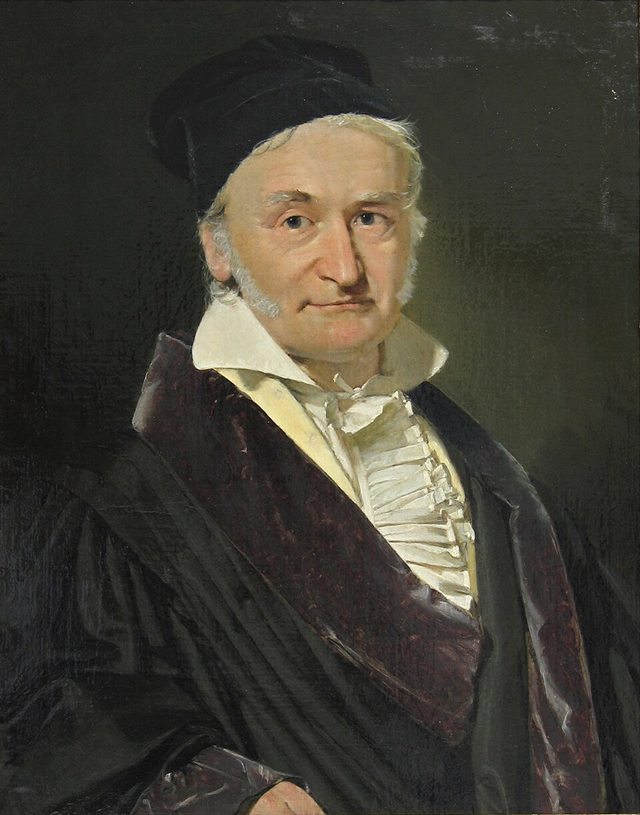
Few, But Ripe · Mathematician & Astronomer · 1777–1855
The Göttingen mathematician who recovered a lost planet from forty-one days of readings that disagreed, and who built the systematic elimination that handles more equations than there are unknowns.
Defend these ideas against Gauss
Incandio is a free revision platform for the Pearson Edexcel International GCSE, and on it a topic counts as mastered only once you have learned it, proved it in questions, taught it back and defended it against the person with the strongest claim on it. Carl Friedrich Gauss is that person for 2 topics on the course:
- Simultaneous Equations — Mathematics
- Linear Sequences & the nth Term — Mathematics
Who was Gauss?
Carl Friedrich Gauss was born at Brunswick in 1777 to a bricklayer's family, and his ability was noticed early enough that the Duke of Brunswick paid for his education. In 1801, at twenty-four, he published the Disquisitiones Arithmeticae, which turned the theory of numbers from a collection of curiosities into a subject with a structure. In the same year the small planet Ceres was discovered by Piazzi at Palermo, tracked for forty-one days, and then lost in the glare of the sun. Recovering it meant computing an orbit from a short arc of observations that were individually imprecise and mutually inconsistent. Gauss did it, said where the object would reappear, and it reappeared there. He was famous by the end of the year. The machinery behind that result was published in 1809 as the Theoria Motus. It contains a systematic elimination that reduces a system of equations by clearing one unknown at a time — an old idea made into a reliable procedure — and it applies that procedure to a situation the textbook case never mentions: more equations than unknowns, none of them exactly true, because each comes from a measurement. Gauss takes the values that make the disagreements collectively as small as possible. Legendre had published that principle first, in 1805, and disputed priority sharply when Gauss said he had been using it since 1795. Gauss published little and late. His motto was pauca sed matura — few, but ripe — and he withheld results he considered unfinished, including a geometry in which the parallels assumption fails; Bolyai and Lobachevsky published it independently and Gauss told Bolyai's father he had reached it years before, which was true and unkind. He directed the Göttingen observatory for nearly fifty years, ran the geodetic survey of Hanover, worked on terrestrial magnetism with Wilhelm Weber, and strung an electric telegraph across the town. The famous story that as a schoolboy he summed the numbers from one to a hundred instantly by pairing the ends was written down by his friend Sartorius von Waltershausen after his death, and is not documented earlier.
Major achievements
- Published the Disquisitiones Arithmeticae in 1801, founding the modern theory of numbers
- Recovered the lost planet Ceres in 1801 by computing its orbit from a short arc of readings
- Published the Theoria Motus in 1809, with systematic elimination applied to over-determined systems
- Developed the method of taking the values that make the disagreements as small as possible
- Proved that the regular seventeen-sided polygon can be constructed with ruler and compasses
Life in brief
- 1777 — Born at Brunswick: To a bricklayer's family; educated at the Duke's expense.
- 1796 — The seventeen-sided polygon: Constructible with ruler and compasses, at nineteen.
- 1801 — Disquisitiones — and Ceres: The theory of numbers founded; the lost planet recovered from forty-one days of readings.
- 1807 — Göttingen: Appointed director of the observatory, a post held for nearly fifty years.
- 1809 — Theoria Motus: Systematic elimination and least disagreement, published together.
- 1818–1832 — Hanover and magnetism: The geodetic survey; then magnetic work and the telegraph with Weber.
- 1855 — Died at Göttingen: His diary, published later, showed how much he had never printed.
Explore the life of Gauss — five chapters
- Brunswick — The story about the schoolroom, and what to make of it
- The Lost Planet — Forty-one days of readings, and a prediction that held
- Few, But Ripe — What he knew and did not say
- The Disquisitiones — Numbers sorted by what they leave behind
- Fifty Years at Göttingen — Surveying, magnetism, and a telegraph across the town
Read the five-chapter life of Carl Friedrich Gauss →
Begin
- Start a conversation with Gauss — a dramatised, historically grounded AI portrayal
- Read the Historical Brief
- Explore the life of Gauss — five chapters
- Find your course · Meet all 280 figures