Explore Their Life · Pearson Edexcel International GCSE revision on Incandio
Carl Friedrich Gauss: A Life in Five Chapters
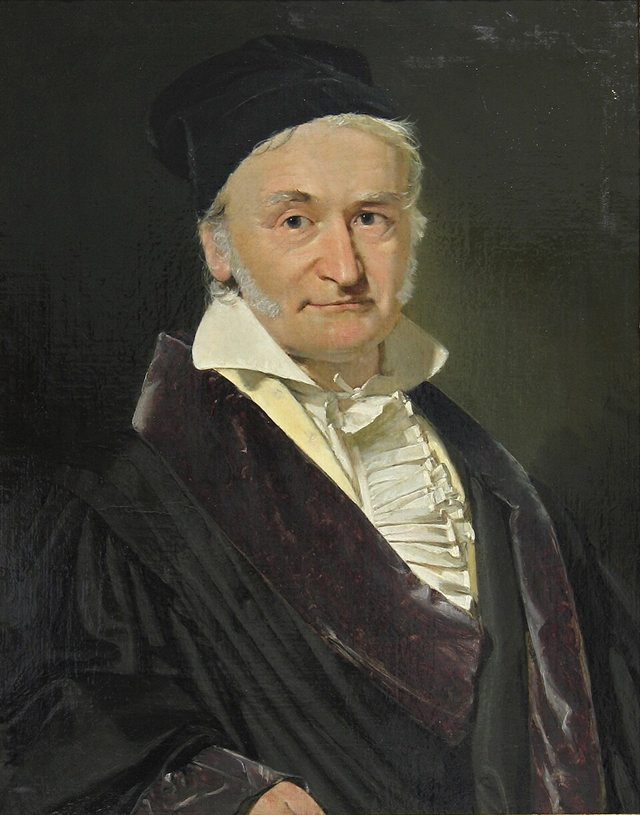
1777–1855
A bricklayer's son found a lost planet using forty-one days of readings that disagreed with one another — and then spent fifty years refusing to publish anything he considered unfinished.
Gauss's motto was pauca sed matura: few, but ripe. He kept that promise so strictly that his diary, opened after his death, showed discoveries he had sat on for decades while other people found them independently. These five chapters follow the schoolboy story, the lost planet, the readings that disagreed, the results he withheld, and the fifty years at Göttingen.
The five chapters
- Brunswick — The story about the schoolroom, and what to make of it
- The Lost Planet — Forty-one days of readings, and a prediction that held
- Few, But Ripe — What he knew and did not say
- The Disquisitiones — Numbers sorted by what they leave behind
- Fifty Years at Göttingen — Surveying, magnetism, and a telegraph across the town
Chapter 1 · Brunswick
The story about the schoolroom, and what to make of it
1777 – 1795 · Brunswick · Göttingen
Carl Friedrich Gauss was born at Brunswick in 1777. His father was a bricklayer, gardener and canal foreman who saw no purpose in education; his mother, who could barely read, backed her son and lived with him for the last twenty years of her life.
The famous story is set in his primary school. The master, wanting quiet, set the class to add the whole numbers from one to a hundred. Gauss put his slate on the table within moments with the answer written on it. He had noticed that the numbers pair up from the ends — one and a hundred, two and ninety-nine, three and ninety-eight — and every pair makes a hundred and one. Fifty pairs, so fifty times a hundred and one, which is five thousand and fifty.
The story deserves care. It was written down by Wolfgang Sartorius von Waltershausen in a memoir published in 1856, the year after Gauss died, and Sartorius had it from Gauss himself in old age. It is not documented at the time, the details differ between tellings, and it may well have grown in the telling of a man enjoying his own legend.
What is documented is that his ability was noticed, and that the Duke of Brunswick paid for his schooling and then his university. Without that patronage the son of a bricklayer would not have got near a university at all. In 1796, aged nineteen, he proved that a regular polygon of seventeen sides can be constructed with straight edge and compasses — a question open since the Greeks — and decided on mathematics rather than languages.
Why this matters
The best-known story about the greatest mathematician of the age is an undocumented anecdote, and saying so is part of telling it properly.
A bricklayer's son, a duke's money, and a story nobody can check. What would you ask him?
Ask Gauss
- “Did you really add one to a hundred at school in a moment?”
- “How do the numbers pairing from the ends give you the total?”
- “What would have happened without the Duke's patronage?”
- “Why did the seventeen-sided polygon settle your career?”
- “What did your parents make of what you were doing?”
Chapter 2 · The Lost Planet
Forty-one days of readings, and a prediction that held
1801 · Brunswick · Palermo
On the first night of 1801, Giuseppe Piazzi at Palermo noticed a moving point of light. He tracked it for forty-one days, over an arc of about three degrees, and then it was lost in the glare of the sun. It would emerge on the far side months later, somewhere along a stretch of sky nobody could narrow down. The object — Ceres, the first of the asteroids — looked likely to be lost for good.
The problem was not observation. It was computation. Determining an orbit normally needed a long arc of good observations; here there was a short arc of readings that were individually imprecise and mutually inconsistent, because every measurement of a faint moving object is slightly wrong.
Gauss, aged twenty-four, worked out where it would reappear. Franz von Zach found it there in December 1801, almost exactly where Gauss had said. It made him famous across Europe in a way that no theorem could have.
The mathematics behind it appeared in 1809 as the Theoria Motus. Two things in it matter for anybody solving equations. The first is a systematic procedure for reducing a set of equations in several unknowns by clearing one letter at a time — an old idea, but organised into something you can carry out reliably and mechanically, which is how a computer does it today.
The second is the harder point. Real observations give you MORE equations than unknowns, and no set of values satisfies all of them, because each carries its own error. Gauss takes the values that make the disagreements collectively as small as possible. Legendre had published that principle in 1805; Gauss said he had been using it since 1795, and the priority dispute between them was bitter.
Why this matters
Systematic elimination and the method of least disagreement — the two tools behind every fitted line in science — came out of finding a lost planet.
A lost planet recovered from arithmetic. What would you ask him?
Ask Gauss
- “How did you find Ceres again from forty-one days of readings?”
- “What do you do when your equations disagree with one another?”
- “Why clear one unknown at a time rather than guess at the whole?”
- “Legendre published the method first. What is your claim?”
- “What did it feel like when they found it where you said?”
Chapter 3 · Few, But Ripe
What he knew and did not say
1796 – 1855 · Göttingen
Gauss published little. His seal showed a tree with a few fruit and the motto pauca sed matura — few, but ripe — and he meant it: nothing left his desk until he considered it finished, polished, and free of any trace of how it had been found.
The cost of that is documented, because he kept a mathematical diary from 1796, and it was not published until 1898. It shows him reaching results years and sometimes decades before anybody else, and saying nothing.
The hardest case is the geometry in which the parallels assumption fails. Gauss had worked out that a consistent geometry exists in which parallel lines behave quite differently from the way Euclid assumed, and he did not publish, apparently from a dislike of controversy. When János Bolyai published his own independent discovery in 1832, his father Farkas — Gauss's old friend — sent it to him proudly. Gauss replied that he could not praise the work, because to praise it would be to praise himself, having reached the same results long before. It was true. It was also devastating to a young man, and Bolyai never really recovered from it.
There is a defence, and Gauss made it: publishing a half-formed result wastes everybody's time, and a proof that is not airtight is not a proof. There is also a cost, and it fell on other people. Whether the balance was right is one of the standing arguments in the history of mathematics, and it does not have an agreed answer.
Why this matters
A famous case where a scholar's high standard for himself became a real cost to others — and the argument about it is still open.
Decades of results kept in a private diary. What would you ask him?
Ask Gauss
- “Why keep a result to yourself for thirty years?”
- “What did you say to Bolyai's father, and would you say it again?”
- “Does mathematics belong to whoever finds it or whoever prints it?”
- “What was in the diary that nobody knew about?”
- “Is 'few, but ripe' good advice for anybody else?”
Chapter 4 · The Disquisitiones
Numbers sorted by what they leave behind
1801 · Brunswick · Göttingen
In the same year as Ceres, Gauss published the Disquisitiones Arithmeticae, written when he was in his early twenties. It took the theory of whole numbers — until then a collection of scattered curiosities and clever tricks — and made it a subject with a structure and a language.
The organising idea is beautifully simple. Instead of asking what a number IS, ask what it LEAVES when you divide it by something. Divide the whole numbers by three and every one of them leaves nothing, one or two; that sorts the entire infinite supply of numbers into three families. Two numbers in the same family behave identically for every question about multiples of three, so you can work with the family instead of the numbers.
Once you look at numbers that way, patterns that had seemed like curiosities turn into consequences. Whether a number can be written as a sum of two squares, which numbers divide which, when a repeating pattern in the decimal expansion of a fraction closes up — these become questions about remainders, and remainders have their own arithmetic.
It also gives a sharp answer to a question every school student meets. Take a sequence that climbs by four each time, starting at five: 5, 9, 13, 17. Every one of those numbers leaves a remainder of one when divided by four, and every number leaving that remainder is in the sequence. Asking whether some particular number appears is then simply asking what it leaves — no listing, no searching.
He called mathematics the queen of the sciences and arithmetic the queen of mathematics. The Disquisitiones is why nobody argued.
Why this matters
Sorting numbers by the remainder they leave turns a heap of curiosities into a structure — and answers 'is this number in the sequence?' at a glance.
The book that made number theory a subject. What would you ask him?
Ask Gauss
- “Why ask what a number leaves rather than what it is?”
- “How does that tell you whether a number is in a sequence?”
- “Why write such a difficult book at twenty-four?”
- “What made the theory of numbers worth systematising?”
- “Do you still think arithmetic is the queen of mathematics?”
Chapter 5 · Fifty Years at Göttingen
Surveying, magnetism, and a telegraph across the town
1807 – 1855 · Göttingen · Hanover
In 1807 Gauss became director of the observatory at Göttingen, a post he held for nearly fifty years and never left, refusing offers from elsewhere including Berlin. He disliked lecturing and did little of it.
A great deal of his later life went into work that was practical rather than abstract. From 1818 he ran the geodetic survey of the kingdom of Hanover, which meant years of triangulation in the field — and, incidentally, the invention of the heliotrope, an instrument using mirrors to flash sunlight from one survey station to another so that distant points could be sighted precisely. Thinking about how to measure a curved surface accurately led him to a deep result about curvature: that the curvature of a surface can be determined entirely from measurements made within the surface itself, without stepping outside it. He called it the remarkable theorem, and it is the foundation of the geometry that Einstein would eventually need.
With Wilhelm Weber he took up terrestrial magnetism, organised an international network of observing stations, and in 1833 strung a wire about three kilometres across Göttingen between the observatory and the physics laboratory to send coded signals — a working electric telegraph, several years before the commercial ones.
His personal life was hard. His first wife died in 1809 and his second in 1831; his relations with his sons were poor and two emigrated to America. He was reserved, discouraging to young mathematicians, and often unwilling to praise.
He died at Göttingen in 1855. The diary, published forty-three years later, revealed how much of the century's mathematics he had reached and never printed.
Why this matters
The mathematician of the century spent decades on surveying, magnetism and a telegraph — and got some of his deepest results out of the practical work.
Fifty years in one town, most of it measuring things. What would you ask him?
Ask Gauss
- “What did surveying Hanover teach you that pure mathematics had not?”
- “What is remarkable about your remarkable theorem?”
- “You built a telegraph in 1833. Why did nothing come of it?”
- “Why did you refuse every offer to leave Göttingen?”
- “Were you as hard on young mathematicians as they say?”
What Gauss changed
The systematic elimination of the Theoria Motus is how a computer solves a system of equations today, and the method of taking the values that make disagreements smallest underlies every trend line fitted to scattered data anywhere in science. The Disquisitiones Arithmeticae of 1801 made number theory a subject, organised around what a number leaves on division. His theorem on curvature — that a surface's curvature is measurable from inside it — is the basis of the geometry general relativity required.
A debate that continues
Legendre published the method of least disagreement in 1805 and Gauss claimed use from 1795 without printing it; the dispute was bitter and cannot be settled. His refusal to publish the geometry in which the parallels assumption fails left Bolyai and Lobachevsky to discover it independently, and his response to Bolyai's work was crushing. The schoolboy summing story rests on a memoir published after his death.
Keep exploring — ask Gauss
- “Is a discovery yours if you never tell anybody?”
- “What should be done when measurements disagree and none can be dismissed?”
- “Does a very high standard for one's own work justify its cost to others?”
Related lives
- Isaac Newton — Lucasian Professor · President of the Royal Society
- Felix Klein — What The Transformations Leave Alone
- John Napier — Who Spared The World Its Multiplying
Related themes
Solving equations · Sequences and remainders · Measurement and error
Continue on Incandio
- Talk to Gauss — every question on this page is one tap from being asked, and the same page carries the Historical Brief, the achievements and the timeline
- All 280 figures · Incandio — learn every idea, teach it, then defend it