Explore Their Life · Pearson Edexcel International GCSE revision on Incandio
Carl Linnaeus: A Life in Five Chapters
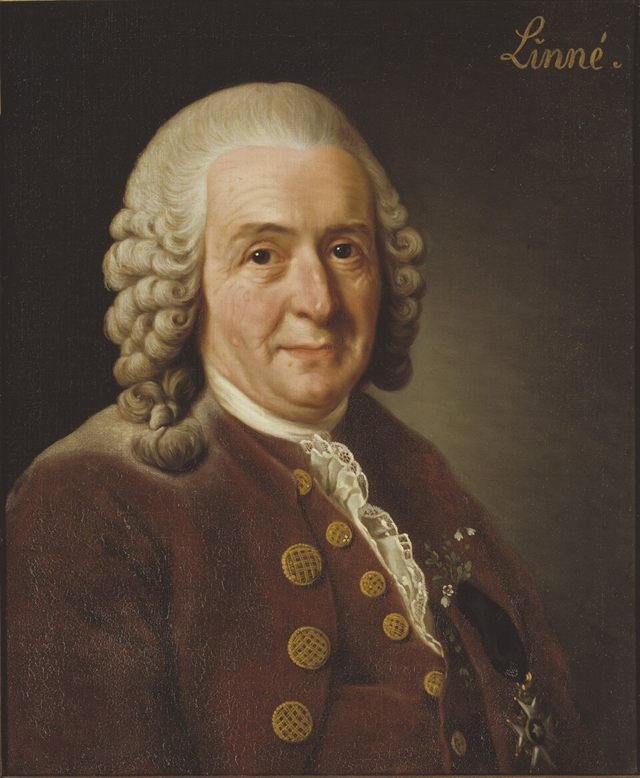
1707–1778
The curate's son who gave every living thing on Earth a two-part name that has outlasted almost everything he believed the names meant.
Linnaeus was nearly apprenticed to a shoemaker, walked hundreds of miles alone through Lapland at twenty-five, and by thirty had proposed a system for the whole of nature. He was wrong about species being fixed, wrong about the fungi, and wrote divisions of humanity that were later used to justify great harm. The system survived it all. These five chapters explain why.
The five chapters
- Nearly a Shoemaker — A boy who learned plants before he could read well
- Lapland, Alone — Hundreds of miles north at twenty-five
- Twelve Sheets for the Whole of Nature — Systema Naturae, 1735
- Two Words, Everywhere, For Ever — Binomial names, and the apostles who filled the system
- Wrong About Nearly Everything the Names Meant — Fixed species, two kingdoms, and a page that did great harm
Chapter 1 · Nearly a Shoemaker
A boy who learned plants before he could read well
1707 – 1732 · Råshult · Växjö · Lund · Uppsala
Carl Linnaeus was born in May 1707 at Råshult in Småland, southern Sweden, the son of Nils Ingemarsson, a curate and a keen gardener. The father's surname was itself an invention: taking a family name was becoming customary, and Nils chose *Linnaeus* after a great lime tree — *lind* — on the family land. So the man who named everything came from a family that had recently named itself.
Nils taught the boy the names of plants in the garden before he read well, and Carl was reportedly quietened as an infant by putting a flower in his hand.
School went badly. He was poor at the subjects that mattered for a clerical career — Greek, Hebrew, theology — and his teachers advised his father to apprentice him to a trade; a shoemaker was mentioned. He was rescued by Johan Rothman, a physician who taught at the school, noticed how much botany the boy already knew, took him into his own house, and steered him toward medicine.
Medicine at the time was largely botany, since most drugs were plant preparations. He studied at Lund, then at Uppsala, where he was so poor he was said to patch his shoes with folded paper.
At Uppsala Olof Celsius, a professor of theology and a botanist, found him working in the garden, was impressed, and took him in. By his early twenties Linnaeus was lecturing on botany to audiences larger than the professors'.
Why this matters
Linnaeus was twice rescued by individuals who noticed what he already knew — without either, a system used by every biologist since would not have been built.
You have the boy who was nearly apprenticed out. What would you ask him?
Ask Linnaeus
- “What did your father's garden teach you before you could read?”
- “How close did you come to being a shoemaker?”
- “Why was studying medicine the way into botany?”
- “What was it like being that poor at Uppsala?”
- “What did Rothman and Celsius see in you?”
Chapter 2 · Lapland, Alone
Hundreds of miles north at twenty-five
1732 · Uppsala · Lapland · The Gulf of Bothnia
In May 1732, funded by a small grant from the Royal Society of Sciences at Uppsala, Linnaeus set out alone for Lapland. He was twenty-five. He travelled for about five months, on foot and on horseback and by boat, through country that had no roads and very few people, cataloguing plants, animals, minerals and the customs of the Sami.
He claimed to have covered some four thousand miles. Modern scholars who have reconstructed his route from his own journal think the real figure is closer to half that, and that some of the journal was written up afterwards with some embellishment. He also had himself painted in Sami dress holding a shaman's drum, which is a piece of self-promotion by a man who was extremely good at self-promotion.
None of that cancels the achievement. He came back with around a hundred plants previously unrecorded, and published *Flora Lapponica* in 1737.
What the journey gave him was more important than the specimens. He saw an entire flora that had never been catalogued, in a place where nothing had a settled name, and he saw at first hand the problem he would spend his life solving: the same plant carried a different name in every valley, and the descriptive Latin names then in use — sometimes a dozen words long, each name a small paragraph — were unusable in the field.
He needed a way of naming things that a person could actually write down and carry.
Why this matters
The Lapland journey showed Linnaeus the naming problem in its rawest form: an entire flora with no stable names, in a place where nobody agreed what anything was called.
You have the walk north and the flora with no names. What is your question?
Ask Linnaeus
- “How far did you actually travel in Lapland?”
- “Why have yourself painted in Sami dress?”
- “What was wrong with the plant names then in use?”
- “What did you learn from the Sami that you kept?”
- “What is it like to name a plant nobody has named?”
Chapter 3 · Twelve Sheets for the Whole of Nature
Systema Naturae, 1735
1735 – 1738 · The Netherlands · Leiden · Hartekamp
Linnaeus went to the Netherlands in 1735, took a medical degree at Harderwijk in about a week — which was normal — and stayed three years, working for the wealthy banker George Clifford at his estate Hartekamp, cataloguing one of the finest private gardens and menageries in Europe.
There, in 1735, he published the first edition of *Systema Naturae*. It is twelve folio sheets — a set of large tables — and it sets out the whole of nature in three kingdoms: animal, vegetable and mineral, each divided into classes, then orders, then genera, then species.
The nested ranks are the key architectural idea. Every organism sits in exactly one place, inside a box that is inside a larger box. You can find anything by working down.
For plants he used a *sexual system*: classify by counting the stamens and pistils — the reproductive parts — of the flower. Twenty-four classes by number and arrangement of stamens, then orders by pistils.
He was entirely candid that this was artificial. It groups plants that are not related and separates plants that are. He defended it on the grounds that it *worked*: anybody with a lens and the ability to count could place a plant in the right box in a few minutes, and no other system available could be taught so fast.
That it was faintly scandalous — describing flowers in terms of husbands and wives sharing beds — did his sales no harm at all.
“God created, Linnaeus organised.”
— A saying attributed to Linnaeus and repeated by his contemporaries
Why this matters
Linnaeus knowingly chose an artificial system because it could be taught and used, over a natural one that might be truer and was unusable.
You have twelve sheets holding the whole of nature. What would you ask?
Ask Linnaeus
- “Why classify plants by counting their sexual parts?”
- “You called your own system artificial — why keep it?”
- “What do the nested ranks actually buy you?”
- “Did the scandal about flowers and marriage help or hurt?”
- “How would you have built a natural system instead?”
Chapter 4 · Two Words, Everywhere, For Ever
Binomial names, and the apostles who filled the system
1741 – 1758 · Uppsala · Japan · North America · South Africa
Linnaeus took the chair of medicine and botany at Uppsala in 1741 and replanted the botanic garden to his own design. He stayed for the rest of his life.
The innovation that outlasted everything else arrived properly with *Species Plantarum* in 1753 and the tenth edition of *Systema Naturae* in 1758: consistent two-part names. A genus, and a species. *Homo sapiens*. *Bellis perennis*. Two words, fixed, the same in every country and every language.
He did not quite invent this — two-part naming had appeared before — but he applied it *systematically*, to everything, and made it the standard. Botanical naming is formally dated from 1753 and zoological naming from 1758, so the modern system of biological names begins with two of his books.
The genius of it is administrative rather than theoretical. Descriptive names had grown to a dozen words and changed whenever the description was refined. A two-part name is a *label*, not a description. It can be written on a specimen, printed in an index, and spoken across a language barrier. It is a filing system, and it worked.
To fill it he sent out seventeen former students — he called them his apostles — to collect on four continents: Kalm to North America, Thunberg to Japan and South Africa, Sparrman to the Pacific with Cook, Solander with Banks on the *Endeavour*.
Seven of them died on those journeys. Linnaeus organised the expeditions, and he outlived the men he sent.
Why this matters
The binomial name is a label rather than a description, which is exactly why it can stay fixed while everything known about the organism changes.
You have the two-word names and the apostles who filled them in. What is your question?
Ask Linnaeus
- “Why is a two-word label better than an accurate description?”
- “Seven of your apostles died — how do you weigh that?”
- “Who decides what a species is?”
- “Why place humans in the system at all?”
- “What happens to a name when the classification changes?”
Chapter 5 · Wrong About Nearly Everything the Names Meant
Fixed species, two kingdoms, and a page that did great harm
1758 – 1778 and after · Uppsala · Hammarby
Linnaeus was wrong about most of what his system was supposed to mean, and this has to be said plainly.
He held that species were fixed and separately created — that God made each one and it has not changed. He put it in an early edition: there are as many species as the Infinite Being created in the beginning. Late in life, having observed hybrids in *Peloria* and elsewhere, he quietly removed that line and allowed that new species might arise by hybridisation. It was a small concession from a man whose whole system assumed permanence.
He recognised two kingdoms of living things, and put the fungi among the plants because they neither moved nor had blood. Fungi are in fact closer to animals. The microscopic organisms Leeuwenhoek had found he could make nothing of at all, and swept them into a single genus he named *Chaos* — which is most of life on Earth.
And in *Systema Naturae* he divided *Homo sapiens* into varieties by continent, attaching to each a set of temperamental and moral characteristics. It was wrong as science — the categories do not correspond to any real biological division — and it was later used, by people who came after him, to justify enormous harm. That is part of his record and it does not go away because the naming system is useful.
He was ennobled as Carl von Linné in 1761, suffered a series of strokes from 1774, and died in January 1778.
Darwin supplied, eighty years later, the reason the nested pattern exists at all: it is a family tree. The boxes Linnaeus drew for a fixed creation turned out to be the shape of descent.
Why this matters
Linnaeus built a hierarchy to describe a fixed creation, and it turned out to be the shape of evolutionary descent — the system survived because it was a notation, not a theory.
You have the system that outlived its own meaning. What would you ask?
Ask Linnaeus
- “What made you finally allow that new species might arise?”
- “Your divisions of humanity were used to justify great harm — what do you say to that?”
- “Why did you file the fungi with the plants?”
- “What did you make of the creatures you called Chaos?”
- “Why did your system survive when your beliefs did not?”
What Linnaeus changed
Every species on Earth still carries a Linnaean two-part name, and the ranks he set out remain the frame biology hangs its groups on. Botanical naming dates formally from his Species Plantarum of 1753 and zoological naming from the tenth edition of Systema Naturae in 1758. What he invented was not a set of answers but a way of writing them down, which is why it survived being wrong about fixed species, about the fungi, and about almost everything the categories were supposed to mean.
A debate that continues
Linnaeus's divisions of humanity in Systema Naturae were scientifically baseless and were later used to justify racial hierarchy and enormous harm; how far to weigh that against the utility of his nomenclature is a live and legitimate argument, as is how far he exaggerated the Lapland journey.
Keep exploring — ask Linnaeus
- “Which of your groupings would you redraw first?”
- “Is a useful system worth keeping when its reasoning was wrong?”
- “What would you have made of Darwin?”
Related lives
- Charles Darwin — Author of On the Origin of Species
- Robert Brown — Who Refused to Explain It
- Gregor Mendel — Father of Genetics
- Antonie van Leeuwenhoek — Who Found A World In A Drop Of Water
Related themes
Classification · Variation and species · Naming in science
Continue on Incandio
- Talk to Linnaeus — every question on this page is one tap from being asked, and the same page carries the Historical Brief, the achievements and the timeline
- All 280 figures · Incandio — learn every idea, teach it, then defend it