Historical figure · Pearson Edexcel International GCSE revision on Incandio
Cecilia Payne
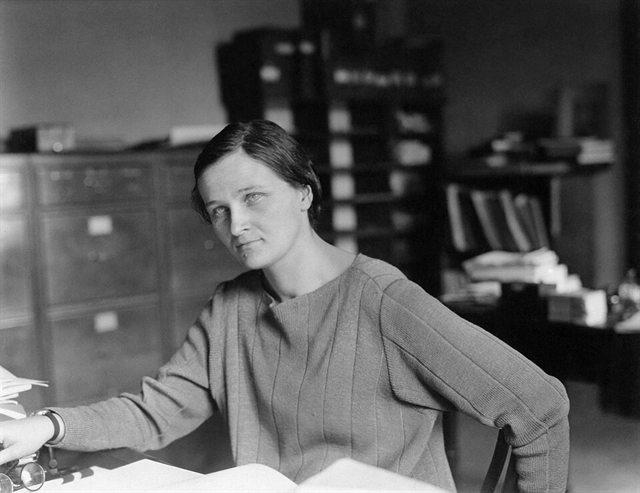
Who Read What The Stars Are Made Of · Astronomer · 1900–1979
Who read from the spectra of stars that the great classification sequence is a sequence of TEMPERATURE and that the universe is overwhelmingly hydrogen — and then, told by the leading authority that it was impossible, wrote in her own thesis that it was almost certainly not real.
Defend these ideas against Payne
Incandio is a free revision platform for the Pearson Edexcel International GCSE, and on it a topic counts as mastered only once you have learned it, proved it in questions, taught it back and defended it against the person with the strongest claim on it. Cecilia Payne is that person for one topic on the course:
- Star Colour and Temperature — Physics
Who was Payne?
Cecilia Payne was born in Buckinghamshire in 1900 and studied at Cambridge, which taught her but would not award a woman a degree; she heard Eddington lecture on the 1919 eclipse and changed subjects on the spot. In 1923 she went to the Harvard College Observatory, where Annie Jump Cannon and the other women employed there had classified a quarter of a million stellar spectra into the sequence O B A F G K M without anybody being able to say what the ordering meant. Payne could say. Meghnad Saha's ionisation equation, published in 1920, relates the strength with which an element shows in a spectrum to the temperature and pressure of the gas producing it, because temperature governs how many atoms are ionised and how many sit in the state that absorbs a particular line. Working backwards from line strengths to abundances, Payne showed that the sequence is a temperature sequence: the stars are made of much the same material throughout, and an O star differs from an M star in heat, not in composition. She also found that the material is overwhelmingly hydrogen, with helium second and everything else a rounding error — a result at odds with the accepted view that stars had roughly the Earth's composition. Henry Norris Russell told her it was clearly impossible, and she wrote in her 1925 thesis that the abundances of hydrogen and helium were almost certainly not real. Four years later Russell reached the same conclusion by a different route and the discovery is often credited to him. Otto Struve called her thesis the most brilliant ever written in astronomy. She spent decades in unpaid or unrecognised positions, becoming Harvard's first female full professor in 1956.
Major achievements
- Showed that the stellar spectral sequence is a sequence of surface temperature, not composition
- Determined that stars are overwhelmingly hydrogen, with helium second
- Applied Saha's ionisation theory to stellar atmospheres for the first time at scale
- Wrote what Otto Struve called the most brilliant doctoral thesis in astronomy
- Made extensive studies of variable stars and of the stars of the Magellanic Clouds
Life in brief
- 1900 — Born in Wendover: Buckinghamshire.
- 1919 — Hears Eddington on the eclipse: Changes from botany to physics.
- 1923 — Harvard College Observatory: The plate stacks and Cannon's classification.
- 1925 — Stellar Atmospheres: The thesis: temperature, and hydrogen — retracted in its own pages.
- 1929 — Russell publishes: The same conclusion, by another route.
- 1956 — Full professor at Harvard: The first woman; then the first to chair a department.
- 1979 — Dies at Cambridge, Massachusetts: The hydrogen result long since hers again.
Explore the life of Payne — five chapters
- Taught, But Not Graduated — Cambridge, and a lecture that changed a subject
- A Quarter of a Million Spectra — The women who classified the sky, and the letters nobody could explain
- Saha's Equation — Line strength depends on temperature, not on how much is there
- Almost Certainly Not Real — The retraction inserted into her own thesis
- Listed Under Astronomical Research — Twenty years without a title, and a chair at fifty-six
Read the five-chapter life of Cecilia Payne →
Begin
- Start a conversation with Payne — a dramatised, historically grounded AI portrayal
- Read the Historical Brief
- Explore the life of Payne — five chapters
- Find your course · Meet all 280 figures