Explore Their Life · Pearson Edexcel International GCSE revision on Incandio
Cecilia Payne: A Life in Five Chapters
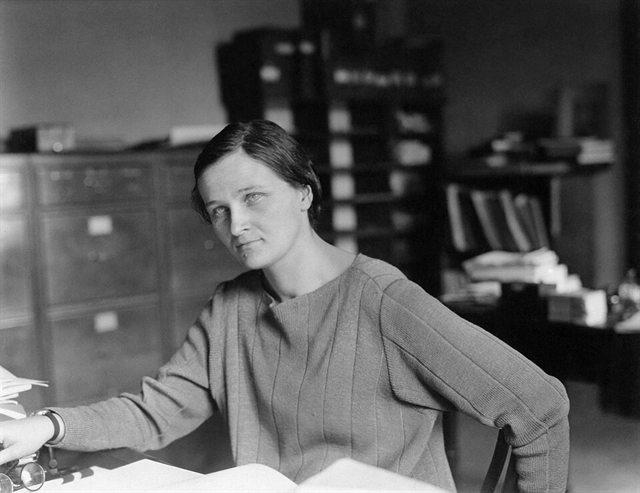
1900–1979
The student Cambridge taught but would not give a degree, who worked out what the stars are made of at twenty-five, was told by the most eminent astronomer in America that it was impossible, and wrote in her own thesis that her result was almost certainly not real.
Payne showed that the stellar spectral sequence is a temperature sequence and that the universe is overwhelmingly hydrogen. Her thesis has been called the most brilliant ever written in astronomy. It also contains a retraction of its central finding, inserted because an eminent man said it could not be right. These five chapters follow both.
The five chapters
- Taught, But Not Graduated — Cambridge, and a lecture that changed a subject
- A Quarter of a Million Spectra — The women who classified the sky, and the letters nobody could explain
- Saha's Equation — Line strength depends on temperature, not on how much is there
- Almost Certainly Not Real — The retraction inserted into her own thesis
- Listed Under Astronomical Research — Twenty years without a title, and a chair at fifty-six
Chapter 1 · Taught, But Not Graduated
Cambridge, and a lecture that changed a subject
1900 – 1923 · Wendover · London · Cambridge
Cecilia Helena Payne was born at Wendover in Buckinghamshire in May 1900. Her father, a barrister and musician, died when she was four, leaving her mother to raise three children.
She was, by her own account, obsessed with science from childhood. At her school in London the science teaching was poor; she taught herself from books in a small laboratory the school kept as a store cupboard.
She won a scholarship to *Newnham College, Cambridge*, in 1919, and began in *botany*.
In December 1919 *Arthur Eddington* gave a lecture in Cambridge on the *eclipse expedition* to Príncipe and the confirmation of Einstein's general relativity.
Payne attended. She wrote afterwards that the result was a complete transformation of her world picture, and that she could reproduce the lecture almost verbatim on returning to her room, and that she did not sleep for three nights.
She changed to *physics* immediately, and went to Eddington to ask about astronomy. He gave her problems and access to the observatory library.
She completed her studies in 1923 — and *Cambridge did not award degrees to women*. It did not do so until *1948*. So she had completed the course, passed the examinations, and was not a graduate.
Her prospects in Britain were teaching in a girls' school.
*Harlow Shapley*, newly director of the *Harvard College Observatory*, had established a graduate programme in astronomy and, unusually, was willing to take women. Payne applied for a fellowship, got it, and sailed for Massachusetts in 1923.
She said later that Eddington had told her he could see no insuperable objection to a woman becoming an astronomer.
“The reward of the young scientist is the emotional thrill of being the first person in the history of the world to see something or to understand something.”
— Cecilia Payne-Gaposchkin, in her autobiographical writing
Why this matters
Payne completed the Cambridge course and passed the examinations in 1923, and the university did not award degrees to women until 1948.
You have the lecture, the missing degree and the crossing. What would you ask?
Ask Payne
- “What did Eddington's lecture do to you?”
- “What did it mean to finish Cambridge without a degree?”
- “What were your options in Britain?”
- “How did you learn science with poor teaching?”
- “Why was Harvard willing when Cambridge was not?”
Chapter 2 · A Quarter of a Million Spectra
The women who classified the sky, and the letters nobody could explain
1886 – 1923 · Harvard College Observatory
The Harvard College Observatory had, since the 1880s, employed a large group of *women* to examine photographic plates. They were called *computers*, they were paid around twenty-five cents an hour — less than a clerical worker — and they did the work.
They included *Williamina Fleming*, originally the director's housemaid; *Antonia Maury*; *Henrietta Swan Leavitt*, who found the Cepheid period–luminosity relation; and *Annie Jump Cannon*, who classified around *a quarter of a million stellar spectra* by hand, at a rate that reportedly reached three stars a minute.
Cannon developed the classification scheme that is still used: the sequence *O B A F G K M*, sorted by the appearance of the absorption lines.
The letters are in that peculiar order because the scheme was originally alphabetical, by the strength of hydrogen lines, and was then *rearranged* into a physically meaningful order with some classes dropped — leaving a sequence whose ordering nobody could justify.
And there is the problem.
The classification *worked*. Stars sorted into it consistently, and their other properties correlated with their class.
Nobody could say *what the sequence meant*.
The leading interpretation was that it reflected differences in *chemical composition*: an A star showing strong hydrogen lines contains more hydrogen; a K star showing strong metal lines contains more metal. On that view the classes are different *kinds* of star made of different stuff.
And there was a strong prior expectation, held by essentially everybody including Henry Norris Russell, that the stars have roughly the *same composition as the Earth* — mostly iron, silicon, oxygen, magnesium.
Payne arrived at Harvard in 1923 into an observatory holding the largest collection of stellar spectra in the world, classified by a scheme nobody could interpret.
Why this matters
Harvard employed women at twenty-five cents an hour to classify a quarter of a million spectra into a sequence nobody could explain.
You have the plate stacks and the unexplained letters. What is your question?
Ask Payne
- “Who actually did the classification?”
- “Why are the letters in that strange order?”
- “What did people think the sequence meant?”
- “Why did everyone assume stars were like the Earth?”
- “What were the working conditions for the computers?”
Chapter 3 · Saha's Equation
Line strength depends on temperature, not on how much is there
1920 – 1925 · Harvard · Calcutta
The key that unlocked it came from India.
In 1920 *Meghnad Saha* published the *ionisation equation*, which relates the degree of ionisation of a gas to its temperature and pressure.
The insight underneath is this. An atom absorbs light at a particular wavelength only when it is in a particular *state* — a particular arrangement of its electrons. Heat the gas and the atoms become *ionised*: electrons are stripped away, and an ionised atom has entirely different absorption lines from a neutral one.
So the strength of a given spectral line depends on *how many atoms are in the state that produces it*, which depends on *temperature*.
And that is *not* the same as how many atoms of the element are present.
Hydrogen lines are a perfect illustration. Hydrogen produces its familiar visible lines only from a particular excited state. In a *cool* star, almost all hydrogen atoms are in the ground state and cannot absorb those lines, so the lines are *weak* even though hydrogen is abundant. In a *very hot* star, hydrogen is largely ionised — stripped of its electron entirely — and cannot absorb them either, so the lines are again *weak*.
The lines are strongest at an *intermediate* temperature, in A stars, where the largest fraction of hydrogen atoms sits in the right state.
So *strong hydrogen lines do not mean lots of hydrogen*. They mean the right temperature.
Payne saw that Saha's equation could be run *backwards*. Measure a line's strength, know the temperature from the rest of the spectrum, and calculate how many atoms of the element must be present to produce that line at that temperature.
That converts a line strength into an *abundance*.
She did it, for a large number of elements, across the spectral sequence.
Why this matters
Strong hydrogen lines mean the right temperature, not lots of hydrogen — which is why the spectral sequence had been misread as a sequence of composition.
You have Saha's equation run backwards. What would you ask?
Ask Payne
- “Why does a strong line not mean a lot of the element?”
- “Why are hydrogen lines strongest in A stars?”
- “How do you turn a line strength into an abundance?”
- “What did Saha's equation actually say?”
- “How much calculation did this involve in 1924?”
Chapter 4 · Almost Certainly Not Real
The retraction inserted into her own thesis
1925 · Harvard · Princeton
Payne got two results.
The *first*: the spectral sequence O B A F G K M is a sequence of *surface temperature*, and the stars are made of much the same material throughout. An O star and an M star differ in *heat*, not in *composition*.
That alone would have made the thesis important. It explained the classification that a quarter of a million spectra had been sorted into.
The *second* result was much stranger.
Working out the abundances, she found that *hydrogen* and *helium* are present in stellar atmospheres in quantities *vastly* greater than anything else. Hydrogen is about a million times more abundant than the metals. Helium is second. Everything else — iron, silicon, oxygen, carbon, calcium — is a *rounding error*.
The universe is essentially made of *hydrogen*.
That contradicted the settled view that stars have roughly the Earth's composition, and it contradicted it by a factor of about a million.
Her thesis was sent to *Henry Norris Russell* at Princeton — the most eminent astronomer in America, effectively the arbiter of the field.
Russell replied that the hydrogen and helium result was *clearly impossible*.
And Payne, twenty-five years old, a woman, foreign, without a permanent position, and dependent on the goodwill of the profession, *put a retraction into her own thesis*. She wrote that the abundances deduced for hydrogen and helium were *almost certainly not real*.
The thesis was published in 1925 as *Stellar Atmospheres*. *Otto Struve* later called it the most brilliant doctoral thesis ever written in astronomy.
In *1929*, Russell reached the same conclusion by a completely different route — from the solar spectrum — and published it. He cited Payne's work.
The discovery has, nonetheless, often been credited to Russell.
Why this matters
Payne inserted a retraction of her own correct result into her own thesis because an eminent man told her it was impossible, and it is the standard example of what deference costs.
You have the result and the sentence disowning it. What would you ask?
Ask Payne
- “What exactly did you find about hydrogen?”
- “Why did you write that it was almost certainly not real?”
- “What could you have done instead?”
- “Was Russell's objection reasonable?”
- “Who should be credited with the discovery?”
Chapter 5 · Listed Under Astronomical Research
Twenty years without a title, and a chair at fifty-six
1925 – 1979 · Harvard · Cambridge, Massachusetts
Payne's career after the thesis is a study in institutional obstruction.
She stayed at Harvard and did an enormous amount of work: studies of stars of high luminosity, of *variable stars* — she and her husband made over *a million* magnitude estimates by eye from photographic plates — and of the stars of the *Magellanic Clouds*.
And for about *twenty years* she held *no formal position*. She was a technical assistant to Shapley. She was paid very little. Courses she taught were *not listed in the Harvard catalogue*, because Harvard would not credit a course taught by a woman; her work appeared in the reports under the heading *astronomical research*.
She was not permitted to be a professor. She could not supervise doctoral students formally, though she did so in practice.
In 1934 she married *Sergei Gaposchkin*, a Russian astronomer who was stateless and stranded in Germany after the Nazis came to power. She had met him on a European trip, and she worked through the American authorities to obtain him a visa. It saved his life. They collaborated for the rest of their careers and had three children.
In *1956* — thirty-one years after the thesis — she was made a *full professor* at Harvard. She was the *first woman* to hold one, and shortly afterwards the *first woman to chair a department* there.
She was fifty-six.
She was awarded the Henry Norris Russell Prize by the American Astronomical Society in 1976.
She died at Cambridge, Massachusetts, in December 1979, aged seventy-nine.
That the universe is mostly hydrogen is now the first fact of astrophysics. It is why stars work — hydrogen fusion is the energy source of every main-sequence star. It is why the Big Bang model predicts what it does. It is the starting point of every account of how the elements were made.
And her retraction is the standard example of what *deference to eminence* costs — a young scientist with the right answer disowning it because an older one said it was impossible.
Why this matters
Payne's courses were not listed in the Harvard catalogue because Harvard would not credit a course taught by a woman, and she held no formal title for twenty years.
You have the unlisted courses and the chair at fifty-six. What would you ask?
Ask Payne
- “What did twenty years without a title mean day to day?”
- “How did you get Sergei out of Germany?”
- “Why does it matter that the universe is mostly hydrogen?”
- “What would you tell a student told they are wrong by an authority?”
- “A million magnitude estimates — how do you do that?”
What Payne changed
That the universe is mostly hydrogen is the first fact of modern astrophysics, and it is Payne's. Her demonstration that the spectral sequence is a temperature sequence explained a classification of a quarter of a million spectra that nobody could interpret. Her thesis is routinely described as the most brilliant in the subject, and her retraction is the standard cautionary example of what deference to eminence costs.
A debate that continues
Henry Norris Russell told Payne the hydrogen result was impossible, she retracted it in her own thesis, and he published the same conclusion four years later by a different route — after which the discovery was often credited to him.
Keep exploring — ask Payne
- “When should a young scientist stand their ground?”
- “What else in the plate stacks was never explained?”
- “Whose names should be on the classification scheme?”
Related lives
- Arthur Eddington — Who Told Them To Find A Hotter Place
- Ejnar Hertzsprung — Who Found Giants Among The Dwarfs
- Edwin Hubble — Who Made the Universe Much Larger
- Rosalind Franklin — The Dark Lady of DNA
Related themes
Stellar spectra and composition · Ionisation and temperature · Recognition in science
Continue on Incandio
- Talk to Payne — every question on this page is one tap from being asked, and the same page carries the Historical Brief, the achievements and the timeline
- All 280 figures · Incandio — learn every idea, teach it, then defend it