Explore Their Life · Pearson Edexcel International GCSE revision on Incandio
Christina Rossetti: A Life in Five Chapters
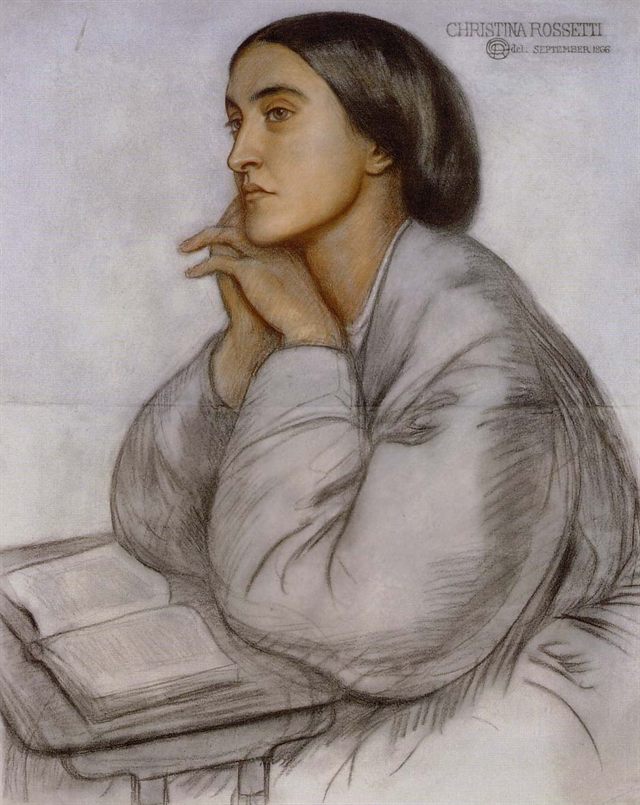
1830–1894
A poet who refused two men she cared for on grounds of belief, spent a decade working with women nobody else would employ, and wrote a sonnet that spends eight lines asking to be remembered and six taking it back.
Rossetti grew up in a house where everyone wrote, was painted by her brother's circle before she was read, and made renunciation into a subject with a genuine argument inside it. Illness ended her public life at forty. These five chapters follow the faith, the refusals, and the turn in the middle of a sonnet.
The five chapters
- A House Where Everybody Wrote — An Italian exile's daughter in Bloomsbury
- The Turn — A sonnet written at nineteen that reverses itself
- Two Refusals — What her belief actually cost her
- Goblin Market and the Highgate Penitentiary — A famous poem, and ten years of work nobody talks about
- Illness, and a Reputation That Kept Rising — Forty years out of sight, and a standing above her brother's
Chapter 1 · A House Where Everybody Wrote
An Italian exile's daughter in Bloomsbury
1830 – 1848 · London · Bloomsbury
Christina Georgina Rossetti was born in London in December 1830, the youngest of four. Her father Gabriele Rossetti was an Italian poet and political exile, a Dante scholar who had fled Naples under sentence of death. Her mother Frances Polidori was half-English and half-Italian; her uncle John Polidori had been Byron's physician and wrote *The Vampyre*.
All four children wrote. Dante Gabriel became the painter and poet at the centre of the Pre-Raphaelite Brotherhood. William Michael became the Brotherhood's secretary and, in time, his sister's editor and biographer. Maria wrote on Dante and eventually took vows as an Anglican nun.
Christina wrote from childhood; her grandfather printed a small volume of her verses on his private press when she was seventeen. The household was cultivated and, after her father's health and eyesight failed in the 1840s, poor. Her mother and sister took in pupils. Christina helped teach, and was not good at it.
In her teens she suffered a severe breakdown — the nature of it is not established, and Victorian reticence has left the record thin. She emerged from it intensely religious, in the High Anglican tradition of the Oxford Movement. That faith governed everything afterwards, and it cost her things she wanted.
Why this matters
Rossetti's High Anglicanism was not decorative piety but the operating principle of her life, and it determined choices that made her unhappy.
You have the writing household and the faith that came out of it. What would you ask?
Ask Rossetti
- “What was it like growing up in a house where everyone wrote?”
- “What did your father's exile mean for the household?”
- “How did your faith take the shape it did?”
- “Were you a good teacher?”
- “Did being the youngest of four writers help or crowd you?”
Chapter 2 · The Turn
A sonnet written at nineteen that reverses itself
1849 · London
*Remember* was written in 1849, when Rossetti was nineteen. It is a Petrarchan sonnet: an octave of eight lines rhyming abbaabba, then a sestet of six, with the hinge between them.
The octave asks. It asks insistently, and the word *remember* returns four times in eight lines: remember me when I am gone away, when you can no more hold me by the hand, when it is too late to counsel or to pray. It is a young woman's demand not to be forgotten, and it is entirely self-interested, and it is completely convincing.
Then line nine turns. *Yet if you should forget me for a while* — and the sestet spends its six lines dismantling everything the octave built, until it arrives at a conclusion the opening would have found unbearable: better that he should forget and smile than that he should remember and be sad.
The poem is set on syllabuses everywhere because a student can watch an argument reverse inside fourteen lines and put a finger on exactly where. It is not a change of subject. It is the same speaker, thinking harder, and deciding that what she wants matters less than what it would cost him.
That is Rossetti's real subject, arrived at at nineteen: renunciation as an argued position, not a pose — and one that admits the loss rather than pretending it is painless.
“Better by far you should forget and smile than that you should remember and be sad.”
— Christina Rossetti, 'Remember' (1849), closing lines
Why this matters
Remember is the clearest teaching example in English of the sonnet's volta — an argument that visibly reverses at a locatable line.
You have fourteen lines that change their own mind. What would you ask her?
Ask Rossetti
- “Where exactly does Remember turn, and why there?”
- “Why take back what the first eight lines worked so hard to ask for?”
- “Is the ending generous or is it a defeat?”
- “Why write about your own death at nineteen?”
- “Why does a strict form suit an argument better than a loose one?”
Chapter 3 · Two Refusals
What her belief actually cost her
1848 – 1866 · London
Rossetti was engaged to the painter James Collinson, a member of the Pre-Raphaelite Brotherhood, around 1848. He had converted from Roman Catholicism to Anglicanism to make the match acceptable. In 1850 he returned to Rome. She broke the engagement.
Years later she was courted by Charles Cayley, a shy, unworldly translator of Dante, Homer and Petrarch, and by every indication she loved him. She refused him in 1866 because he was not a Christian believer. They remained close friends for the rest of his life; he left her his writing desk, and she kept his memory in poems for decades.
It is easy to read this as Victorian repression and be finished with it. That reading is too cheap. Rossetti's own position, worked out across her poems, is that renunciation is the choosing of a better thing and that it costs exactly what it appears to cost. She never wrote as though the sacrifice were painless, which is precisely what makes her different from the devotional verse around her. The poems are full of appetite — for love, for beauty, for the world — held down deliberately by somebody who wanted all of it.
She also had opinions that sit badly now. She was against women's suffrage, on grounds drawn from her reading of scripture, while being ferociously clear about the exploitation of women in other respects. Both are hers.
Why this matters
Rossetti's renunciations are the argument of her poetry made into biography: she refused things she wanted and never pretended the refusal was free.
You have the two men she turned down. What would you put to her?
Ask Rossetti
- “Why refuse Charles Cayley when you loved him?”
- “Is renunciation a loss or a choice?”
- “Did you ever think you had been wrong to refuse?”
- “How could you oppose the vote and still write as you did about women?”
- “Why is there so much appetite in poems about giving things up?”
Chapter 4 · Goblin Market and the Highgate Penitentiary
A famous poem, and ten years of work nobody talks about
1859 – 1870 · Highgate · London
From about 1859 Rossetti worked as a volunteer at the St Mary Magdalene Penitentiary at Highgate, an Anglican institution for what the period called fallen women — former prostitutes, and women who had had children outside marriage. She went for over a decade. She was not a visiting lady patron; she lived on the premises for periods and worked.
*Goblin Market* was published in 1862 and made her reputation immediately. Two sisters, Laura and Lizzie; goblin men selling fruit; Laura buys with a lock of her golden hair, tastes, and begins to waste away; Lizzie goes to the goblins, refuses to eat, is assaulted as they try to force the fruit against her mouth, and comes home covered in juice for her sister to lick from her face. Laura is saved. The last line is that there is no friend like a sister.
What it is about has been argued for a hundred and sixty years: a children's fairy tale, a poem about temptation and redemption, about the Eucharist, about addiction, about sexual exploitation and rescue, about desire between the sisters. Rossetti said it was for children. Almost nobody believes she meant only that.
The Highgate years are the useful context. She spent a decade with women who had been ruined by exactly the transaction the poem allegorises, and who were being redeemed by an institution that also judged them.
Why this matters
Goblin Market is unusually resistant to a single reading, and the ten years Rossetti spent at Highgate are the biographical fact most often left out of the argument.
You have the goblins and the penitentiary. What would you ask?
Ask Rossetti
- “What did you see at Highgate?”
- “Did you really write Goblin Market for children?”
- “Is Lizzie's rescue a religious act or a sisterly one?”
- “Why is the ending about sisters rather than about God?”
- “Should a poet mind that nobody can agree what her poem means?”
Chapter 5 · Illness, and a Reputation That Kept Rising
Forty years out of sight, and a standing above her brother's
1871 – 1894 and after · London · Torrington Square
In 1871 Rossetti contracted Graves' disease, a thyroid disorder that in her case altered her appearance markedly, caused exhaustion and eye trouble, and effectively ended her social life. She was forty. She nursed her mother, then her aunts, and lived quietly in Torrington Square.
She kept writing. Much of the later work is devotional — *Called to be Saints*, *Time Flies*, *The Face of the Deep*, a long commentary on Revelation — and this is the part of her output least read now, though it is a third of it. *In the Bleak Midwinter* was written as a poem in the early 1870s and became a carol after her death when Gustav Holst set it.
After Tennyson died in 1892 she was mentioned seriously as a candidate for the Laureateship. She was diagnosed with breast cancer in the same year, had an operation, and died on 29 December 1894, aged sixty-four.
Her brother William Michael edited the poems and wrote the memoir that shaped how she was read for decades — as a saintly recluse, which suited him and flattened her.
Her reputation now sits above Dante Gabriel's. She was for a long time seen chiefly as the face in Pre-Raphaelite paintings, having modelled for her brother as a girl; she spent the rest of her life being looked at as one thing while writing another.
Why this matters
Rossetti was framed for a century by an affectionate brother's memoir as a saintly recluse, and recovering the arguing, appetitive poet took most of the twentieth century.
You have the illness, the memoir and the reputation that outgrew both. What is your question?
Ask Rossetti
- “What was it like to be painted rather than read?”
- “Did your brother's memoir do you a service or a disservice?”
- “Why should anyone read the devotional prose?”
- “What did the illness take from you?”
- “Would you have taken the Laureateship?”
What Rossetti changed
Rossetti made renunciation into a subject with a real argument inside it, and Remember is taught everywhere because a student can watch fourteen lines change their own mind and locate the exact hinge. Goblin Market is still being argued over more than a century and a half after publication, and In the Bleak Midwinter is sung every December by people who could not name the poet. Her standing now sits above her brother's.
A debate that continues
What Goblin Market is actually about remains genuinely unsettled, and critics continue to argue over how far her brother's memoir distorted her, and how to hold her opposition to women's suffrage alongside the rest of her work.
Keep exploring — ask Rossetti
- “Which of your poems has been most misread?”
- “Can a poem argue with the belief that produced it?”
- “What would you have written with a different faith?”
Related lives
- Robert Browning — Who Let The Speaker Convict Himself
- John Keats — Who Could Stay In The Uncertainty
- George Eliot — Author of Middlemarch
- Emmeline Pankhurst — Deeds, Not Words
Related themes
The sonnet and the volta · Victorian faith and doubt · Women writers and reputation
Continue on Incandio
- Talk to Rossetti — every question on this page is one tap from being asked, and the same page carries the Historical Brief, the achievements and the timeline
- All 280 figures · Incandio — learn every idea, teach it, then defend it