Explore Their Life · Pearson Edexcel International GCSE revision on Incandio
Emmeline Pankhurst: A Life in Five Chapters
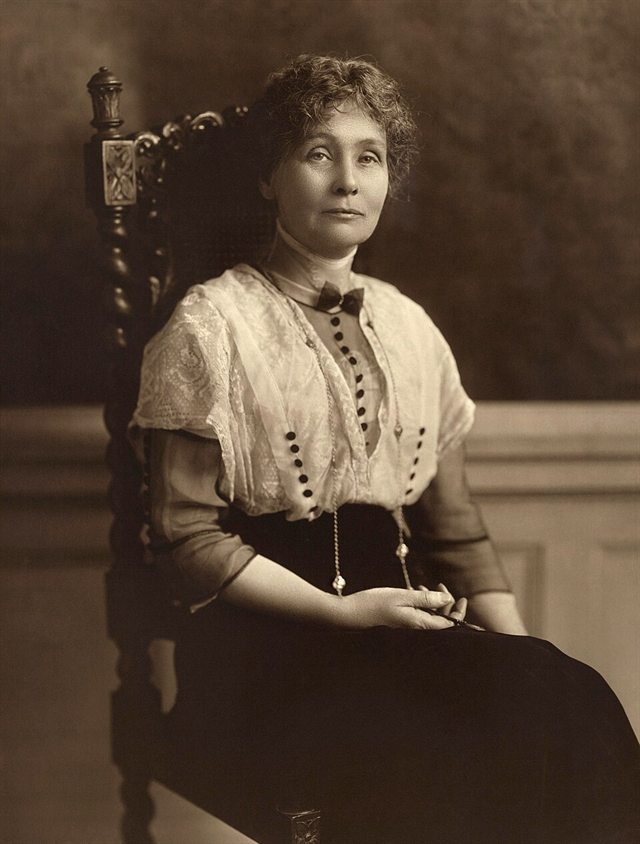
1858–1928
The woman who decided that forty years of polite petitioning had failed, and led a campaign of window-smashing, arson and hunger strikes to force votes for women.
Pankhurst turned the suffrage campaign from a respectable lobbying effort into a confrontation the government could not ignore. She was imprisoned repeatedly, force-fed, and expelled two of her own daughters from the organisation she founded. Whether her militancy advanced the cause or delayed it is still argued. These five chapters set out what she did and why.
The five chapters
- A Radical Household — Manchester politics and a marriage of equals
- Deeds Not Words — Founding the WSPU, and the first arrests
- Hunger Strikes and the Cat and Mouse Act — The body as the last available weapon
- The War, and the Daughters She Expelled — Sylvia, Adela and a movement divided
- Weeks Short of Equality — A conservative turn and a statue by Parliament
Chapter 1 · A Radical Household
Manchester politics and a marriage of equals
1858 – 1898 · Manchester · Paris · London
Emmeline Goulden was born in Manchester in July 1858 into a politically active middle-class family; her parents were abolitionists and campaigners, and her mother took her to a women's suffrage meeting when she was about fourteen. She said she was already a suffragist before she fully understood the word. She noted her birthday as 14 July, Bastille Day, though the baptismal record gives the fifteenth — a small preference that says something about how she saw herself.
She was sent to school in Paris, where she acquired a lifelong sense of style and the conviction that Englishwomen were treated as decorative dependants.
In 1879 she married Richard Pankhurst, a radical barrister twenty-four years older, who had drafted the Married Women's Property Acts allowing wives to own property in their own right. It was a genuine partnership of politics as well as marriage. They had five children, two of whom died young.
Richard died suddenly in 1898, leaving debts. Emmeline, now a widow supporting four children, took paid work as a registrar of births and deaths in a working-class district of Manchester and served as a Poor Law Guardian. Both jobs showed her things the suffrage societies rarely discussed: workhouse conditions, and girls of thirteen and fourteen registering births of children fathered by relatives, with the law offering them almost nothing.
She concluded that women's powerlessness in law was not an abstraction, and that the vote was the instrument that would change it.
Why this matters
Pankhurst's radicalism came from administrative work among the poor, not from theory: what she saw as a registrar and Poor Law Guardian is why she found gradualism intolerable.
You have the making of a militant. What would you ask her?
Ask Emmeline
- “What did you see as a Poor Law Guardian that changed you?”
- “What did your marriage to Richard give you politically?”
- “Why did you prefer to say you were born on Bastille Day?”
- “What did registering births teach you about the law?”
- “How did widowhood change your position?”
Chapter 2 · Deeds Not Words
Founding the WSPU, and the first arrests
1903 – 1910 · Manchester · London
On 10 October 1903, in her front room at 62 Nelson Street, Manchester, Pankhurst founded the Women's Social and Political Union. It was women-only, and its motto was Deeds Not Words. Suffrage societies had been petitioning politely since the 1860s; bills had been introduced and talked out for forty years.
The new tactic arrived in October 1905, when her daughter Christabel and the mill worker Annie Kenney interrupted a Liberal meeting at Manchester's Free Trade Hall to ask whether the party would give women the vote. They were ejected; Christabel deliberately spat at a policeman to ensure arrest. They chose prison over paying a fine. The press covered it, and the WSPU had discovered that disruption produced attention petitions never had.
The campaign escalated in stages: mass demonstrations, including a Hyde Park rally in 1908 estimated at a quarter of a million people, chaining to railings, deputations to Parliament, and by 1912 organised smashing of shop windows in the West End with hammers carried in muffs.
On Black Friday in November 1910, women attempting to reach Parliament were assaulted by police and bystanders for six hours, with numerous reports of sexual assault. Two women died later of injuries. Pankhurst's conclusion was that the state's violence against women was tolerated and that women's damage to property would at least be noticed.
Her own leadership became increasingly autocratic. In 1907 members who wanted a democratic constitution were pushed out and formed the Women's Freedom League.
“Deeds, not words.”
— Motto of the Women's Social and Political Union, adopted 1903
Why this matters
The WSPU's discovery that disruption generated coverage that petitions never did is a foundational lesson in how media attention shapes political campaigning.
You have militancy being invented. What would you ask her?
Ask Emmeline
- “Why did forty years of petitioning achieve nothing?”
- “What did the Free Trade Hall interruption prove?”
- “What happened on Black Friday in 1910?”
- “Why did you run the WSPU without a democratic constitution?”
- “Why choose prison rather than pay a fine?”
Chapter 3 · Hunger Strikes and the Cat and Mouse Act
The body as the last available weapon
1909 – 1914 · Holloway Prison · London
In 1909 the sculptor Marion Wallace Dunlop, imprisoned for stencilling a extract from the Bill of Rights on the wall of St Stephen's Hall, refused food. She was released after ninety-one hours. The tactic spread instantly.
The government's response was force-feeding. A tube was forced through the nose or mouth into the stomach while the prisoner was held down, often by several wardresses. Doctors described broken teeth, torn tissue, pneumonia from liquid entering the lungs, and lasting damage. Prison medical officers resigned over it; the *British Medical Journal* published objections. Around a thousand women were imprisoned during the campaign, and hundreds were force-fed.
In 1913 the government passed the Prisoners (Temporary Discharge for Ill-Health) Act, immediately nicknamed the Cat and Mouse Act. Hunger strikers were released when dangerously weak and re-arrested once they had recovered, so that no one died in custody and no sentence was ever served. Pankhurst was released and re-arrested repeatedly under it; by 1913 she had been imprisoned many times and her health was seriously damaged.
Militancy escalated further into arson and bombing of empty buildings, with instructions to avoid loss of life. Lloyd George's partly built house was bombed in February 1913; Pankhurst publicly accepted responsibility and was sentenced to three years.
On 4 June 1913 Emily Wilding Davison stepped in front of the King's horse at the Derby and died four days later. She was carrying a return train ticket and had made no arrangements suggesting suicide; most historians now believe she intended to attach a suffragette flag to the horse. Her funeral filled London's streets.
Why this matters
Force-feeding and the Cat and Mouse Act show a government finding ways to defeat a protest tactic without conceding anything — an escalation that made the confrontation impossible to ignore.
This is the campaign at its most brutal. What would you ask her?
Ask Emmeline
- “Why did hunger striking become the central tactic?”
- “What was force-feeding actually like?”
- “How did the Cat and Mouse Act work?”
- “How do you justify arson and bombing?”
- “What do you think Emily Davison intended at the Derby?”
Chapter 4 · The War, and the Daughters She Expelled
Sylvia, Adela and a movement divided
1914 – 1918 · London · East London · Australia
The WSPU's internal politics were as fierce as its external campaign. Sylvia Pankhurst had built the East London Federation of Suffragettes among working-class women in Bow, worked with the labour movement, and believed the vote had to come with wider social change. In 1914 Emmeline and Christabel expelled her and her organisation for refusing to accept central control and for allying with socialists. Adela, who also disagreed, was given a ticket to Australia and effectively sent away; she and her mother never met again.
When war broke out in August 1914, Emmeline and Christabel suspended militancy immediately, negotiated the release of imprisoned suffragettes, and turned the WSPU into a recruitment organisation, renaming its paper *Britannia* and campaigning for women to enter munitions work and for men to enlist. The movement's members were bitterly divided; Sylvia opposed the war throughout and ran a milk centre and clinic in the East End instead.
The Representation of the People Act of February 1918 gave the vote to women over thirty who met a property qualification — around 8.4 million women, and deliberately not the young working-class women who had worked in munitions, since politicians feared a female majority in the electorate.
Historians disagree sharply about what produced it. Some argue militancy made the question unavoidable; others that it hardened opposition and that the constitutional suffragists of Millicent Fawcett's NUWSS, far larger and steadily persuasive, plus women's war work, did the decisive work. The honest answer is that the two wings operated together, and no experiment can separate them.
Why this matters
The 1918 Act's age and property limits show what actually happened: an establishment conceding the principle while carefully controlling who benefited from it.
You have the split and the partial victory. What would you ask her?
Ask Emmeline
- “Why did you expel your own daughter Sylvia?”
- “Why suspend the campaign the moment war broke out?”
- “Why did the 1918 Act exclude women under thirty?”
- “Did militancy help or hinder the cause?”
- “What did the constitutional suffragists contribute?”
Chapter 5 · Weeks Short of Equality
A conservative turn and a statue by Parliament
1918 – 1928 and after · London · Canada · Whitechapel
Pankhurst's later politics surprised many supporters. She lectured in North America against Bolshevism, spent time in Canada campaigning on social hygiene, and on returning to Britain joined the Conservative Party, standing as its prospective candidate for Whitechapel and St George's — a poor East End constituency — on the grounds that the Conservatives were now the party most likely to deliver full equality and to resist communism. Sylvia, by then a communist and an anti-fascist campaigner, found the choice incomprehensible, and the two remained estranged.
Her health, wrecked by repeated imprisonment and hunger strikes, failed. She died on 14 June 1928, aged sixty-nine.
On 2 July 1928, eighteen days later, the Equal Franchise Act gave women the vote on the same terms as men, at twenty-one. She did not live to see it.
A statue of her was unveiled beside the Houses of Parliament in 1930, and the unveiling was attended by former suffragettes and by Stanley Baldwin, a Conservative prime minister — a striking scene given that fifteen years earlier the state had been force-feeding her.
Her reputation continues to move. Feminist historians from the 1970s recovered the campaign in detail; more recent work has emphasised the working-class suffragettes and the East London movement that Sylvia built, and has questioned Emmeline's autocratic control. What is not in dispute is that she made a question the political establishment had shelved for forty years into one it could no longer avoid answering.
Why this matters
Pankhurst's life poses a question every protest movement faces: whether disruptive action wins concessions faster than patient persuasion, or provokes a backlash that delays them.
You have the ending and the argument. What would you ask her?
Ask Emmeline
- “Why did you join the Conservative Party?”
- “Did you and Sylvia ever reconcile?”
- “What did prison and hunger strikes cost your health?”
- “What would you say to campaigners deciding whether to break the law?”
- “Which of the women who worked with you deserve more credit?”
What Emmeline changed
Pankhurst's campaign made women's suffrage the most visible political question in Edwardian Britain and contributed to the Representation of the People Act of 1918 and the Equal Franchise Act of 1928. The WSPU's tactics — mass publicity, courting arrest, hunger striking — were studied and adapted by protest movements throughout the twentieth century.
A debate that continues
Historians remain divided over whether WSPU militancy accelerated the vote or hardened parliamentary resistance, and over Pankhurst's autocratic control of the organisation and her expulsion of her own daughters.
Keep exploring — ask Emmeline
- “How did you decide how far the campaign should escalate?”
- “What did working-class suffragettes bring that the leadership overlooked?”
- “Would you have won the vote sooner by other means?”
Related lives
- Mary Wollstonecraft — Founder of Modern Feminism
- Susan B. Anthony — Champion of the Ballot
- Margaret Thatcher — The Iron Lady · Prime Minister
Related themes
Women's suffrage · Protest and civil disobedience · Edwardian Britain
Continue on Incandio
- Talk to Emmeline — every question on this page is one tap from being asked, and the same page carries the Historical Brief, the achievements and the timeline
- All 280 figures · Incandio — learn every idea, teach it, then defend it