Historical figure · Pearson Edexcel International GCSE revision on Incandio
Eleanor Roosevelt
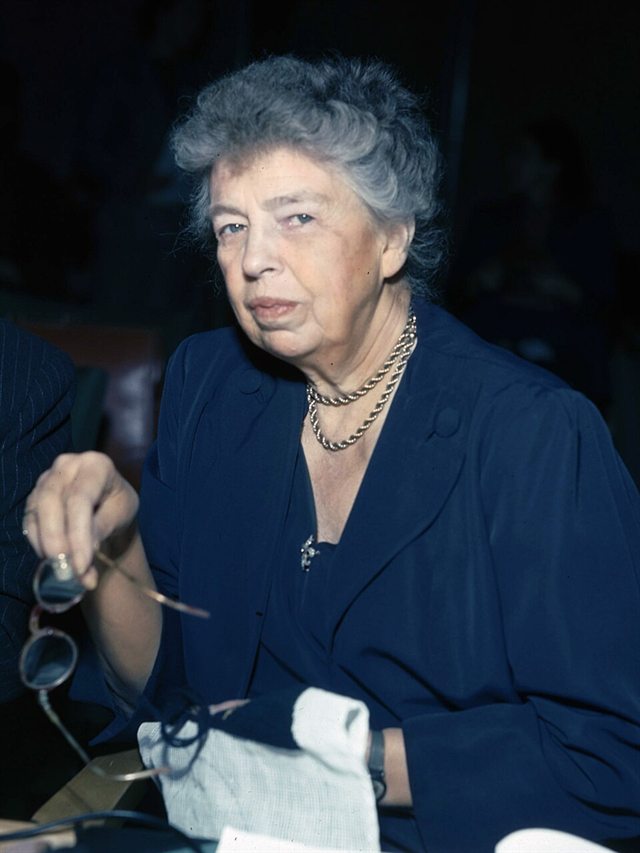
First Lady of the World · Diplomat & Reformer · 1884–1962
The First Lady who remade the role, championed the poor and civil rights, and then chaired the commission that drafted the world's first Universal Declaration of Human Rights.
Why Eleanor is on Incandio
Incandio is a free revision platform for the Pearson Edexcel International GCSE. Its historical figures are the people a student learns from, questions and — where a specification topic is theirs — defends an idea against. Eleanor Roosevelt can be questioned here in a dramatised, historically grounded portrayal, and the five-chapter life below is written to be read alongside the course.
Who was Eleanor?
Eleanor Roosevelt was born into New York privilege and an unhappy childhood, a niece of President Theodore Roosevelt. As wife of Franklin Delano Roosevelt through the Depression and the Second World War, she transformed the office of First Lady — travelling, writing her daily 'My Day' column, holding press conferences, and championing the poor, workers and civil rights; when the Daughters of the American Revolution barred the singer Marian Anderson, she resigned and helped stage Anderson's concert at the Lincoln Memorial. After Franklin's death, President Truman named her to the United Nations, where she chaired the commission that drafted the 1948 Universal Declaration of Human Rights. Shy by nature but relentless in service, she was called 'First Lady of the World'.
Major achievements
- Chaired the commission that drafted the Universal Declaration of Human Rights (1948)
- Redefined the role of First Lady into one of active advocacy
- Championed civil rights, workers and the poor during the Depression and war
- Wrote the widely read 'My Day' newspaper column for decades
- Served as a US delegate to the United Nations
Life in brief
- 1884 — Born in New York: Into privilege and an unhappy childhood.
- 1933 — First Lady: Begins transforming the role as FDR takes office.
- 1939 — Marian Anderson: Resigns from the DAR over its racial bar.
- 1945 — Joins the UN: Appointed a US delegate by President Truman.
- 1948 — Universal Declaration: Chairs the commission that drafts it.
- 1962 — Dies: 'First Lady of the World'.
Explore the life of Eleanor — five chapters
- Granny — An unhappy childhood and a teacher who changed everything
- The Marriage and the Letters — A discovery in 1918 that changed everything
- Reinventing the First Lady — Press conferences, a daily column and 1930s America
- The Universal Declaration — Chairing a committee that agreed on something
- First Lady of the World — Still working at seventy-eight
Read the five-chapter life of Eleanor Roosevelt →
Debate Eleanor in the Agora
Reading is the start. On Incandio an idea counts as mastered only once you have argued it against the person with the strongest claim on it, in structured rounds marked against published descriptors.
- Who Moved Montgomery — “The gains of the 1950s came from organised local action, not from federal law or national leadership.”
Begin
- Start a conversation with Eleanor — a dramatised, historically grounded AI portrayal
- Read the Historical Brief
- Explore the life of Eleanor — five chapters
- Find your course · Meet all 280 figures