Explore Their Life · Pearson Edexcel International GCSE revision on Incandio
Eleanor Roosevelt: A Life in Five Chapters
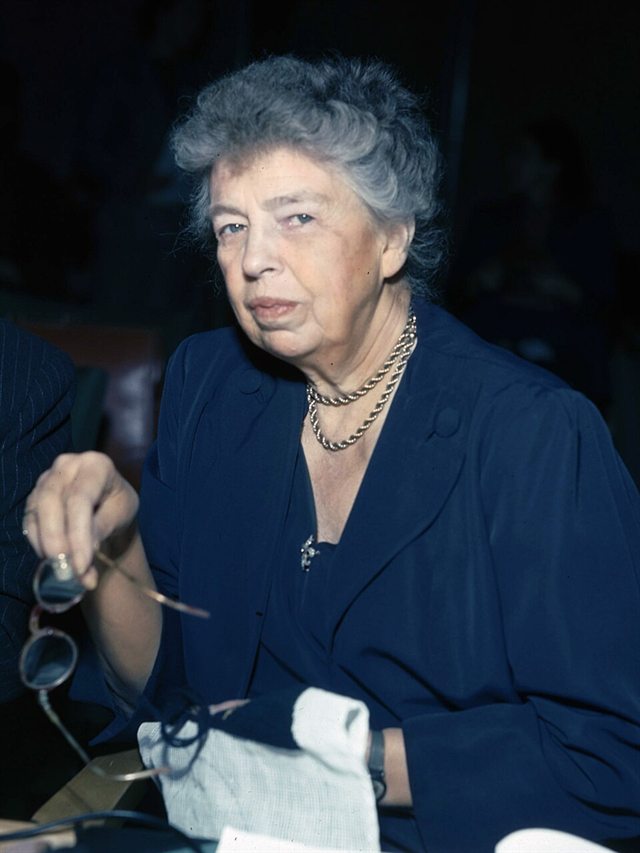
1884–1962
An orphaned, painfully shy girl who reinvented the role of First Lady and then drove the Universal Declaration of Human Rights through the United Nations.
Eleanor Roosevelt held no elected office and became one of the most consequential Americans of the twentieth century. She was also constrained by her husband's political calculations and did not always push as hard as she could have. These five chapters follow how a woman told from childhood that she was plain and awkward became a global political force.
The five chapters
- Granny — An unhappy childhood and a teacher who changed everything
- The Marriage and the Letters — A discovery in 1918 that changed everything
- Reinventing the First Lady — Press conferences, a daily column and 1930s America
- The Universal Declaration — Chairing a committee that agreed on something
- First Lady of the World — Still working at seventy-eight
Chapter 1 · Granny
An unhappy childhood and a teacher who changed everything
1884 – 1902 · New York · Allenswood, England
Eleanor Roosevelt was born in New York on 11 October 1884 into wealth and misery. Her mother Anna was a celebrated beauty who called her solemn, plain daughter Granny in front of guests. Her father Elliott — Theodore Roosevelt's younger brother — adored her and was an alcoholic who was repeatedly sent away for treatment.
Her mother died of diphtheria when she was eight, a brother the following year, and her father in 1894 when she was ten. She was raised by a strict grandmother in a household with little warmth, and grew up convinced she was unattractive and disappointing.
At fifteen she was sent to Allenswood Academy outside London, run by Marie Souvestre, a French educator of formidable independence who taught her students to think for themselves, argue in French, question received opinion and take an interest in politics. Souvestre took Eleanor travelling in Europe and made her responsible for the arrangements.
Eleanor described the three years there as the happiest of her life and Souvestre as one of the greatest influences on her. It was the first time anyone had treated her as capable.
She was brought home at eighteen for her social debut, which she dreaded, and immediately began volunteering at a settlement house on the Lower East Side, teaching dance and exercise to immigrant children and investigating conditions in garment sweatshops for the Consumers' League — her first direct exposure to how most Americans lived.
Why this matters
Marie Souvestre's teaching is the hinge of Eleanor Roosevelt's life: it converted an unhappy, self-doubting girl into someone who expected her own judgement to count.
You have met the girl and the teacher. What would you ask her?
Ask Eleanor
- “What did Marie Souvestre teach you about yourself?”
- “How did losing both parents so young shape you?”
- “What did you find in the sweatshops you investigated?”
- “Why did your mother call you Granny?”
- “What did you dread about your social debut?”
Chapter 2 · The Marriage and the Letters
A discovery in 1918 that changed everything
1905 – 1928 · New York · Washington · Hyde Park
In 1905 she married her fifth cousin once removed, Franklin Delano Roosevelt; her uncle Theodore, then president, gave her away. They had six children, one of whom died in infancy. Franklin's mother Sara controlled the household, the finances and the houses, and Eleanor spent years, by her own account, as an anxious young wife with little say.
In September 1918, unpacking her husband's luggage after he returned ill from Europe, she found love letters from Lucy Mercer, her own social secretary. She offered him a divorce. Sara threatened to cut off his money and Louis Howe warned it would end his political career; Franklin agreed to end the affair, and the marriage continued as a partnership rather than a romance. Eleanor later wrote that she had faced herself, her surroundings and her world honestly for the first time.
What followed was independence. She built her own political life: the Women's Trade Union League, the League of Women Voters, and the women's division of the New York Democratic Party. Louis Howe trained her in speaking — she had a nervous habit of giggling at the wrong moment, which he drilled out of her.
When Franklin was paralysed by polio in 1921, Sara wanted him retired to Hyde Park. Eleanor and Howe insisted he stay in politics, and she became his substitute in public — travelling, speaking and reporting back what she saw.
She also built a circle of close women friends, including the journalist Lorena Hickok, with whom she exchanged thousands of letters; the nature of that relationship is debated by historians and the letters are unusually intimate.
Why this matters
Eleanor Roosevelt's public career began as a response to two crises — her husband's affair and his paralysis — which forced her out of a supporting role she had never chosen.
You have the marriage and the independence that came from it. What would you ask her?
Ask Eleanor
- “What changed for you after 1918?”
- “Why did you insist Franklin stay in politics after polio?”
- “How did Louis Howe train you to speak in public?”
- “What did your mother-in-law's control cost you?”
- “What did your friendships with women give you?”
Chapter 3 · Reinventing the First Lady
Press conferences, a daily column and 1930s America
1933 – 1941 · Washington · Appalachia · the South
When Franklin became president in 1933, Eleanor announced she would not be a hostess. Within a week she held the first press conference ever given by a First Lady — and admitted only women reporters, forcing newspapers that wanted the story to employ women. She held nearly 350 of them.
From 1935 she wrote *My Day*, a syndicated newspaper column, six days a week, for twenty-seven years. She travelled constantly during the Depression, going down coal mines and into migrant camps and tenement districts, and reported directly to a president who could not easily travel. A cartoon of the period showed miners looking up and saying, for gosh sakes, here comes Mrs Roosevelt.
On race she went further than her husband, who depended on southern Democrats in Congress. She lobbied publicly for anti-lynching legislation, which Franklin declined to spend political capital on. In 1939, when the Daughters of the American Revolution refused to let the contralto Marian Anderson sing in their Washington hall because she was Black, Eleanor resigned from the organisation publicly and helped arrange the concert at the Lincoln Memorial, where 75,000 people came. In 1938 in Birmingham, told she could not sit in the Black section of a segregated meeting, she placed her chair in the aisle between the two.
Her record has limits that should be stated. She pressed for admitting Jewish refugees and was largely unsuccessful; the *St Louis* was turned away in 1939. She objected privately to the internment of Japanese Americans in 1942 but did not oppose it publicly at the time, and later said the decision had been wrong.
“No one can make you feel inferior without your consent.”
— Attributed to Eleanor Roosevelt; the phrasing appears in a 1940 Reader's Digest item and is widely quoted, though no exact source in her own writing has been identified
Why this matters
Roosevelt transformed an entirely ceremonial position into an independent political platform — every subsequent First Lady has worked within the space she created.
You have the office she rebuilt. What would you ask her?
Ask Eleanor
- “Why admit only women to your press conferences?”
- “What did you see travelling through Depression America?”
- “Why did the president not back anti-lynching legislation?”
- “Why resign from the DAR over Marian Anderson?”
- “Why did you not publicly oppose Japanese American internment?”
Chapter 4 · The Universal Declaration
Chairing a committee that agreed on something
1945 – 1948 · New York · Paris · Lake Success
Franklin Roosevelt died in April 1945. Eleanor told reporters at the door that the story was over. President Truman then appointed her a delegate to the new United Nations, partly as a gesture; several State Department officials expected her to be decorative.
She was elected chair of the Commission on Human Rights, and spent two years chairing the drafting of the Universal Declaration of Human Rights. The task looked impossible. The Soviet bloc argued that economic and social rights were primary and that the document intruded on sovereignty; Western delegations prioritised civil and political liberties; delegates including Charles Malik of Lebanon, Peng-chun Chang of China and René Cassin of France brought Confucian, Islamic, Thomist and secular traditions to the same table. The final text includes both political freedoms and rights to work, education, health and an adequate standard of living.
Roosevelt's contribution was chairing: she was relentless about time, kept exhausted delegates working, and used her international standing to make walking away costly. She also insisted on plain language, arguing that a declaration nobody could read would protect nobody.
The General Assembly adopted it on 10 December 1948 with no votes against and eight abstentions. Delegates gave her a standing ovation. She called it a common standard of achievement rather than a treaty — it binds no one legally, and its power has come from being quoted by campaigners, courts and constitutions ever since.
Asked where universal human rights begin, she answered that they begin in small places close to home — the neighbourhood, the school, the workplace — because without meaning there, they have little meaning anywhere.
Why this matters
The Universal Declaration is the single most widely translated document in the world and the foundation of modern international human rights law, treaties and constitutions.
You have the Declaration. What would you ask her?
Ask Eleanor
- “How did you get the Soviet and Western delegations to agree on anything?”
- “Why include rights to work, health and education?”
- “What did other delegates contribute that is often forgotten?”
- “What use is a declaration that binds nobody?”
- “Why do human rights begin in small places close to home?”
Chapter 5 · First Lady of the World
Still working at seventy-eight
1949 – 1962 and after · New York · Washington · India
She kept working for another fourteen years. She travelled to India, Japan, the Soviet Union and across Europe; she interviewed Khrushchev; she remained a power in the Democratic Party, supporting Adlai Stevenson and pressing John F. Kennedy on civil rights before endorsing him.
In 1961 Kennedy appointed her chair of the Presidential Commission on the Status of Women. Its 1963 report, published after her death, documented pay discrimination, legal inequality and the absence of childcare across American life, and led directly to the Equal Pay Act and to state commissions that helped seed the women's movement of the following decade.
She wrote *My Day* until weeks before her death, defended civil liberties during the McCarthy period when it was dangerous to do so, and campaigned for the United Nations at a time when American opinion was cooling on it.
She died on 7 November 1962, aged seventy-eight, of complications from tuberculosis and a rare bone-marrow disease. Truman had called her the First Lady of the World, and Adlai Stevenson said at her memorial that she would rather light a candle than curse the darkness.
Her legacy is double-edged in a useful way for students. She showed how much a person with no formal power can accomplish through persistence, visibility and moral authority. She also shows the limits: she could not get anti-lynching legislation passed, could not open the door to refugees, and did not publicly resist internment. Working inside a system means accepting some of its constraints, and her record is one of the clearest examples of both what that achieves and what it costs.
Why this matters
The Presidential Commission on the Status of Women that Roosevelt chaired produced the evidence base for the equal-pay and anti-discrimination legislation of the following decade.
You have a life of work without office. What would you ask her at the end?
Ask Eleanor
- “What did the Commission on the Status of Women find?”
- “How did you defend civil liberties during the McCarthy years?”
- “What can someone with no formal power actually change?”
- “Which of your failures troubled you most?”
- “How do you decide when to work inside a system and when to break with it?”
What Eleanor changed
Eleanor Roosevelt transformed the role of First Lady into an independent political platform, chaired the drafting of the Universal Declaration of Human Rights — the foundation of modern international human rights law — and led the commission whose findings produced the Equal Pay Act and helped launch the modern American women's movement.
A debate that continues
Historians weigh her genuine advocacy on civil rights and refugees against her acceptance of political limits set by her husband's coalition, and continue to discuss the nature of her closest friendships and how far her private life should inform her public record.
Keep exploring — ask Eleanor
- “How did you keep working when the causes moved so slowly?”
- “What did travelling through Depression America teach you that reports could not?”
- “What did you want the Declaration to do for ordinary people?”
Related lives
- Theodore Roosevelt — Rough Rider · Conservationist · President
- Desmond Tutu — Voice of the Rainbow Nation
- Helen Keller — Who Reached Language Through Touch
Related themes
Human rights and the United Nations · The Great Depression and the New Deal · Women in twentieth-century politics
Debate Eleanor in the Agora
Reading is the start. On Incandio an idea counts as mastered only once you have argued it against the person with the strongest claim on it, in structured rounds marked against published descriptors.
- Who Moved Montgomery — “The gains of the 1950s came from organised local action, not from federal law or national leadership.”
Continue on Incandio
- Talk to Eleanor — every question on this page is one tap from being asked, and the same page carries the Historical Brief, the achievements and the timeline
- All 280 figures · Incandio — learn every idea, teach it, then defend it