Explore Their Life · Pearson Edexcel International GCSE revision on Incandio
Emil Erlenmeyer: A Life in Five Chapters
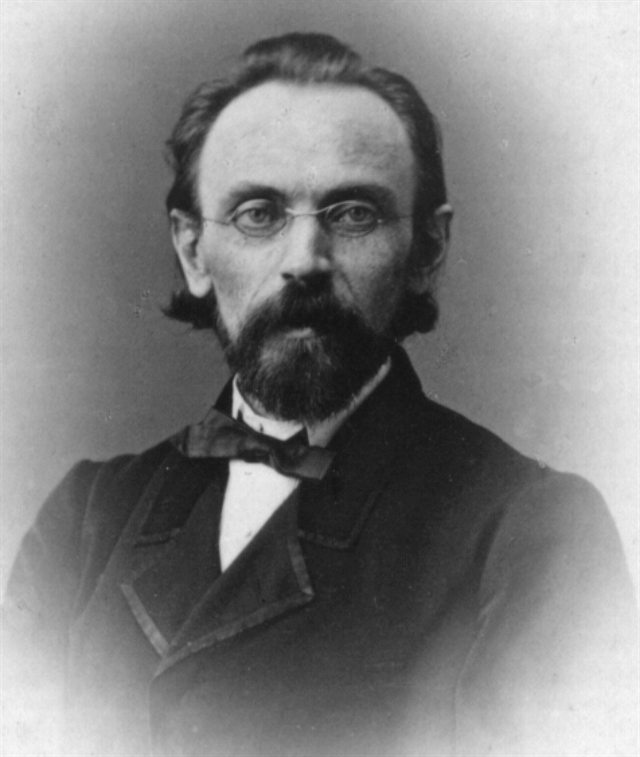
1825–1909
The chemist who drew the second line between two carbon atoms, was accused of inventing notation to balance a formula, and answered that a line must earn its keep by predicting a reaction.
Erlenmeyer gave chemistry the double bond and the triple bond, and the argument he used to defend them is still how structural claims are settled. He is known to the general public for a flask. These five chapters follow a contribution to notation, which is to say a contribution to how chemists think.
The five chapters
- An Indirect Route — Apothecary, medical student, chemist, late
- One Affinity Left Over — The problem of ethylene
- Let the Line Predict — Addition, and how a notation earns its keep
- The Rule That Bears His Name — Naphthalene, natural products, and a journal
- Known for a Flask — What a notation actually does
Chapter 1 · An Indirect Route
Apothecary, medical student, chemist, late
1825 – 1860 · Wehen · Giessen · Heidelberg
Richard August Carl Emil Erlenmeyer was born at Wehen in Nassau in June 1825, the son of a Protestant pastor.
His route into chemistry was slow and indirect. He trained first as an *apothecary*, then studied medicine at Giessen, then turned to chemistry under Justus von Liebig, whose laboratory was then the only place in Europe where a chemist could be properly trained. He took a doctorate, worked for a period as a *practising apothecary* running his own pharmacy, and only afterwards returned to academic life.
He worked briefly as an assistant, then habilitated at Heidelberg in 1857 — at thirty-two, which was late — and became a private lecturer, paid directly by the students who attended.
Heidelberg in the late 1850s was an extraordinary place to be. Bunsen and Kirchhoff were there. Kekulé had been a private lecturer there until 1858. The city was full of arguments about structure.
And the timing put Erlenmeyer exactly where he needed to be. Kekulé published tetravalent carbon in 1857 and carbon-to-carbon bonding in 1858. Erlenmeyer arrived in the middle of it, without a professorial position to protect and without a theory of his own to defend.
In 1860 he designed a piece of glassware. A round-bottomed flask will not stand on a bench and must be held in a clamp or set in a ring; a beaker stands but splashes when swirled and evaporates freely. Erlenmeyer made a conical flask with a *flat bottom* and a narrow neck: it stands, it can be swirled vigorously without spilling, it can be stoppered, and it presents a small surface for evaporation.
It is a modest and enormously useful object, and it is what most people know his name for.
“Then let the line say what the substance will do.”
— Attributed to Emil Erlenmeyer, defending the double bond
Why this matters
Erlenmeyer arrived at Heidelberg in 1857 with no chair to protect and no theory of his own, at the exact moment structural chemistry was being argued out.
You have the indirect route and the flask. What would you ask him?
Ask Erlenmeyer
- “Why does a conical flask beat a beaker?”
- “Did training as an apothecary help you?”
- “What was Heidelberg like in 1858?”
- “What is it like to be paid directly by your students?”
- “Does coming to a field late change what you can see?”
Chapter 2 · One Affinity Left Over
The problem of ethylene
1860 – 1862 · Heidelberg
Kekulé had established two things: carbon is *tetravalent*, and carbon atoms bond to one another.
Apply that to ethane, C₂H₆. Two carbons. Each spends one bond on the other carbon and three on hydrogens. Four bonds each, all accounted for, six hydrogens in total. It works.
Now apply it to *ethylene*, C₂H₄. Two carbons and only four hydrogens.
Each carbon spends one bond on the other carbon and two on hydrogens. That is three. Each carbon has *one bond left over*, unaccounted for.
This was a real embarrassment. Chemists proposed various evasions: perhaps carbon is sometimes divalent; perhaps there is a hidden hydrogen; perhaps the formula is really C₄H₈.
Erlenmeyer's answer, in 1862, was simply to write what the accounting required. The two spare affinities face one another. So join them: draw a *second line* between the two carbons.
A double bond.
And he extended it. Acetylene, C₂H₂, leaves two spare on each carbon — so a *triple* bond.
The objection came immediately and it was serious. He had invented a line to balance a book. There was no independent evidence that anything physical corresponded to the second stroke; he had a bookkeeping deficit and had drawn a line to make the sum come out.
That objection had to be answered, and answering it is the interesting part.
Why this matters
The double bond began as an accounting device to make carbon's four bonds add up, and the objection that it was mere notation had to be answered with evidence.
You have the spare affinities and the extra line. What is your question?
Ask Erlenmeyer
- “Why does ethylene not work with single bonds?”
- “What alternatives did other chemists propose?”
- “Is drawing a line to balance a formula cheating?”
- “How did you get to a triple bond?”
- “Did anybody know what the second line was made of?”
Chapter 3 · Let the Line Predict
Addition, and how a notation earns its keep
1862 – 1870s · Heidelberg · Munich
Erlenmeyer's answer to the objection is the important part of his career, and it is a general principle about how structural claims should be settled.
His argument: a notation is not a decoration. If the second line means anything, it must *predict* something. Specifically: a compound written with a double bond has, in effect, a spare capacity that a singly bonded one does not. So it ought to be able to *take up two more atoms* and become a singly bonded compound. A compound written entirely with single lines ought to take up nothing at all.
So test it.
Bubble bromine into ethylene — written with a double bond — and it *reacts*, taking up two bromine atoms and giving 1,2-dibromoethane. The reddish-brown colour of the bromine disappears.
Bubble bromine into ethane — written with single bonds only — under the same conditions, and *nothing happens*. The colour stays.
The prediction succeeds. And it succeeds systematically: hydrogen adds across the double bond, water adds, hydrogen halides add. Compounds written with double bonds *add*; compounds written with single bonds do not.
That is why the notation was accepted. Not because it made the arithmetic tidy, but because it *told you what a substance would do* before you tried it.
The bromine test is still performed in every school laboratory to distinguish saturated from unsaturated compounds, and it is still a direct test of Erlenmeyer's claim.
The answer to what the second line consists of — a second shared pair of electrons, held less tightly — came with Lewis in 1916 and quantum mechanics afterwards.
Why this matters
The bromine test performed in every school laboratory is a direct test of Erlenmeyer's claim: a structure must earn its keep by predicting a reaction.
You have the prediction and the bromine that vanishes. What would you ask?
Ask Erlenmeyer
- “What does the double bond predict that a single bond does not?”
- “Why does the bromine colour disappear with ethylene?”
- “How should a structural claim be settled?”
- “What if the prediction had failed?”
- “Do you mind not knowing what the line is?”
Chapter 4 · The Rule That Bears His Name
Naphthalene, natural products, and a journal
1866 – 1883 · Munich
Erlenmeyer became professor at the Munich Polytechnic in 1866 and stayed for two decades.
He established the constitution of *naphthalene* — the two fused benzene rings, published in 1866, shortly after Kekulé's benzene ring and extending the same reasoning to a fused system. He worked out the structures of a number of natural products, including *tyrosine* and *guanidine*.
He formulated the *Erlenmeyer rule*: an alcohol in which the hydroxyl group is attached to a carbon that is part of a carbon–carbon double bond — an *enol* — is unstable, and rearranges to the corresponding aldehyde or ketone. Vinyl alcohol rearranges to acetaldehyde essentially instantly.
The rule matters because it explains why a great many compounds that a student can draw perfectly reasonably do not actually exist as stable substances. A structural formula is a claim about a real thing, and not every drawable structure corresponds to one.
That is a natural continuation of his central position: a formula makes a claim, and the claim can fail.
He edited the *Zeitschrift für Chemie* for years, which put him at the centre of German chemical publication and gave him a role in what got read.
He was involved in a number of priority disputes, having come to the field late and without a protected position, and his contributions were sometimes attributed to more established men.
He retired to Aschaffenburg and died there in January 1909, aged eighty-three. His son, also Emil Erlenmeyer, became a chemist and worked on amino acid synthesis.
Why this matters
The Erlenmeyer rule explains why many perfectly drawable structures do not exist as stable compounds — a formula is a claim, and claims can fail.
You have naphthalene, the rule and the journal. What is your question?
Ask Erlenmeyer
- “Why is an enol unstable?”
- “How did you work out naphthalene?”
- “Can every structure a student draws actually exist?”
- “What did editing a journal give you?”
- “Did coming late cost you credit?”
Chapter 5 · Known for a Flask
What a notation actually does
1862 – present · Everywhere
Erlenmeyer's public fame rests on a piece of glassware, and his actual contribution is something almost nobody outside chemistry has heard of.
That is worth sitting with, because the double bond is not a small thing.
Every organic reaction mechanism a student learns depends on it. Alkenes react by addition and alkanes do not — that distinction organises an entire section of any chemistry syllabus. Polymerisation, the process that makes plastics, is double bonds opening and joining end to end; polythene is ethylene molecules whose double bonds have opened and linked. The difference between a saturated and an unsaturated fat, and the whole argument about them in nutrition, is a matter of double bonds. Hydrogenation, which turns liquid oils into solid fats, is addition across those bonds.
All of it is written using a line Erlenmeyer drew in 1862 to make an accounting deficit come out.
And the principle underneath is the durable one. A structural formula is not a picture — atoms do not have lines between them. It is a *claim about behaviour*, expressed in a diagram, and it earns its place by predicting what a substance will do.
That is why a chemist can look at a structure for a compound nobody has ever made and say with confidence how it will react. The notation carries the reasoning.
Erlenmeyer's answer to the accusation that he had invented a line — *then let the line say what the substance will do* — is still the standard by which any structural proposal in chemistry is judged.
Why this matters
Every alkene reaction, every polymerisation and every argument about saturated and unsaturated fats is written using the line Erlenmeyer drew in 1862.
You have the line, and the flask everyone knows instead. What would you ask?
Ask Erlenmeyer
- “How does a polymer form from a double bond?”
- “What is the difference between a saturated and unsaturated fat?”
- “Does it irritate you to be known for a flask?”
- “How can a chemist predict a reaction for a compound never made?”
- “Is a structural formula a picture of anything?”
What Erlenmeyer changed
Every double bond drawn in every chemistry lesson descends from Erlenmeyer's 1862 formula for ethylene, and the argument he used for it — that a structure must earn its keep by predicting a reaction — is still how structural claims are settled. The bromine test performed in school laboratories is a direct test of his claim. He also established the structure of naphthalene, formulated the rule on enols that bears his name, and designed the conical flask.
A debate that continues
Erlenmeyer came to academic chemistry late and without a protected position, and his priority for several contributions was disputed at the time and sometimes attributed to more established figures.
Keep exploring — ask Erlenmeyer
- “Which structural claim of yours came closest to failing?”
- “What should a diagram be allowed to assert?”
- “Would you rather be remembered for the line or the flask?”
Related lives
- August Kekulé — Who Gave Carbon Four Hands
- Justus von Liebig — Who Weighed What Burned Away
- Emil Fischer — Who Said A Lock Must Fit Its Key
- Wallace Carothers — Who Built The Giant Molecule
Related themes
Double bonds and unsaturation · Alkenes and addition · Structural formulae
Continue on Incandio
- Talk to Erlenmeyer — every question on this page is one tap from being asked, and the same page carries the Historical Brief, the achievements and the timeline
- All 280 figures · Incandio — learn every idea, teach it, then defend it