Explore Their Life · Pearson Edexcel International GCSE revision on Incandio
Wallace Carothers: A Life in Five Chapters
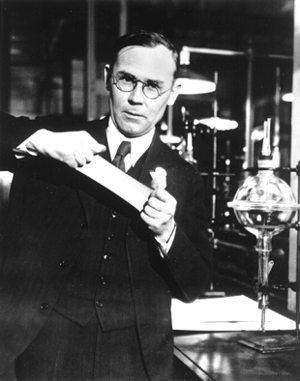
1896–1937
The Harvard chemist who took an industrial job on condition that he could do fundamental research, settled what a polymer is by building them to order, invented nylon, and killed himself at forty-one two years before it reached the public.
Carothers proved that a polymer is an ordinary molecule that happens to be very large, by making them deliberately from reactions he understood. He invented neoprene and nylon. He lived with a severe depression that no success touched. These five chapters follow the chemistry and the illness together, because they were concurrent.
The five chapters
- An Unusual Offer — An industrial laboratory with a mandate for fundamental research
- What Is a Polymer? — Real molecules, or clumps?
- Addition and Condensation — The classification every syllabus uses
- Neoprene and Nylon — Two materials, and a problem of melting point
- The Illness That Nothing Touched — Philadelphia, April 1937
Chapter 1 · An Unusual Offer
An industrial laboratory with a mandate for fundamental research
1896 – 1928 · Des Moines · Tarkio · Illinois · Harvard · Wilmington
Wallace Hume Carothers was born in Burlington, Iowa, in April 1896. His father taught at a commercial college. He studied accountancy and secretarial work first, then chemistry at Tarkio College in Missouri, where he was so far ahead of the other students that he was made an instructor while still an undergraduate after the chemistry teacher left for war work.
He took a doctorate at Illinois, taught there and then at Harvard, and by 1926 was a promising young organic chemist thinking about large molecules.
Then DuPont made him an offer.
*Charles Stine*, DuPont's director of chemical research, had persuaded the company to fund *fundamental* research — work with no assigned commercial objective, on the argument that industrial laboratories were living off discoveries made in universities and would eventually run out. This was an unusual position for a company to take in 1927 and it was genuinely radical.
Carothers was offered a laboratory, a free hand, a substantial salary, and no product to deliver.
He hesitated. He wrote to Stine mentioning what he called *neurotic spells of diminished capacity*, and warning that he might be a poor risk. That letter is worth knowing about: he disclosed the illness before he took the job, and DuPont hired him anyway.
He went to Wilmington in 1928 and set the group's direction himself: the chemistry of *large molecules*.
“A polymer is a molecule of high molecular weight built up from simple units by ordinary chemical reactions.”
— Attributed to Wallace Carothers, on the macromolecular hypothesis
Why this matters
DuPont funded fundamental research with no product objective on the argument that industry was living off university discoveries — and nylon came out of it.
You have the offer and the letter disclosing the illness. What would you ask?
Ask Carothers
- “Why would a company pay for research with no product in mind?”
- “Why did you warn Stine that you might be a poor risk?”
- “What made you choose large molecules?”
- “Was leaving Harvard for industry a step down?”
- “What did teaching at Tarkio as a student teach you?”
Chapter 2 · What Is a Polymer?
Real molecules, or clumps?
1928 – 1931 · Wilmington
There was a genuine argument in the 1920s about what substances like rubber, cellulose, silk and the early plastics *are*.
*Hermann Staudinger* held that they are true molecules of enormous size — chains of thousands of atoms joined by ordinary covalent bonds — and coined the word *macromolecule*.
The majority view was different, and it was held by very distinguished chemists. On that account, such substances are *aggregates*: clusters of ordinary small molecules held together by some weak associative force, not by chemical bonds. A molecule of ten thousand atoms seemed physically absurd; nobody had seen one, and the usual methods of determining molecular weight gave unreliable answers for these materials.
Staudinger's evidence was mostly *analytical* — measurements of viscosity and of molecular weight, both of which could be disputed.
Carothers took a different approach, and it is the reason his answer settled the argument. He decided to *build* them.
If you take a molecule with a reactive group at *each end*, and another molecule with a complementary reactive group at each end, and let them react, each new bond leaves the growing chain still reactive at both ends. It cannot stop. The chain grows by ordinary, well-understood chemistry, and you know exactly what bond has formed because you chose the reaction.
His group made polyesters this way, from a *diacid* and a *diol*, deliberately, and then measured what they had made.
The products were high molecular weight, and they had been assembled by esterification — a reaction every chemist understood. There was no mystery force. A polymer is an ordinary molecule that happens to be very large.
Carothers always said the hypothesis was Staudinger's and that he had supplied the proof.
Why this matters
Carothers settled what a polymer is by building one from reactions everybody understood, which left no room for a mysterious associative force.
You have the argument and the way of ending it. What is your question?
Ask Carothers
- “Why did distinguished chemists think polymers were clumps?”
- “How does building one settle the argument?”
- “Why does a molecule reactive at both ends keep growing?”
- “Why insist the hypothesis was Staudinger's?”
- “What is so hard to believe about a molecule of ten thousand atoms?”
Chapter 3 · Addition and Condensation
The classification every syllabus uses
1929 – 1931 · Wilmington
Carothers drew the distinction that organic chemistry has used ever since, and it is on every school syllabus.
*Addition polymerisation*. The monomer contains a *carbon–carbon double bond*. The bond opens, and the units join end to end, with *nothing lost*. Every atom of every monomer ends up in the polymer, so the empirical formula of the polymer is the same as that of the monomer. Ethylene gives polythene; propylene gives polypropylene; chloroethene gives PVC.
*Condensation polymerisation*. The monomers each carry two *functional groups*, and each new link *expels a small molecule* — usually water, sometimes hydrogen chloride. So the polymer's formula is not that of the monomers; something has been lost at each join. A diacid with a diol gives a *polyester*; a diacid with a diamine gives a *polyamide*.
The distinction matters practically as well as descriptively. Condensation polymerisations are reversible — water can attack the linkage and break the chain, which is why polyesters hydrolyse and why nylon degrades in strong acid. Addition polymers have only carbon–carbon backbones, which is why polythene is so extraordinarily unreactive, and why it persists in the environment essentially indefinitely.
He also formulated what is called the *Carothers equation*, relating the average chain length to the extent of reaction. It carries an uncomfortable implication: to get a long chain by condensation you need the reaction to go *very* nearly to completion — ninety-nine per cent conversion gives an average of only about a hundred units — and you need the two monomers in almost exact balance. That is a demanding manufacturing requirement, and it explains why condensation polymers are harder to make well than addition ones.
In 1930 his colleague *Julian Hill*, working with a molten polyester, touched it with a glass rod and drew it out — and found it formed a *fibre* that kept stretching, and got stronger as it stretched. The laboratory story is that the group ran down the corridor pulling it out to see how far it would go.
Why this matters
Addition polymers have carbon-carbon backbones and are almost unreactive, which is why polythene persists in the environment essentially indefinitely.
You have the two mechanisms and the fibre drawn down a corridor. What would you ask?
Ask Carothers
- “What is the difference between addition and condensation?”
- “Why does polythene last so long in the environment?”
- “Why is a long chain so hard to make by condensation?”
- “What happened when Julian Hill drew that fibre?”
- “Why does a fibre get stronger as it is stretched?”
Chapter 4 · Neoprene and Nylon
Two materials, and a problem of melting point
1931 – 1935 · Wilmington
In 1931 the group produced *neoprene*, a synthetic rubber made by the addition polymerisation of chloroprene. It resists oil, heat, weather and ozone far better than natural rubber, and it went into hoses, gaskets, seals and wetsuits. It was DuPont's first major polymer product, and it was commercially important during the Second World War when natural rubber supplies from Asia were cut off.
The first polyester fibres were a problem. They drew beautifully, but they melted at too low a temperature to survive washing or ironing. A fibre that dissolves in dry-cleaning fluid or softens under an iron is not a textile.
The solution came from switching from a *polyester* to a *polyamide* — replacing the diol with a *diamine*, so that the linkage is the same kind of amide bond found in proteins and in silk.
Amide groups form *hydrogen bonds* between adjacent chains. Those bonds hold the chains together strongly, and the result is a much higher melting point and much greater strength.
On 28 February 1935 Gerard Berchet, in Carothers's group, made the polyamide from *hexamethylenediamine* and *adipic acid* — six carbons in each — which became known as nylon 6,6.
It melted at around 265 degrees, drew into a fibre of remarkable strength, and could be washed.
DuPont put enormous resources into commercialising it. Nylon stockings went on sale in 1940 and sold four million pairs in the first four days. During the war the entire supply went to parachutes, ropes and tyre cords.
Carothers took out the key patents but characteristically doubted the value of the work, and had to be pressed to file.
Why this matters
Nylon works because the amide linkage lets adjacent chains hydrogen-bond to one another, exactly as they do in silk and in proteins.
You have the polyester that melted and the polyamide that did not. What is your question?
Ask Carothers
- “Why did the first polyester fibres fail?”
- “What do hydrogen bonds do between nylon chains?”
- “Why is nylon like silk?”
- “What is neoprene good for that rubber is not?”
- “Why did you have to be pressed to file the patent?”
Chapter 5 · The Illness That Nothing Touched
Philadelphia, April 1937
1936 – 1937 and after · Wilmington · Philadelphia
Carothers lived with severe depression throughout his adult life, and it should be described plainly because it is part of the record and because it is often left out.
He had periods of profound incapacity from his twenties. He was hospitalised more than once. He consulted psychiatrists. He carried a *cyanide capsule* with him for years — colleagues knew about it — and told friends he did not expect to live long.
No amount of success relieved it. He was elected to the National Academy of Sciences in 1936, the first industrial organic chemist so honoured, and it did not help. He was convinced his work was less than others believed and that he had failed as a scientist, at exactly the period when he had invented two of the most important materials of the century.
His sister *Isobel*, a radio performer to whom he was close, died suddenly in January 1936. He did not recover from it.
He married Helen Sweetman, a DuPont chemist, in February 1936. She was pregnant in 1937.
On 29 April 1937 he checked into a hotel room in Philadelphia and drank lemon juice laced with potassium cyanide. He was forty-one. He had chosen lemon juice because he knew, as a chemist, that the acid would liberate the hydrogen cyanide rapidly.
His daughter Jane was born seven months later, in November 1937.
Nylon stockings went on sale in 1940. He did not see any of it.
His colleague *Paul Flory* went on to build the physical chemistry of polymers and received the Nobel Prize in 1974, saying he had learned the subject from Carothers.
The questions his work raises about what synthetic polymers do after they are thrown away — the persistence of polythene, microplastics in the ocean, the fact that essentially every plastic object ever made still exists in some form — became urgent in a way he never saw.
Why this matters
Carothers was convinced he had failed as a scientist during the exact period in which he invented neoprene and nylon, and no recognition altered that conviction.
You have the depression, the capsule and the daughter born after. What would you ask?
Ask Carothers
- “Why did success not touch the depression?”
- “Did your colleagues know about the capsule?”
- “What would you have made of nylon stockings selling out in four days?”
- “What do you think about plastics that never break down?”
- “What did you think you had actually achieved?”
What Carothers changed
Modern materials rest on the point Carothers proved: that a polymer can be designed, built to order and understood molecule by molecule. The addition–condensation distinction he drew is taught in every school chemistry course, polyester and nylon remain among the most widely produced materials on earth, and the questions his work raises about what synthetic polymers do after they are thrown away have become urgent in a way he never saw.
A debate that continues
The macromolecular hypothesis Carothers proved was Hermann Staudinger's, and he said so consistently; and he took his own life at forty-one, convinced he had failed, two years before nylon reached the public.
Keep exploring — ask Carothers
- “Which polymer would you design differently now?”
- “What should a company owe a researcher who is unwell?”
- “Was fundamental research in industry worth defending?”
Related lives
- Emil Erlenmeyer — Who Drew the Second Line
- August Kekulé — Who Gave Carbon Four Hands
- Vladimir Shukhov — Who Broke the Long Molecules
- Rachel Carson — Author of Silent Spring
Related themes
Polymers and plastics · Addition and condensation · Materials and the environment
Where Carothers appears in your course
Wallace Carothers has a genuine claim on 4 lessons of the Pearson Edexcel International GCSE science course built into Incandio:
- Alkene Reactions And The Bromine Test — Chemistry: This page shows a double bond opening once, to take on two bromine atoms. Carothers' work rests on what happens when the same thing occurs millions of times over and the bond opens onto another molecule of the same alkene instead of onto a bromine. He established that the giant molecules formed this way are genuine single molecules rather than clumps, and he separated this kind of joining, in which nothing is lost, from the kind in which a small molecule is expelled. He is the right figure to ask what a reaction that has been demonstrated in a test tube can become at industrial scale.
- Esters And How To Make One — Chemistry: The reaction on this page joins one alcohol to one acid and expels one molecule of water. Carothers asked what would happen if each molecule had TWO reactive ends instead of one, so that every product could react again — and the answer was a polyester, a molecule thousands of links long that can be drawn out into a fibre. He also drew the distinction this page relies on, between joining that expels a small molecule and joining that expels nothing. He is the right figure to ask what separates a laboratory curiosity from a material.
- Addition Polymers — Chemistry: This page asserts something a learner has no way to check: that a piece of poly(ethene) contains single molecules tens of thousands of atoms long. When Carothers began, that was disputed — many chemists held that polymers were merely clusters of small molecules clinging together, since nothing so large had ever been shown to exist. He settled it by building polymers deliberately, from known starting materials by reactions already understood, and measuring what he had made. He also named the distinction between addition and condensation that the next page depends on.
- Condensation Polymers — Chemistry: The polymer on this page is Carothers' own invention. Working at DuPont in 1930 he set out to build a giant molecule deliberately, from a diol and a diacid, precisely so that every product could react again — and his colleague Julian Hill, touching a glass rod to the molten result, found it drew out into a filament that kept stretching far beyond what anyone expected. That accident revealed that the chains were aligning as they were pulled, which is why a synthetic fibre is strong. Nylon followed five years later on the same principle.
Continue on Incandio
- Talk to Carothers — every question on this page is one tap from being asked, and the same page carries the Historical Brief, the achievements and the timeline
- All 280 figures · Incandio — learn every idea, teach it, then defend it