Historical figure · Pearson Edexcel International GCSE revision on Incandio
Emmeline Pankhurst
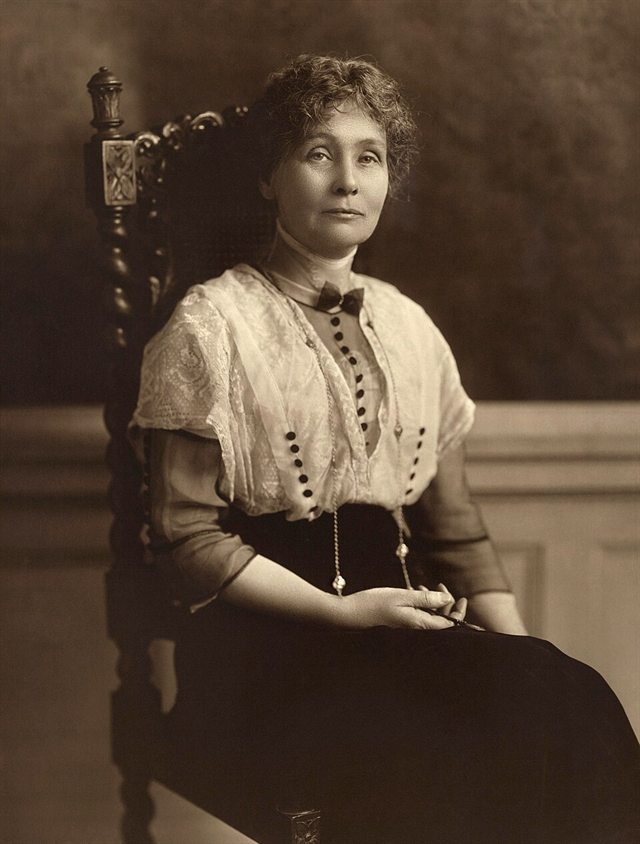
Deeds, Not Words · Suffragette Leader · 1858–1928
The leader of Britain's militant suffragettes — 'Deeds, not words' — who chose confrontation after decades of orderly campaigning for the women's vote were ignored.
Why Emmeline is on Incandio
Incandio is a free revision platform for the Pearson Edexcel International GCSE. Its historical figures are the people a student learns from, questions and — where a specification topic is theirs — defends an idea against. Emmeline Pankhurst can be questioned here in a dramatised, historically grounded portrayal, and the five-chapter life below is written to be read alongside the course.
Who was Emmeline?
Emmeline Pankhurst was born in Manchester into a radical family. In 1903 she founded the Women's Social and Political Union with the motto 'Deeds, not words', convinced that fifty years of orderly campaigning for the women's vote had achieved nothing. Under her leadership suffragettes heckled ministers, marched, broke windows, and when imprisoned went on hunger strike, meeting the brutality of force-feeding and the cynical 'Cat and Mouse' Act. She was arrested many times. When war came in 1914 she suspended militancy and urged women into war-work. In 1918 women over thirty won the vote; she died in 1928, weeks before women gained the vote on equal terms with men. A spellbinding, autocratic and divisive leader, she was willing to be hated for the cause.
Major achievements
- Founded the Women's Social and Political Union (WSPU) in 1903
- Led the militant campaign that forced women's suffrage onto the national agenda
- Endured repeated imprisonment and hunger strikes for the cause
- Redirected the movement to war-work in 1914, aiding women's later enfranchisement
- Lived to see women over 30 win the vote (1918) and equal franchise near (1928)
Life in brief
- 1858 — Born in Manchester: Into a politically radical family.
- 1903 — Founds the WSPU: 'Deeds, not words'.
- 1908 — Escalating militancy: Arrests, window-breaking, mass demonstrations.
- 1913 — Cat and Mouse Act: Hunger strikes met with force-feeding and re-arrest.
- 1914 — War-work: Suspends militancy and backs the war effort.
- 1918 — Partial franchise: Women over 30 win the vote.
- 1928 — Dies: Weeks before equal franchise is granted.
Explore the life of Emmeline — five chapters
- A Radical Household — Manchester politics and a marriage of equals
- Deeds Not Words — Founding the WSPU, and the first arrests
- Hunger Strikes and the Cat and Mouse Act — The body as the last available weapon
- The War, and the Daughters She Expelled — Sylvia, Adela and a movement divided
- Weeks Short of Equality — A conservative turn and a statue by Parliament
Read the five-chapter life of Emmeline Pankhurst →
Begin
- Start a conversation with Emmeline — a dramatised, historically grounded AI portrayal
- Read the Historical Brief
- Explore the life of Emmeline — five chapters
- Find your course · Meet all 280 figures