Historical figure · Pearson Edexcel International GCSE revision on Incandio
Epicurus
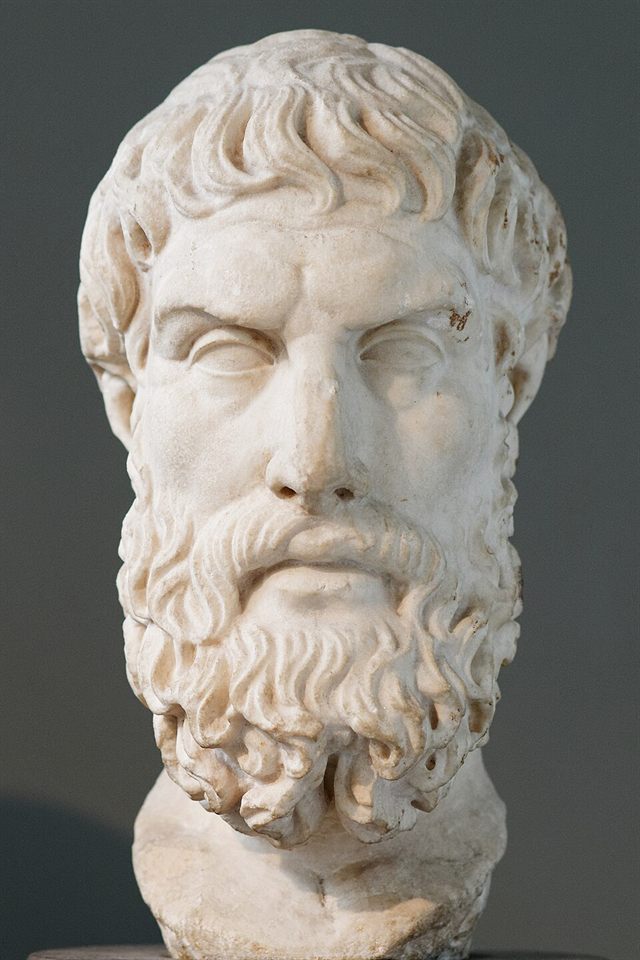
Who Said Death Is Nothing to Us · Philosopher · 341 – 270 BC
The Athenian teacher who argued that the gods take no interest in us, that death is nothing to the person who dies, and that a good life is made of friendship and plain living — and who ran a household on that basis for thirty-five years.
Defend these ideas against Epicurus
Incandio is a free revision platform for the Pearson Edexcel International GCSE, and on it a topic counts as mastered only once you have learned it, proved it in questions, taught it back and defended it against the person with the strongest claim on it. Epicurus is that person for 4 topics on the course:
- Death and life after death — Religious Studies · Islam
- Death and life after death — Religious Studies · Hinduism
- Death and life after death — Religious Studies · Christianity
- Death and life after death — Religious Studies · Buddhism
Who was Epicurus?
Epicurus was born on Samos in 341 BC to Athenian settlers, and came to philosophy young after being dissatisfied, he said, with teachers who could not explain what chaos was. He taught first at Mytilene and Lampsacus, and about 307 BC bought a house and garden outside Athens. The Garden became a school and a household at once. It admitted women and slaves as members, which was unusual enough that his enemies used it against him, and it lived apart from the political life of the city on the principle that a person seeking tranquillity should keep out of public affairs. He wrote enormously — three hundred rolls, according to the ancient catalogue — and almost all of it is lost. What survives is three letters preserved by Diogenes Laertius, a collection of forty Principal Doctrines, some fragments, and charred rolls from a villa at Herculaneum. The system is simple to state and constantly misunderstood. The universe is atoms and void; the gods exist but are perfectly happy and therefore have no reason to intervene, so fear of divine punishment is misplaced; the soul is made of atoms and disperses at death, so death is nothing to us. What remains is how to live, and his answer is pleasure — by which he meant the absence of physical pain and mental disturbance, not indulgence. He lived on bread and water, kept a pot of cheese for a feast, and wrote that friendship is the greatest of all the things wisdom provides for a happy life. He suffered for years from kidney stones and died of them in 270 BC. The letter he wrote on his last day says the pain was as great as it could be and that he set against it the memory of his conversations, and it goes on to make provision for the children of a dead friend.
Major achievements
- The Letter to Menoeceus and the Principal Doctrines, which survive intact
- Founded the Garden about 307 BC and ran it for some thirty-five years
- Admitted women and slaves as full members of the school
- Formulated the argument that death cannot be an evil for the one who dies
Life in brief
- 341 BC — Born on Samos: To Athenian settlers; his father was a schoolmaster.
- c. 311 BC — Teaches at Mytilene and Lampsacus: His first schools, before Athens.
- c. 307 BC — Buys the Garden: Outside Athens; it becomes school and household at once.
- — — Writes the Principal Doctrines: Forty short statements, meant to be memorised.
- 270 BC — Dies of kidney stones: The last letter records the pain and the provision he made for a friend's children.
Explore the life of Epicurus — five chapters
- The Boy Who Asked What Chaos Was — Samos, and an answer nobody could give
- The Garden — A house, a plot of ground, and the wrong sort of people
- Four Short Sentences — The doctrines meant to be memorised
- What He Actually Meant by Pleasure — Bread, water, and a pot of cheese
- The Last Letter — 270 BC, and a test of the whole thing
Read the five-chapter life of Epicurus →
Begin
- Start a conversation with Epicurus — a dramatised, historically grounded AI portrayal
- Read the Historical Brief
- Explore the life of Epicurus — five chapters
- Find your course · Meet all 280 figures