Explore Their Life · Pearson Edexcel International GCSE revision on Incandio
Epicurus: A Life in Five Chapters
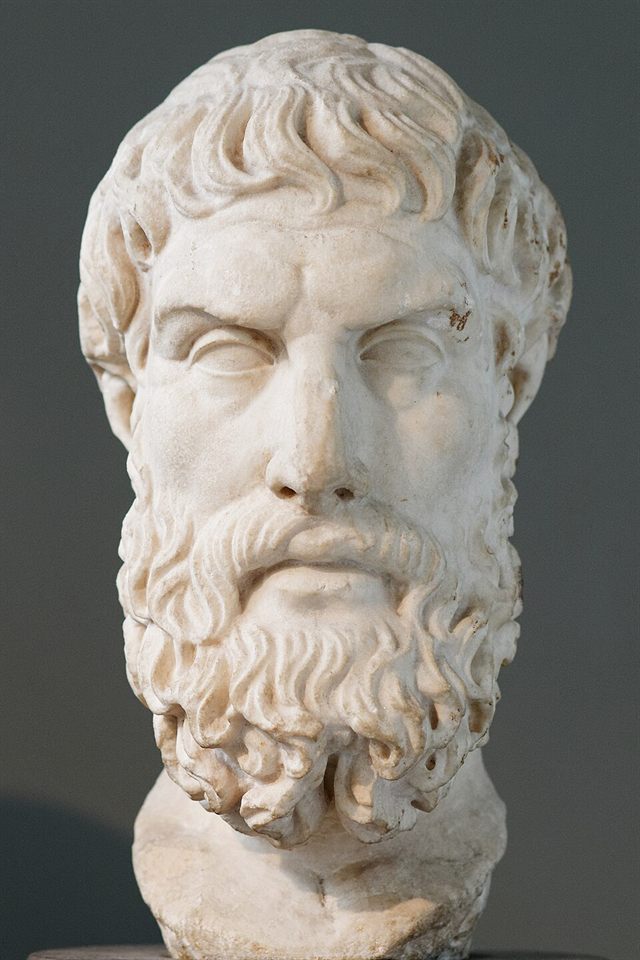
341 – 270 BC
He taught that the gods leave us alone and that death is nothing to us, then spent thirty-five years demonstrating what a good life looks like on bread, water and friendship.
His name became a byword for gluttony, which is close to the opposite of what he taught. These five chapters follow the boy on Samos who could not get an answer out of his teachers, the Garden he bought outside Athens and filled with people Athens did not think belonged there, the four short doctrines he built everything on, what he actually meant by pleasure, and the letter he wrote on the day he died.
The five chapters
- The Boy Who Asked What Chaos Was — Samos, and an answer nobody could give
- The Garden — A house, a plot of ground, and the wrong sort of people
- Four Short Sentences — The doctrines meant to be memorised
- What He Actually Meant by Pleasure — Bread, water, and a pot of cheese
- The Last Letter — 270 BC, and a test of the whole thing
Chapter 1 · The Boy Who Asked What Chaos Was
Samos, and an answer nobody could give
341 – c. 311 BC · Samos · Athens · Colophon
Epicurus was born on Samos in 341 BC. His parents were Athenian settlers; his father Neocles was a schoolmaster, which meant the family had learning and very little money.
The story he told about his own beginning is that he came to philosophy at about fourteen, out of frustration. He had been reading Hesiod, where everything begins from Chaos, and asked his teacher what Chaos came from. The teacher told him that was a question for philosophers, not for schoolmasters. He decided to become one.
When he was eighteen he went to Athens for military service. While he was away the Athenian settlers were expelled from Samos and his family moved to Colophon on the Asian coast, so he returned not to a home but to a displacement. He studied under a follower of Democritus, whose atomism he took and altered, and under Nausiphanes, with whom he later quarrelled sharply — he was not generous about teachers.
He began teaching in his early thirties, first at Mytilene, where he made himself unpopular enough to have to leave, and then at Lampsacus, where he gathered the friends who would follow him for the rest of his life. Metrodorus and Hermarchus both came from that period. When he finally moved to Athens about 307 BC, he did not arrive alone. He arrived with a household.
Why this matters
The Epicurean school was a community before it was a doctrine, and the order matters: what he taught was a way of living with other people rather than a set of conclusions.
What would you ask him about the question his schoolmaster refused to answer?
Ask Epicurus
- “What did your teacher actually say when you asked about Chaos?”
- “What did losing Samos change for your family?”
- “Why did you fall out with Nausiphanes?”
- “What did you take from Democritus, and what did you change?”
- “Why did teaching at Mytilene go so badly?”
Chapter 2 · The Garden
A house, a plot of ground, and the wrong sort of people
c. 307 – 270 BC · Athens
About 307 BC Epicurus bought a house in Athens and a garden outside the city wall, between the wall and the Academy. The school took its name from the ground.
It was not a school in the sense the Academy or the Lyceum were. There were no lecture fees in the ordinary way, no public disputations, no training for civic life. It was a household that studied together, ate together and lived on very little, deliberately apart from the political life of the city. His advice was to live unnoticed.
Two things about the membership caused offence. Women were admitted as full members, including women whose reputations Athens disapproved of, and so were slaves — one of them, Mys, is named in Epicurus's will. Ancient critics used both facts to insinuate that the Garden was a place of orgies. Nothing in what survives supports it, and a great deal contradicts it: the school's own writings are about digestion, anxiety, friendship and the memorising of short formulas.
What held it together was friendship, which he treated as the most important practical discovery of his philosophy rather than as a sentiment. Friends make a life secure in a way that money and status cannot, because they are the only protection that does not depend on the world staying arranged as it is.
Why this matters
The Garden is the evidence for the claim the Religious Studies debate turns on: that a life can be organised around a purpose nobody handed down.
What would you ask him about a household that Athens found scandalous?
Ask Epicurus
- “Why admit women and slaves when no other school did?”
- “What did people outside think was going on in the Garden?”
- “Why tell your followers to live unnoticed?”
- “What makes friendship more secure than money?”
- “What did a normal day in the Garden actually look like?”
Chapter 3 · Four Short Sentences
The doctrines meant to be memorised
Athens
Epicurus wrote an enormous amount — three hundred rolls, according to the ancient catalogue — and almost all of it is lost. What survives is three letters, a set of forty Principal Doctrines, some sayings, and charred fragments from a library buried at Herculaneum.
That the doctrines are short is not an accident of survival. He meant them to be memorised, so that they would be available at the moment they were needed rather than sitting in a book. Later followers condensed them further into four:
The gods are nothing to fear. Death is nothing to feel. What is good is easy to get. What is terrible is easy to endure.
Each is the conclusion of an argument. The gods exist and are perfectly happy, and a perfectly happy being has no anger, no favourites and no reason to interfere — so the elaborate machinery of appeasement is pointless. The soul is made of atoms and disperses at death, so there is nobody left for anything to happen to. What we actually need — food, shelter, company, freedom from pain — is cheap and available, while what we crave is expensive and never enough. And extreme pain is either brief or bearable.
What a learner should notice is that this is not a set of beliefs about the world offered for its own sake. Every one of them is aimed at removing a specific disturbance. The physics exists to make the ethics possible.
“Death is nothing to us; for that which is dissolved is without sensation.”
— Epicurus, Principal Doctrines II
Why this matters
It is a complete account of how to live with no divine command, no afterlife and no cosmic purpose — the position a religious answer to the meaning of life has to be better than.
What would you ask him about four sentences meant to be carried in the head?
Ask Epicurus
- “Why should a doctrine be short enough to memorise?”
- “If the gods are perfectly happy, what follows for prayer?”
- “Is what is good really easy to get?”
- “Which of your three hundred rolls do you most regret losing?”
- “Why does the physics have to come before the ethics?”
Chapter 4 · What He Actually Meant by Pleasure
Bread, water, and a pot of cheese
Athens
No philosopher has been more thoroughly misunderstood. The word 'epicurean' now suggests a connoisseur; in antiquity it suggested a pig. Both are wrong, and the correction is not a technicality.
He held that pleasure is the good — but he defined pleasure as the absence of pain in the body and of disturbance in the mind. That is a ceiling rather than a scale. Once the pain and the anxiety are gone, pleasure cannot be increased by adding luxuries; it can only be varied. So the person who has enough is already at the top, and the person chasing more has misunderstood the arithmetic.
He sorted desires accordingly. Some are natural and necessary — food, shelter, safety, friendship — and these are easy to satisfy. Some are natural but unnecessary, like rich food. Some are neither, like fame and unlimited wealth, and these are the dangerous ones because nothing satisfies them.
He lived it. He wrote to a friend asking him to send a pot of cheese so that he could have a feast when he wanted one. The school lived on bread and water. He was clear that this was not asceticism for its own sake: living plainly means you are never afraid of losing what you have, and it makes luxury, when it comes, taste of something.
He also held that you cannot live pleasantly without living justly and honourably — because a person who cheats will be afraid of being found out, and fear is precisely what pleasure was defined as the absence of.
Why this matters
The correction of the caricature is the argument: a humanist account of the good life turns out to be demanding rather than indulgent, which is what makes it a real rival.
What would you ask him about a pleasure that has a ceiling?
Ask Epicurus
- “How can pleasure be the good if you lived on bread and water?”
- “Which desires did you think were the dangerous ones?”
- “Why does a cheat live less pleasantly than an honest person?”
- “Does your account leave any room for ambition?”
- “Why did people decide you were a glutton?”
Chapter 5 · The Last Letter
270 BC, and a test of the whole thing
270 BC · Athens
Epicurus suffered for years from kidney and bladder stones. In 270 BC they killed him, and the death was not gentle: the ancient account describes retention of urine and a fortnight of agony.
On the last day he wrote a letter to Idomeneus. It is preserved by Diogenes Laertius, and it is short. He says that the pain of the bladder and the stomach is as great as it can be, and that he sets against it the joy of remembering the conversations they had had. Then, without a break, he asks Idomeneus to look after the children of Metrodorus — a friend who had died some years before.
That sequence is the whole philosophy in one paragraph. The doctrine that pleasure is the absence of disturbance is being tested at the worst possible moment; memory is offered as the counterweight; and the practical obligation to somebody else's children is treated as the next thing to attend to.
His will, also preserved, is a careful document: the Garden is left to the school, provision is made for the annual memorial of his parents and brothers, for the birthday feast, and for the freeing of named slaves — Mys among them.
A learner arguing against Epicurus should know this. The position is not that nothing matters. It is that a life can be made worth having out of ordinary materials, and that its maker thought so at the point where it was hardest to say.
Why this matters
It is the strongest available evidence that a purpose people made for themselves held under pressure, which is exactly the claim the meaning-of-life debate is about.
What would you ask him about a letter written in that much pain?
Ask Epicurus
- “How could remembering a conversation weigh against that much pain?”
- “Why write about Metrodorus's children on your last day?”
- “Why did you free named slaves in your will?”
- “Did the philosophy actually help at the end?”
- “What did you want the Garden to do after you were gone?”
What Epicurus changed
Epicurus gave the West its first complete account of a good life that needs no divine purpose, no afterlife and no cosmic plan — and unusually for a philosophy, it was lived by a household for decades rather than only argued. His formula that death is nothing to us is still the standard version of that argument, and his classification of desires has been rediscovered repeatedly by people who had never read him.
A debate that continues
Whether Epicurus was sincere about the gods is genuinely disputed. He insists they exist and are blessed, but they do nothing whatever, and critics from antiquity onwards have argued that this was a prudent formula for an atheist in a city that had executed Socrates for impiety.
Keep exploring — ask Epicurus
- “Can a purpose you make for yourself be as strong as one you believe you were given?”
- “Is a god who does nothing meaningfully different from no god at all?”
- “Does living plainly make a person freer, or only smaller?”
Related lives
- Lucretius — Who Wrote Physics as a Poem
- Socrates — Gadfly of Athens
- Marcus Aurelius — Emperor · Philosopher · Stoic
Related themes
The meaning of life · Life after death · Ancient philosophy · Happiness and wellbeing
Continue on Incandio
- Talk to Epicurus — every question on this page is one tap from being asked, and the same page carries the Historical Brief, the achievements and the timeline
- All 280 figures · Incandio — learn every idea, teach it, then defend it