Historical figure · Pearson Edexcel International GCSE revision on Incandio
Erasmus
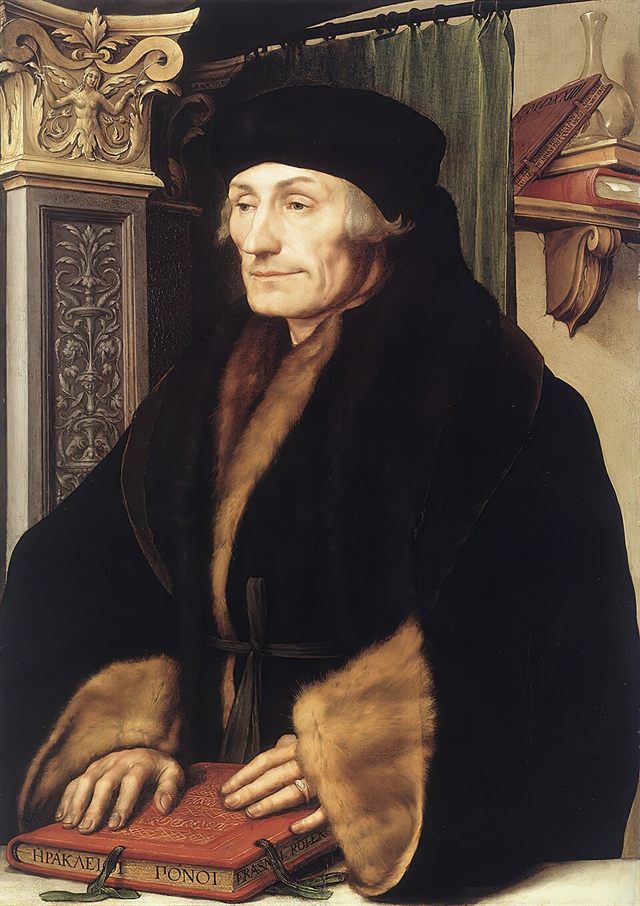
Who Laid the Egg Others Hatched · Humanist & Scholar · c. 1466 – 1536
The scholar who put the Greek New Testament back into print, mocked relics and pilgrimages in his own books while staying inside the Church, and was attacked by both sides for refusing to join either.
Defend these ideas against Erasmus
Incandio is a free revision platform for the Pearson Edexcel International GCSE, and on it a topic counts as mastered only once you have learned it, proved it in questions, taught it back and defended it against the person with the strongest claim on it. Erasmus is that person for 3 topics on the course:
- Pilgrimage — Religious Studies · Hinduism
- Pilgrimage — Religious Studies · Buddhism
- Pilgrimage — Religious Studies · Christianity
Who was Erasmus?
Erasmus was born at Rotterdam about 1466, the illegitimate son of a priest, and was orphaned young by plague. He was put into a monastery at Steyn and ordained in 1492, and he spent much of his life obtaining and defending dispensations that released him from the habit. He studied in Paris in poverty, went to England in 1499 and met John Colet and Thomas More, and learned Greek in his thirties because he had concluded that the Latin Bible everybody used could not be checked without it. That decision produced his life's work. In 1516 he published the Novum Instrumentum: the Greek New Testament with a fresh Latin translation beside it and notes explaining where the old version had gone wrong. It was the first Greek New Testament in print, and it made the text a thing scholars could argue about rather than an object handed down. He also wrote The Praise of Folly in 1509, dashed off at More's house, which laughs at monks, theologians, pardon-sellers and popes; and the Colloquies, a set of dialogues used to teach schoolboys Latin, which include a devastating account of a pilgrimage he had actually made to Walsingham and Canterbury — the relics that multiply, the milk of the Virgin, the money, and the question of whether a man who cannot find God at home will find him at the end of a road. When Luther broke with Rome, Erasmus was expected to follow, and refused. In 1524 he published On Free Will against him and received a savage reply. He was then denounced by Catholics for having laid the egg Luther hatched and by Protestants for cowardice. He left Basel when the Reformation took the city, returned when he was dying, and died there in 1536.
Major achievements
- The Novum Instrumentum (1516), the first published Greek New Testament
- The Praise of Folly (1509), written at Thomas More's house in a week
- The Colloquies, including the pilgrimage dialogue of 1526
- The Adages, which put thousands of classical proverbs into general circulation
Life in brief
- c. 1466 — Born at Rotterdam: The illegitimate son of a priest.
- 1492 — Ordained: After the monastery at Steyn; he spent years seeking release from the habit.
- 1499 — First visit to England: Meets Thomas More and John Colet.
- 1509 — The Praise of Folly: Written at More's house in about a week.
- 1516 — The Greek New Testament: The first in print, with a new Latin version and notes.
- 1524 — On Free Will: Against Luther, who replied with On the Bondage of the Will.
- 1526 — The pilgrimage colloquy: Drawing on his own visits to Walsingham and Canterbury.
- 1536 — Dies at Basel: Having returned to a city he had left over the Reformation.
Explore the life of Erasmus — five chapters
- The Monastery He Spent Years Leaving — Gouda, Steyn, and a habit he did not want
- Learning Greek at Thirty — Because the Latin could not be checked
- A Joke That Stopped Being Funny — The Praise of Folly, written in a week
- A Pilgrimage He Actually Made — Walsingham, Canterbury, and the milk of the Virgin
- Refusing Both Sides — Luther, free will, and a reputation for cowardice
Read the five-chapter life of Erasmus →
Begin
- Start a conversation with Erasmus — a dramatised, historically grounded AI portrayal
- Read the Historical Brief
- Explore the life of Erasmus — five chapters
- Find your course · Meet all 280 figures