Explore Their Life · Pearson Edexcel International GCSE revision on Incandio
Erasmus: A Life in Five Chapters
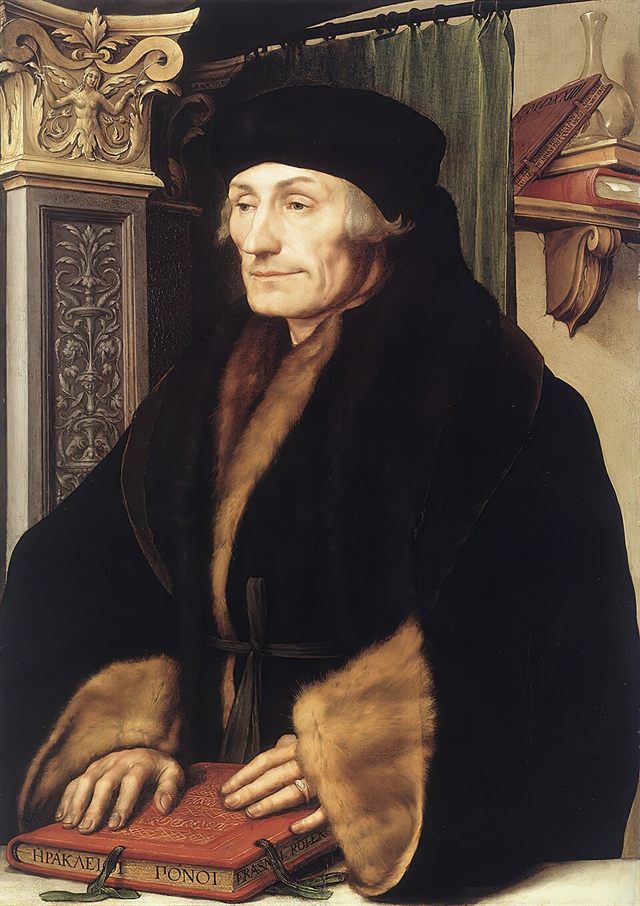
c. 1466 – 1536
He put the Greek New Testament back into print, mocked the relic trade in books schoolboys used to learn Latin, and was denounced by Rome and by the reformers for refusing to join either.
He was the most famous scholar in Europe and ended it disliked by everybody who mattered. These five chapters follow the orphan pushed into a monastery, the decision to learn Greek in his thirties, the book that made popes laugh and then stopped being funny, the pilgrimage he actually made and then wrote up, and the quarrel with Luther that decided how he would be remembered.
The five chapters
- The Monastery He Spent Years Leaving — Gouda, Steyn, and a habit he did not want
- Learning Greek at Thirty — Because the Latin could not be checked
- A Joke That Stopped Being Funny — The Praise of Folly, written in a week
- A Pilgrimage He Actually Made — Walsingham, Canterbury, and the milk of the Virgin
- Refusing Both Sides — Luther, free will, and a reputation for cowardice
Chapter 1 · The Monastery He Spent Years Leaving
Gouda, Steyn, and a habit he did not want
c. 1466 – 1499 · Rotterdam · Gouda · Paris
Erasmus was born at Rotterdam about 1466, the second illegitimate son of a priest named Gerard and a woman called Margaretha. Both parents died of plague while he was still a boy, and his guardians did what guardians did with unprovided-for boys of ability: they put him and his brother into a monastery.
He was at Steyn, among the Augustinian canons, for about six years, and he hated it. He was ordained in 1492 and got out as soon as he could by becoming secretary to a bishop, and he spent much of the rest of his life obtaining papal dispensations that released him from wearing the habit and from returning. He wrote about the experience with a bitterness he never quite lost, and it left him with a permanent suspicion of religion organised as an institution rather than as a way of thinking.
What the monastery did give him was Latin and time. He read the classical authors constantly, and he came out of it writing better Latin than almost anybody alive.
He went to Paris to study theology and lived in genuine poverty, tutoring rich young men to survive. One of them took him to England in 1499. There he met Thomas More, who became the closest friend of his life, and John Colet, who told him that the New Testament ought to be studied as a text rather than recited as a set of proof-passages. That conversation changed what he did with the rest of his life.
Why this matters
His whole later suspicion of ceremony, obligation and religious institutions comes out of a childhood in which the institution was something done to him.
What would you ask him about a habit he spent decades getting permission to take off?
Ask Erasmus
- “What was actually wrong with life at Steyn?”
- “Why did it take so long to be released from the habit?”
- “What did John Colet say that changed your mind?”
- “How poor were you in Paris, really?”
- “What did Thomas More give you that other friends did not?”
Chapter 2 · Learning Greek at Thirty
Because the Latin could not be checked
1500 – 1516 · Louvain · Italy · Cambridge · Basel
The Bible of western Europe was the Latin Vulgate. It had been copied by hand for a thousand years, and it was quoted, preached from, and used to settle arguments about doctrine as though it were the original.
Erasmus concluded that it could not be checked without Greek, and taught himself Greek in his thirties, which he described as an ordeal. He then spent years hunting manuscripts, and in 1516 published the Novum Instrumentum at Basel: the Greek text of the New Testament, a fresh Latin translation beside it, and annotations explaining where the traditional version had gone wrong.
Some of the corrections were explosive precisely because they were small. Where the Vulgate had 'do penance', the Greek says something closer to 'change your mind' — and a sacrament had been built on the Latin. Where a verse had been used to prove the Trinity, he could find it in no Greek manuscript, and left it out; the outcry forced him to reinstate it in a later edition when a manuscript containing it appeared, and he suspected the manuscript had been made to order.
He had rushed it. The Greek text rests on a handful of late manuscripts and he corrected it through four further editions. But the principle had been established in public: the words could be examined, and whoever examined them was doing theology.
Luther used Erasmus's Greek text for his German New Testament. So did Tyndale.
“I laid a hen's egg; Luther hatched a bird of quite a different sort.”
— Erasmus, reported in his correspondence and widely quoted in his lifetime
Why this matters
This is where the study of scripture becomes a discipline with methods, which is the ground every later argument about the authority of a text stands on.
What would you ask him about correcting a text everybody thought was settled?
Ask Erasmus
- “Why could the Latin Bible not simply be corrected from within?”
- “What happened when you left a verse out?”
- “Do you regret publishing the Greek text as fast as you did?”
- “How does changing one word change a sacrament?”
- “Did you know reformers would use your text?”
Chapter 3 · A Joke That Stopped Being Funny
The Praise of Folly, written in a week
1509 – 1511 · London · Paris
In 1509 Erasmus came back to England ill after crossing the Alps and stayed at Thomas More's house. To amuse himself while he waited for his books to arrive, he wrote The Praise of Folly in about a week. The title puns on More's name.
It is a speech delivered by Folly herself, praising her own influence over human affairs, and for most of its length it is genuinely funny. Then it turns. Folly gets to the churchmen — monks counting their fasts, theologians tying themselves in knots over questions nobody asked, pardon-sellers, and finally popes who fight wars and are attended like princes while claiming to succeed a poor fisherman.
It was enormously popular. Several popes are said to have enjoyed it. It went through edition after edition and was read across Europe.
And then the Reformation happened, and the same passages stopped reading as satire and started reading as a programme. The theologians of Louvain and the Sorbonne went through his books hunting for propositions to condemn. Erasmus spent the rest of his life explaining that laughing at what monks actually did was not the same as denying that monasticism could be good — a distinction that was perfectly clear in 1511 and impossible to maintain after 1520.
He never disowned the book. He went on adding to it.
Why this matters
It is the clearest case on this course of a criticism from inside a tradition being read, once the argument hardens, as an attack from outside it.
What would you ask him about a joke that became evidence against him?
Ask Erasmus
- “Is mocking what monks do the same as attacking monasticism?”
- “Which passage got you into the most trouble?”
- “Why did popes laugh at it and theologians not?”
- “Would you write the same book in 1530?”
- “What can a joke do that an argument cannot?”
Chapter 4 · A Pilgrimage He Actually Made
Walsingham, Canterbury, and the milk of the Virgin
c. 1512 – 1526 · Walsingham · Canterbury · Basel
Erasmus went on pilgrimage twice in England — to Our Lady of Walsingham and to the shrine of Thomas Becket at Canterbury, the second time with John Colet. In 1526 he published an account of both in the Colloquies, a book written to teach schoolboys Latin, which is why generations of them learned their grammar from a demolition of the relic trade.
The dialogue is careful. He does not say the shrines are frauds, and he does not say that praying to a saint is wrong. He describes what he saw. A milky substance shown as the Virgin's milk, which he notes is displayed in a great many other places too. Relics produced and charged for. A guide who becomes cold when the offering is small. Colet, at Canterbury, being offered a rag said to have been used by Becket to wipe his nose, and visibly recoiling.
Underneath the comedy is one question, and it is the question that makes him useful to a Religious Studies learner. What is the journey for? If God is everywhere, and the same prayers can be said at home, what does being in this particular place add — and if the answer is 'nothing spiritual, but it concentrates the mind', is that enough to justify the expense, the danger and the industry that has grown up around it?
Henry VIII destroyed both shrines within twelve years.
Why this matters
It is the sharpest short attack on pilgrimage anybody has written, made from observation by a man who went, and it is the objection a candidate defending pilgrimage has to answer.
What would you ask him about a shrine he visited before he wrote about it?
Ask Erasmus
- “What can a journey give somebody that staying at home cannot?”
- “What exactly were you shown at Walsingham?”
- “How did Colet react at Canterbury?”
- “Are you attacking pilgrimage itself, or only the trade around it?”
- “Why put this in a schoolbook?”
Chapter 5 · Refusing Both Sides
Luther, free will, and a reputation for cowardice
1517 – 1536 · Louvain · Basel · Freiburg
When Luther broke with Rome, everybody assumed Erasmus would follow. He had said many of the same things first, and said them better. He refused.
He held out for years, urging moderation on both sides and being trusted by neither. Under pressure from Rome he finally wrote On Free Will in 1524, choosing the narrowest possible ground: not the papacy, not indulgences, but whether the human will plays any real part in salvation. He argued, cautiously, that it does. Luther replied with On the Bondage of the Will — a long, savage, brilliant book — and told him that of all his opponents he alone had seized the real question. It ended the relationship.
After that Erasmus was in an impossible position. Catholics said he had laid the egg Luther hatched. Protestants said he had seen the truth and been too frightened to act on it. His books went onto the Index after his death.
He left Basel in 1529 when the Reformation took the city and his printer's press began turning out reformed books, and he settled at Freiburg. He came back to Basel in 1535, ill, and died there in July 1536, among Protestant friends, without the last rites.
He had spent his life arguing that a quarrel conducted by anathema settles nothing that a conversation could settle better. Whether that was principle or timidity is still argued about.
Why this matters
He is the test case for whether staying inside an institution you criticise is integrity or evasion, which is a question this course asks about every reformer it names.
What would you ask him about refusing to choose when everybody demanded it?
Ask Erasmus
- “Why choose free will as the ground to fight Luther on?”
- “What did Luther's reply say that stung most?”
- “Was staying inside the Church courage or fear?”
- “Why did you leave Basel in 1529?”
- “What did you think both sides had got wrong?”
What Erasmus changed
Erasmus made the critical study of scripture a scholarly activity rather than an act of rebellion, and his Greek New Testament stood behind Luther's German and Tyndale's English. His account of the pilgrimage he actually made is still the sharpest short case against the practice, and it is made without denying the faith it belongs to — which is what makes it hard to answer.
A debate that continues
Whether his refusal to join the Reformation was principled moderation or a failure of nerve has been argued since his own lifetime, and both sides can quote him.
Keep exploring — ask Erasmus
- “Can you criticise a religious practice without weakening the religion?”
- “Is it braver to reform an institution from inside or to leave it?”
- “What does a pilgrimage give a believer that prayer at home does not?”
Related lives
- William Shakespeare — Playwright · Poet · Man of the Theatre
- Niccolò Machiavelli — Who Wrote Down What Rulers Actually Do
- Michelangelo — Il Divino · Sculptor of the Sistine
Related themes
Pilgrimage · The authority of scripture · The Reformation · Religious toleration
Continue on Incandio
- Talk to Erasmus — every question on this page is one tap from being asked, and the same page carries the Historical Brief, the achievements and the timeline
- All 280 figures · Incandio — learn every idea, teach it, then defend it