Explore Their Life · Pearson Edexcel International GCSE revision on Incandio
Francis Drake: A Life in Five Chapters
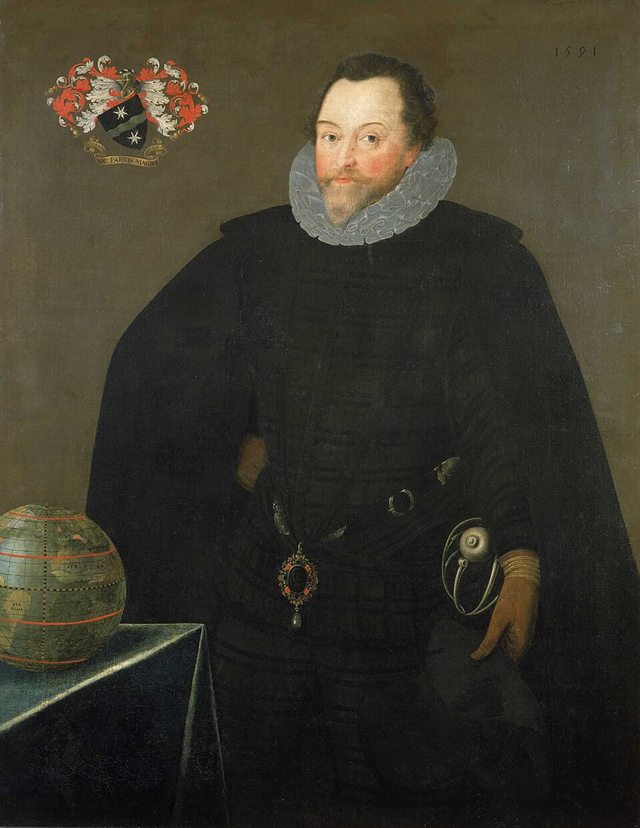
c.1540–1596
A Devon farmer's son who sailed on slaving voyages, raided Spain's silver, sailed round the world, fought the Armada, and died at sea off Panama.
Drake was a hero to Elizabethan England and a pirate to Spain, and he was also a participant in the Atlantic slave trade and in a massacre in Ireland. These five chapters follow his early voyages with John Hawkins, the raids in Panama and the events on Rathlin Island, the circumnavigation, the war at sea against Spain, and the Armada and his last voyage.
The five chapters
- Devon, the Medway and Guinea — A seaman's apprenticeship in the slave trade
- Panama and Rathlin — An alliance with escaped Africans, and a massacre in Ireland
- Round the World — A beheading, a treasure ship and a fortune for the Queen
- War by Sea — A knighthood, the Caribbean and Cadiz
- The Armada and the Last Voyage — Fireships, failure and a burial at sea
Chapter 1 · Devon, the Medway and Guinea
A seaman's apprenticeship in the slave trade
c.1540 – 1568 · Tavistock · the River Medway · the Guinea coast · San Juan de Ulúa
Francis Drake was born around 1540 near Tavistock in Devon, the son of a Protestant farmer, Edmund Drake, who later became a preacher. The family moved to Kent and for a time lived in an old ship on the River Medway. As a boy Drake was apprenticed to the master of a small coasting vessel and learned to handle a ship in the North Sea and the Channel.
His career at sea began through his kinsman John Hawkins of Plymouth. In the 1560s Hawkins organised voyages that sailed to the coast of West Africa, seized African men, women and children by raiding and by buying captives, and carried them across the Atlantic to be sold into slavery in Spain's Caribbean colonies. Drake sailed on these voyages. This was the beginning of English involvement in the Atlantic slave trade. The people taken were torn from their families and homes, crammed into ships where many died, and sold to work in Spanish colonies for the rest of their lives. Drake's part in it must be named plainly: it was the kidnapping and sale of human beings.
In September 1568 the third Hawkins voyage sheltered in the Mexican port of San Juan de Ulúa. A Spanish fleet arrived and, despite an agreement, attacked. Most of the English ships were lost and many men were killed or captured. Drake, commanding the small ship Judith, escaped and sailed home. Hawkins later complained that the Judith had abandoned him.
Drake blamed Spanish treachery for the disaster, and his lifelong hatred of Spain dates from it.
Why this matters
Drake's early voyages show that English overseas expansion began with the slave trade, and San Juan de Ulúa explains his lifelong war on Spain.
A slaving voyage and an ambush in a Mexican harbour. What would you put to him?
Ask Drake
- “How do you answer for the Africans you helped carry into slavery on Hawkins's voyages?”
- “Did you abandon John Hawkins at San Juan de Ulúa?”
- “Why did San Juan de Ulúa make you an enemy of Spain for life?”
- “What did you learn about the sea as an apprentice on a coasting barque?”
- “Why did English merchants like Hawkins want to break into Spain's colonial trade?”
Chapter 2 · Panama and Rathlin
An alliance with escaped Africans, and a massacre in Ireland
1572 – 1575 · Nombre de Dios · the Isthmus of Panama · Rathlin Island
In 1572 Drake sailed to Panama, where Spanish silver from Peru was carried across the isthmus by mule train to the Caribbean coast. He attacked the port of Nombre de Dios and was wounded, and the raid failed. He stayed on and found allies in the Cimarrons — Africans who had escaped slavery under the Spanish and built free communities in the forests. They guided him across the isthmus, where, according to the account of the voyage, he climbed a tree and saw the Pacific for the first time. In 1573, with the Cimarrons and French privateers, he captured a mule train carrying gold and silver.
The irony is sharp. A few years after helping to carry Africans into slavery, Drake depended on Africans who had freed themselves from it. One of them, Diego, joined him and later sailed on the voyage round the world.
In 1575 Drake was in Ireland, serving the Earl of Essex's attempt to conquer and settle Ulster. In July he commanded the ships that carried soldiers under John Norris to Rathlin Island, off the Antrim coast, where the MacDonnell clan had sent women, children and the elderly for safety. After the castle surrendered, the English soldiers killed the garrison and then hunted down and killed hundreds of people hiding on the island, including many women and children. Drake's ships blocked any escape or rescue by sea.
Rathlin is rarely mentioned in the heroic story of Drake. It should be, as part of the brutal English conquest of Ireland.
Why this matters
The Panama raids show Drake's methods and his reliance on the Cimarrons, while Rathlin shows the violence of English expansion in Ireland.
Silver taken with the help of escaped Africans, and a massacre on an Irish island. What would you ask him?
Ask Drake
- “Who were the Cimarrons, and why did they help you against Spain?”
- “How could you ally with escaped Africans after sailing on slaving voyages?”
- “What part did your ships play in the killings on Rathlin Island in 1575?”
- “Why did the English want to conquer Ulster in the 1570s?”
- “Why was the silver of Peru carried across Panama, and why was it so hard to guard?”
Chapter 3 · Round the World
A beheading, a treasure ship and a fortune for the Queen
1577 – 1580 · Port San Julián · the Strait of Magellan · the Pacific coast · Plymouth
In December 1577 Drake sailed from Plymouth with five ships, backed by investors who probably included the Queen. The official purpose was trade and exploration; the real aim was to raid Spain's undefended Pacific coast.
At Port San Julián in Patagonia in 1578, Drake accused Thomas Doughty, a gentleman on the voyage, of mutiny and witchcraft. After a hasty trial Doughty was beheaded. Drake then made a famous speech insisting that gentlemen must work alongside sailors. Whether Doughty was guilty of anything serious, and whether Drake had the legal right to execute him, is still argued.
Drake's flagship, the Pelican, was renamed the Golden Hind, and passed through the Strait of Magellan in about sixteen days. Storms then scattered the fleet; one ship sank and another turned home. Drake, alone, sailed north up the coasts of Chile and Peru, raiding ports and ships. In March 1579 he captured the treasure ship Nuestra Señora de la Concepción, nicknamed the Cacafuego, loaded with silver and gold.
He sailed far up the coast of North America and landed in June 1579 at a place he called Nova Albion, probably in California, claiming it for Elizabeth. He then crossed the Pacific, traded for spices in the Moluccas, nearly lost the ship on a reef, rounded Africa and reached Plymouth on 26 September 1580.
He was the first English captain to sail round the world. The treasure was enormous; the Queen's share was more than a year of her ordinary income, and his backers reportedly received many times their investment.
Why this matters
The circumnavigation showed English seamen could reach Spain's empire anywhere, and its profits encouraged the privateering war that followed.
A beheading in Patagonia, a treasure ship and a voyage round the world. What would you ask him?
Ask Drake
- “Did Thomas Doughty deserve to die at Port San Julián?”
- “Was the voyage meant for exploration or for raiding Spain?”
- “How did you capture the Cacafuego, and what was in her hold?”
- “Why did you claim Nova Albion for the Queen?”
- “How did the Queen's share of your treasure change her policy towards Spain?”
Chapter 4 · War by Sea
A knighthood, the Caribbean and Cadiz
1581 – 1587 · Deptford · Plymouth · Cartagena · Cadiz
On 4 April 1581 Elizabeth visited the Golden Hind at Deptford, and Drake was knighted on board. Spain demanded the return of the treasure; Elizabeth refused. Drake bought Buckland Abbey in Devon, became mayor of Plymouth and sat in Parliament. His first wife, Mary Newman, died in 1583, and in 1585 he married Elizabeth Sydenham, a wealthy heiress.
In 1585 relations with Spain broke down completely, and Drake led a large fleet to the Caribbean. He sacked Santo Domingo and Cartagena, holding them to ransom, and burned the Spanish fort at St Augustine in Florida. At Cartagena several hundred people held as galley slaves or enslaved — Africans, Turks and others — were taken aboard. What became of most of them is unknown; some may have been left at the English colony of Roanoke, and the record is unclear. On the way home Drake picked up the struggling Roanoke colonists and brought them back to England. The voyage made less money than its backers hoped, but it humiliated Spain.
In April 1587, as Philip II gathered his invasion fleet, Drake sailed into the harbour of Cadiz and destroyed or captured a large number of ships and great quantities of stores, including seasoned barrel staves the Armada badly needed. He then cruised off the Portuguese coast, attacking supplies.
How much this delayed the Armada is debated, but most historians think it pushed the invasion back about a year.
Why this matters
Drake's raids of 1585–87 turned privateering into open naval war and helped delay the Armada.
A knighthood on deck, ransomed cities and a burning harbour at Cadiz. What would you ask him?
Ask Drake
- “Why did the Queen knight you when Spain was demanding the treasure back?”
- “What happened to the people taken aboard your ships at Cartagena in 1586?”
- “How much did your raid on Cadiz really delay the Armada?”
- “Why were barrel staves so important to the Spanish fleet?”
- “Was your 1585 voyage to the Caribbean war or piracy?”
Chapter 5 · The Armada and the Last Voyage
Fireships, failure and a burial at sea
1588 – 1596 · Plymouth · the Channel · Gravelines · Lisbon · Portobelo
In July 1588 the Spanish Armada entered the Channel. Lord Howard of Effingham commanded the English fleet and Drake was his Vice-Admiral. The famous story that Drake insisted on finishing his game of bowls on Plymouth Hoe first appears long after his death and is a legend.
On the first night of the running fight, Drake was meant to lead the fleet by a lantern. He put it out and went after the damaged Spanish ship Rosario, capturing her and her commander, Pedro de Valdés, with a large sum of money. The fleet lost its way, and Martin Frobisher accused Drake of putting prize before duty. When the Armada anchored off Calais, the English sent in fireships, one of them Drake's own, which scattered the Spanish fleet. At Gravelines on 8 August the English closed in with their guns. The Armada was then driven north and wrecked by storms around Scotland and Ireland. The victory belonged to many commanders, to Spanish supply problems and to the weather, not to one man.
In 1589 Drake and Sir John Norris led a counter-armada against Spain and Portugal. It failed to destroy the surviving Spanish ships or take Lisbon, and thousands of men died, mostly of disease. Drake's reputation suffered and he was given no major command for years.
In 1595 he and Hawkins sailed once more for the Caribbean. Hawkins died off Puerto Rico; the attacks failed. Drake died of dysentery off Portobelo on 28 January 1596 and was buried at sea in a lead coffin.
Why this matters
Drake's part in 1588 was real but shared, and the failures of 1589 and 1595–96 show the limits of Elizabethan sea power.
A lantern put out, fireships at Calais, and a failure at Lisbon. What would you ask him?
Ask Drake
- “Why did you put out the lantern and go after the Rosario?”
- “How did the fireships off Calais break the Armada's formation?”
- “How much did English seamanship decide 1588, and how much the weather?”
- “Why did the counter-armada of 1589 fail?”
- “Did you ever say anything about bowls on Plymouth Hoe?”
What Drake changed
Drake helped make sea power central to English strategy and identity, and his circumnavigation and raids challenged Spain's hold on the Americas. He was also part of the beginning of England's role in the Atlantic slave trade and of the violent conquest of Ireland, and both belong in any honest account of him.
A debate that continues
Historians debate whether Drake should be seen chiefly as a national hero, a state-sponsored pirate, or a figure whose career shows the violence at the root of English expansion — and how important he really was to the defeat of the Armada.
Keep exploring — ask Drake
- “How should a country remember national heroes who also took part in the slave trade?”
- “Was there a real difference between a privateer and a pirate?”
- “Why do some events, like Rathlin, drop out of popular history?”
Related lives
- Elizabeth I — Queen of England · The Virgin Queen
- Francis Walsingham — Principal Secretary · Spymaster
- William Cecil — Secretary · Lord Treasurer · The Queen's Spirit
Related themes
Elizabethan exploration and voyages · The Spanish Armada · The beginnings of the English slave trade · Privateering
Continue on Incandio
- Talk to Drake — every question on this page is one tap from being asked, and the same page carries the Historical Brief, the achievements and the timeline
- All 280 figures · Incandio — learn every idea, teach it, then defend it