Explore Their Life · Pearson Edexcel International GCSE revision on Incandio
William Cecil: A Life in Five Chapters
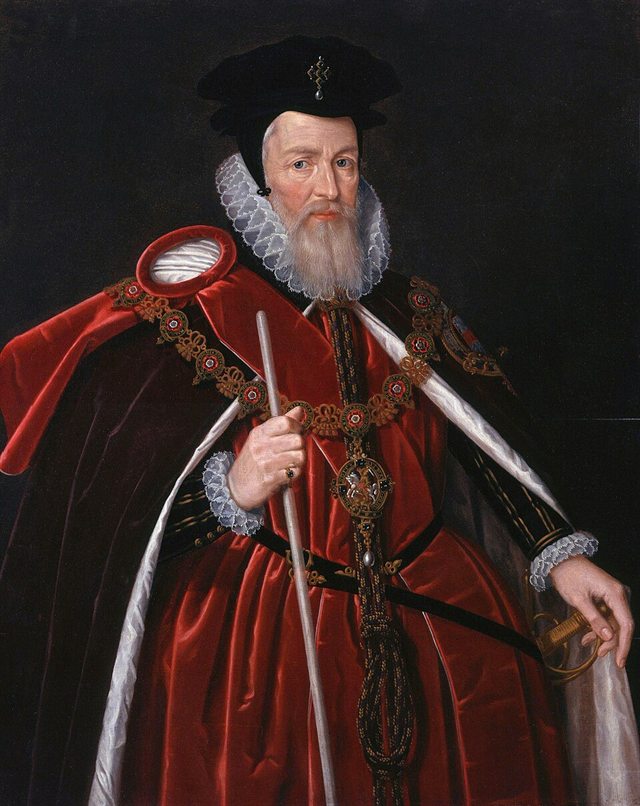
1520–1598
A Lincolnshire courtier's son who survived four Tudor monarchs, served Elizabeth for forty years, settled her Church, and sent the warrant that ended the life of a queen.
William Cecil is the man behind almost every decision of Elizabeth's reign, and the man historians argue about most when they ask who really governed. These five chapters follow his apprenticeship under Edward and Mary, the first years of Elizabeth's reign, the crisis that followed Mary Stuart's arrival in England, the warrant of 1587, and an old man's last struggle over money, war and the succession.
The five chapters
- A Survivor's Apprenticeship — Three reigns, two falls and one conformity
- The Queen's Secretary — A new reign, a new Church, and a vote of three
- The Problem in the North — A queen in England, a rising, a bull and a duke
- The Warrant — A bond, a trial and a queen's fury
- Money, War and the Succession — An old Lord Treasurer and a son to follow him
Chapter 1 · A Survivor's Apprenticeship
Three reigns, two falls and one conformity
1520 – 1558 · Bourne · Cambridge · London
William Cecil was born in 1520 at Bourne in Lincolnshire, the son of a minor official at Henry VIII's court. He went to St John's College, Cambridge, which in the 1530s was the centre of the new humanist learning and of quiet Protestant sympathy, and then to Gray's Inn to study law. He married Mary Cheke, the sister of his tutor; she died in 1544 and the next year he married Mildred Cooke, one of the most learned women in England.
He rose in the household of the Duke of Somerset, who governed for the boy-king Edward VI. When Somerset fell in 1549 Cecil spent some weeks in the Tower of London. He came out, switched his service to the new leader, the Duke of Northumberland, and in 1550 became Secretary of State at about thirty.
In 1553 Edward died and Northumberland tried to put Lady Jane Grey on the throne. Cecil put his name to the document that settled the crown on her, and later claimed he had signed only as a witness. When Mary I won, he made his peace with her. He kept no high office, but he heard Mass, conformed outwardly to the restored Catholic Church, and even travelled with the delegation that brought Cardinal Pole back to England.
Throughout, he managed the lands of Princess Elizabeth. Historians disagree about how deliberately he was preparing for her reign; what is clear is that he had learned the one lesson that kept a Tudor minister alive — survive first, and serve the next monarch better than the last.
Why this matters
Cecil's early career shows how dangerous Tudor politics was, and that the Protestant minister of Elizabeth's reign had conformed under a Catholic queen to stay alive.
Two falls, a disputed signature and a quiet conformity. What would you ask him about how he survived?
Ask Cecil
- “Did you sign Lady Jane Grey's device as a witness or as a supporter?”
- “How could a Protestant like you hear Mass under Mary without shame?”
- “What did your weeks in the Tower in 1549 teach you about serving great men?”
- “Were you already planning for Elizabeth's reign while you managed her lands?”
- “Why did the learning of St John's College matter so much to your generation?”
Chapter 2 · The Queen's Secretary
A new reign, a new Church, and a vote of three
1558 – 1563 · Hatfield · Westminster · Edinburgh
Mary I died on 17 November 1558 and Elizabeth chose Cecil as her Secretary at once. He had served her as surveyor of her lands while she was a princess, and she trusted his judgement and his discretion. For forty years he gave her advice she did not always want, and she kept him in office.
The first task was religion. England had changed its official faith three times in twelve years. The Act of Supremacy of 1559 made Elizabeth Supreme Governor of the Church, and the Act of Uniformity restored a Protestant Prayer Book. The Catholic bishops in the House of Lords fought it, and the Act of Uniformity passed there by just three votes, after two bishops had been imprisoned following a public disputation. Historians still argue how much of the Settlement was Elizabeth's design and how much Cecil's management.
The second task was Scotland. In 1560 Cecil persuaded a reluctant Queen to send money and troops to help Scottish Protestant lords against the French forces supporting Mary of Guise. He went north himself and negotiated the Treaty of Edinburgh, which sent the French home. It was probably his greatest single success in foreign policy.
The third task he never achieved. Cecil wanted Elizabeth to marry and produce an heir. He feared above all a marriage to her favourite Robert Dudley, whose wife Amy Robsart was found dead at the foot of the stairs in 1560. The Queen did not marry Dudley — and did not marry anyone.
Why this matters
The Religious Settlement and the Treaty of Edinburgh shaped the whole reign, and Cecil's failure on marriage left the succession question that haunted it.
A Settlement passed by three votes, a treaty and a marriage that never happened. What would you ask him?
Ask Cecil
- “Was the Settlement of 1559 your design or the Queen's?”
- “How did you get the Act of Uniformity through a House of Lords full of Catholic bishops?”
- “Why did you risk English troops in Scotland in 1560?”
- “Why were you so determined that the Queen should not marry Robert Dudley?”
- “What did the Queen mean when she asked you for counsel without respect of her private will?”
Chapter 3 · The Problem in the North
A queen in England, a rising, a bull and a duke
1568 – 1572 · York · Durham · Tower Hill
In May 1568 Mary, Queen of Scots crossed the Solway into England. For Cecil she was the danger he had always feared made flesh: a Catholic with the strongest claim to Elizabeth's throne, now inside the realm. He organised the inquiry at York and Westminster in 1568–69, where the Scottish lords produced the 'casket letters' that seemed to tie Mary to her husband's murder. No verdict was given. Mary stayed, as a prisoner.
In 1569 a plan was floated to marry Mary to the Duke of Norfolk, England's only duke, and some conservative nobles hoped at the same time to bring Cecil himself down. In November the Earls of Northumberland and Westmorland rose in the north, heard Mass in Durham Cathedral and marched south. The rising collapsed, and hundreds of the rebels were executed on the Queen's orders.
In 1570 Pope Pius V issued the bull Regnans in Excelsis, excommunicating Elizabeth and releasing her subjects from obedience. In Cecil's eyes it turned a religious difference into a question of loyalty. In 1571 he helped uncover the Ridolfi Plot, a scheme by a Florentine banker to bring a Spanish army to England, free Mary and marry her to Norfolk. Norfolk was tried and executed in June 1572.
The same years made Cecil Baron Burghley in 1571 and Lord Treasurer in 1572. He now argued that Mary should die as well. Parliament agreed with him in 1572. Elizabeth refused, and kept refusing for fifteen years.
Why this matters
The years 1568–72 turned Mary from a guest into a prisoner and English Catholicism from a private faith into a political danger in the government's eyes.
A rising, a papal bull and a duke on the scaffold. What would you ask him about the danger Mary posed?
Ask Cecil
- “Why did the inquiry at York and Westminster end without a verdict on Mary?”
- “Were the northern earls rising against the Queen or against you?”
- “How did the papal bull of 1570 change the way you treated English Catholics?”
- “How was the Ridolfi Plot discovered, and how real a danger was it?”
- “Why did Elizabeth refuse Parliament's demand for Mary's death in 1572?”
Chapter 4 · The Warrant
A bond, a trial and a queen's fury
1583 – 1587 · Westminster · Greenwich · Fotheringhay
In 1583 Cecil published a pamphlet called The Execution of Justice in England. Catholic priests trained abroad were entering England in growing numbers, and some were being executed. The pamphlet argued that they died not for their faith but for treason, because they would not reject the Pope's power to depose the Queen. Catholics answered that they were martyrs. The argument has never ended.
The Throckmorton Plot of 1583 and the assassination of the Protestant leader William of Orange in 1584 frightened the council badly. Cecil and Walsingham drew up the Bond of Association, whose signers swore to kill anyone in whose name the Queen was murdered; Parliament's Act for the Queen's Safety of 1585 gave it legal form. When Walsingham's agents trapped Mary in the Babington Plot in 1586, the law was ready.
Mary was tried at Fotheringhay in October 1586 and condemned. Elizabeth delayed for months. On 1 February 1587 she signed the death warrant and gave it to her secretary William Davison, while hinting that she would prefer Mary to be quietly killed by her keeper under the Bond. Cecil called the council together and they sent the warrant without telling her. Mary was executed on 8 February.
Elizabeth's anger was enormous, whether real or performed for the courts of Europe. Davison was fined and sent to the Tower. Cecil was banished from her presence and wrote her letters begging to be readmitted. He had got what he had wanted for nearly twenty years, and he paid for it in the only coin that frightened him.
Why this matters
The execution of Mary was the turning point of the reign's Catholic threat, and Cecil's part in it shows how a councillor could act for a queen against her stated wishes.
A pamphlet, a bond and a warrant sent without her knowledge. What would you ask him?
Ask Cecil
- “Were the priests executed in the 1580s traitors or martyrs?”
- “Why did you send the warrant to Fotheringhay without telling the Queen?”
- “Was Elizabeth's anger after the execution real or a performance for Spain and Scotland?”
- “Was it fair that William Davison went to the Tower for doing what the council decided?”
- “What did the Bond of Association ask ordinary gentlemen to swear?”
Chapter 5 · Money, War and the Succession
An old Lord Treasurer and a son to follow him
1588 – 1598 · Theobalds · Cecil House · the Exchequer
Cecil had argued for years against open war with Spain, mainly because of what it would cost. When it came, he had to pay for it. The defeat of the Armada in 1588 was followed by fifteen more years of war at sea, in the Netherlands, in France and in Ireland. The Crown's ordinary income was far too small. Cecil raised money through parliamentary grants, sales of royal land and loans, and the old weakness of royal finance was never reformed.
He also grew rich in the Queen's service. As Master of the Court of Wards he controlled the profitable guardianship of heirs who inherited as children, and the fees and favours that came with it helped pay for his great houses at Theobalds and Burghley. Contemporaries complained; Cecil saw no contradiction.
His political energy in the 1590s went into one aim: making sure his younger son Robert, small, clever and crooked-backed, would succeed to his influence. The young Earl of Essex, the Queen's last favourite, saw the Cecils as his enemies, and court politics divided between the two camps. In 1596 Robert became Secretary of State.
By then his father was old and crippled by gout. He died at Cecil House on 4 August 1598. It was reported that in his last illness the Queen fed him with her own hand. He did not live to see the question he had worried about for forty years settled. Robert Cecil would secretly arrange the succession of James VI of Scotland — Mary's son.
Why this matters
Cecil's last decade shows the costs of the Spanish war, the private profits of public office, and how a minister built a political dynasty.
A war he never wanted, a fortune and a son to carry it on. What would you ask him?
Ask Cecil
- “How did you pay for a war against the richest empire in Europe?”
- “Was it right for the Master of the Court of Wards to grow rich from orphaned heirs?”
- “Why did the Earl of Essex see you and your son as enemies?”
- “Why did the Queen still refuse to name an heir in the 1590s?”
- “What did you teach Robert about serving a monarch?”
What Cecil changed
Cecil gave Elizabethan government its shape: the Religious Settlement, the working Privy Council, careful if unreformed finance and a ruthless approach to the Catholic threat. He served one queen for forty years and founded a family that has stayed in English politics ever since.
A debate that continues
Did Cecil govern Elizabeth, or did she govern him? Older histories made him the real ruler behind a cautious queen; more recent work stresses how often she overruled him on marriage, war and money.
Keep exploring — ask Cecil
- “Can a minister be loyal to a monarch while acting against her wishes?”
- “Was outward conformity in religion a fair demand to make of people?”
- “How much did Elizabeth's success depend on Cecil?”
Related lives
- Elizabeth I — Queen of England · The Virgin Queen
- Francis Walsingham — Principal Secretary · Spymaster
- Mary, Queen of Scots — Queen of Scots · Dowager of France · Prisoner of England
- Francis Drake — Circumnavigator · Privateer · Vice-Admiral
Related themes
The Elizabethan Religious Settlement · Elizabethan government and the Privy Council · Mary, Queen of Scots · The succession question
Continue on Incandio
- Talk to Cecil — every question on this page is one tap from being asked, and the same page carries the Historical Brief, the achievements and the timeline
- All 280 figures · Incandio — learn every idea, teach it, then defend it