Historical figure · Pearson Edexcel International GCSE revision on Incandio
Franklin D. Roosevelt
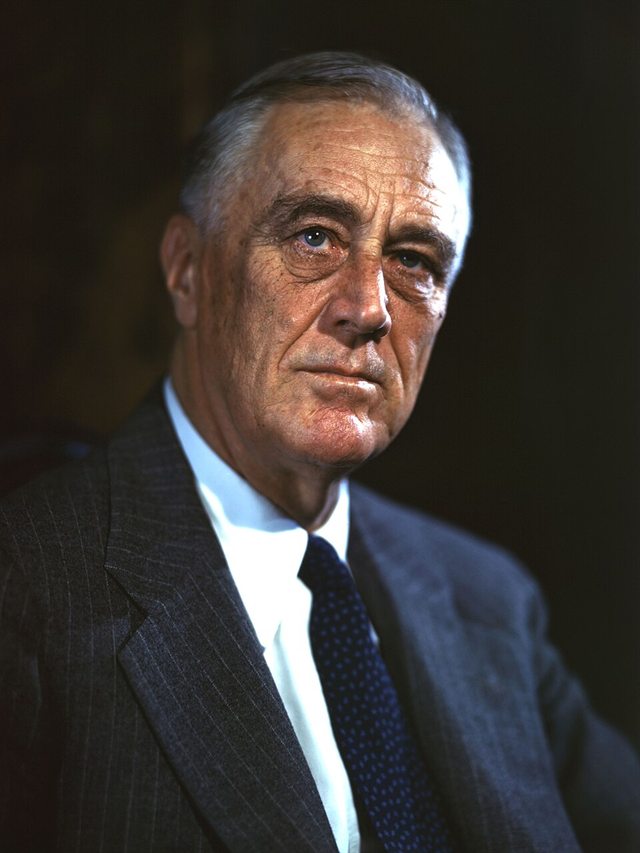
Try It, And If It Fails Admit It Frankly · President of the United States · 1882–1945
The president of the Depression and the war, elected four times, who closed the banks in his first week and was dead two months after Yalta.
Defend these ideas against Roosevelt
Incandio is a free revision platform for the Pearson Edexcel International GCSE, and on it a topic counts as mastered only once you have learned it, proved it in questions, taught it back and defended it against the person with the strongest claim on it. Franklin D. Roosevelt is that person for one topic on the course:
- Tehran, Yalta and Potsdam — History · A world divided: superpower relations, 1943–72
Who was Roosevelt?
Born at Hyde Park in 1882 into a patrician family, Roosevelt lost the use of his legs to polio in 1921 and returned to politics as Governor of New York. He took office in March 1933 with the banking system closing, shut every bank by proclamation and reopened the sound ones four days later. The Hundred Days produced the AAA, the NRA, the CCC and the TVA; the Wagner Act and Social Security followed in 1935. He attempted to enlarge the Supreme Court in 1937 and was defeated by his own party, and cut spending the same year, producing a sharp recession. He moved the United States from neutrality to Lend-Lease to war, met Churchill and Stalin at Tehran in 1943 and Yalta in February 1945, and died at Warm Springs on 12 April 1945.
Major achievements
- Reopened the banking system within a week of taking office in March 1933
- Carried the Hundred Days legislation and, in 1935, the Wagner Act and Social Security
- Moved a neutral country to Lend-Lease and then to war
- Held the wartime alliance together through Tehran and Yalta
Life in brief
- 1882 — Born at Hyde Park: Into a patrician New York family.
- 1921 — Polio: Loses the use of his legs at thirty-nine.
- 1933 — The bank holiday and the Hundred Days: Banks closed by proclamation in his first week.
- 1937 — Court-packing and recession: Beaten by his own party; spending cuts contract the economy.
- 1945 — Yalta, February: The Declaration on Liberated Europe is agreed.
- 1945 — Dies on 12 April: At Warm Springs, two months after Yalta.
Explore the life of Roosevelt — five chapters
- Hyde Park — An only child with a famous surname
- Campobello — Thirty-nine, and unable to stand
- The New Deal — A hundred days, and an argument that never ended
- The Arsenal and the Alliance — Neutrality, Lend-Lease, and a war run from a wheelchair
- Two Things That Do Not Fit — Executive Order 9066, and the trains that were not bombed
Read the five-chapter life of Franklin D. Roosevelt →
Begin
- Start a conversation with Roosevelt — a dramatised, historically grounded AI portrayal
- Read the Historical Brief
- Explore the life of Roosevelt — five chapters
- Find your course · Meet all 280 figures