Explore Their Life · Pearson Edexcel International GCSE revision on Incandio
Franklin D. Roosevelt: A Life in Five Chapters
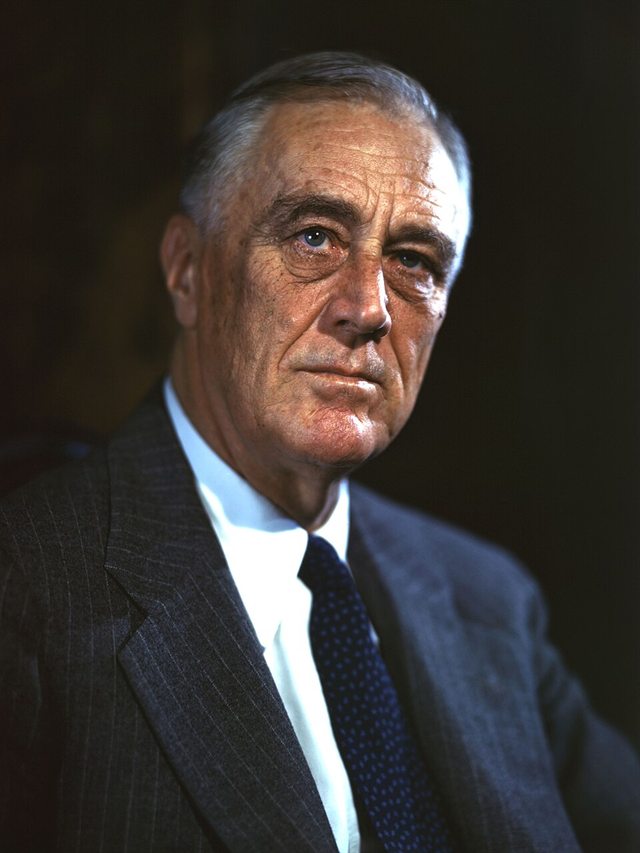
1882–1945
A rich man's son who lost the use of his legs at thirty-nine, was elected president four times, rebuilt the American state, and signed the order that put a hundred and twenty thousand of his own citizens behind wire.
Roosevelt governed the United States for twelve years, through the worst depression and the largest war in its history. These five chapters follow the privileged beginning, the illness that reshaped him, the New Deal, the war and the alliance, and the two decisions of his presidency that are hardest to defend.
The five chapters
- Hyde Park — An only child with a famous surname
- Campobello — Thirty-nine, and unable to stand
- The New Deal — A hundred days, and an argument that never ended
- The Arsenal and the Alliance — Neutrality, Lend-Lease, and a war run from a wheelchair
- Two Things That Do Not Fit — Executive Order 9066, and the trains that were not bombed
Chapter 1 · Hyde Park
An only child with a famous surname
1882 – 1920 · Hyde Park · Groton · Harvard · Washington
Franklin Roosevelt was born in 1882 on his family's estate at Hyde Park in the Hudson Valley, the only child of an elderly father and a formidable mother who remained the dominant figure in his life for another fifty years. He was educated at home until fourteen, then Groton and Harvard. He was not academically distinguished and was extremely socially successful.
His distant cousin Theodore Roosevelt became president when Franklin was nineteen, and provided both a model and a route: state legislature, then a federal appointment, then higher office. Franklin followed it almost exactly. In 1905 he married Eleanor Roosevelt, Theodore's niece — a marriage that became one of the most consequential political partnerships in American history and, after 1918, was not a marriage in the ordinary sense.
He was elected to the New York state senate in 1910 and made Assistant Secretary of the Navy in 1913, the same post Theodore had held. He ran for vice-president on the losing Democratic ticket in 1920.
At thirty-eight he was charming, ambitious, well connected and widely considered lightweight. Contemporaries described him as a young man with a famous name and no particular convictions, and the description was not unfair.
Why this matters
Roosevelt began as a conventional patrician politician, which makes the question of what changed him a real question.
A famous surname and no particular convictions. What would you ask him?
Ask Roosevelt
- “How much of your career was Theodore's route walked again?”
- “What did your mother expect of you?”
- “What did Eleanor bring to your politics?”
- “Were you a serious politician before 1921?”
- “What did the Navy Department teach you about running things?”
Chapter 2 · Campobello
Thirty-nine, and unable to stand
1921 – 1932 · Campobello Island · Warm Springs · Albany
In August 1921, on holiday at Campobello Island, Roosevelt fell ill and within days had lost the use of his legs. It was diagnosed as poliomyelitis; some later analyses have suggested Guillain–Barré syndrome, and the question cannot now be settled. He was thirty-nine and he never walked unaided again.
His mother wanted him to retire to Hyde Park and live as an invalid. Eleanor and his adviser Louis Howe fought her and won, and the fight changed the marriage and the political operation permanently: Eleanor began speaking and travelling on his behalf because he could not, and never stopped.
He spent years on rehabilitation at Warm Springs in Georgia, which he bought and turned into a treatment centre. He learned to appear to walk, using leg braces locked at the knee, a stick, and the arm of a son — a slow, exhausting performance he used for the rest of his life, because a man in a wheelchair could not be elected president in 1932. The press cooperated in the fiction almost completely.
What the illness did to him is genuinely contested. Frances Perkins and others who knew him before and after said it gave him a capacity for other people's suffering he had entirely lacked. He returned to politics in 1928 as Governor of New York and was elected president in 1932 with the country in its fourth year of depression.
Why this matters
The performance of walking was a political necessity, and the fact that an entire press corps sustained it says as much about the period as about the man.
Leg braces, a stick and a son's arm. What would you ask him?
Ask Roosevelt
- “What did the years at Warm Springs actually change?”
- “Why was it necessary to appear to walk?”
- “What did Eleanor do for you in those years that nobody else could?”
- “Did losing the use of your legs make you a different politician?”
- “Should the press have told the country the truth about your health?”
Chapter 3 · The New Deal
A hundred days, and an argument that never ended
1933 – 1939 · Washington · The Tennessee Valley
Roosevelt took office in March 1933 with a quarter of the workforce unemployed and the banking system closing. In the first hundred days he shut the banks and reopened the sound ones under federal guarantee, took the dollar off gold, and pushed through a volume of legislation no president had attempted: relief, public works, farm price supports, industrial codes, and the Tennessee Valley Authority.
The second wave from 1935 was more permanent and more radical: the Social Security Act, which created old-age pensions and unemployment insurance; the Wagner Act, which made union recognition enforceable; and the Works Progress Administration, which employed millions directly.
He also used the radio. The fireside chats were roughly thirty broadcasts across twelve years, in plain language, explaining what the government was doing — and they changed the relationship between a president and the public permanently.
Whether the New Deal ended the Depression is still argued: unemployment fell substantially and remained very high, and there was a sharp renewed downturn in 1937–38 when spending was cut. What is not in doubt is that it built the American welfare state and the regulatory system, and that both survived.
In 1937, frustrated by a Supreme Court striking down his programme, he proposed enlarging the Court. Congress refused, his own party split, and it is generally regarded as the worst political misjudgement of his career.
Why this matters
The New Deal is the origin of the modern American state, and the question of whether it ended the Depression is separate from the question of what it built.
A hundred days and a court-packing plan. What would you ask him?
Ask Roosevelt
- “Was there a plan in March 1933, or did you improvise?”
- “Which New Deal measure did you expect to last longest?”
- “Why did you try to enlarge the Supreme Court?”
- “What did the fireside chats let you do that speeches could not?”
- “Why did you never support a federal anti-lynching law?”
Chapter 4 · The Arsenal and the Alliance
Neutrality, Lend-Lease, and a war run from a wheelchair
1939 – 1945 · Washington · Placentia Bay · Tehran · Yalta
Roosevelt spent 1939 to 1941 moving a country that did not want a war closer to one. Neutrality was progressively loosened; destroyers were traded to Britain for bases; and in March 1941 Lend-Lease allowed the United States to supply Britain and later the Soviet Union without payment. He called America the arsenal of democracy and said the country would not fight, and he knew the two positions could not both hold.
In January 1941 he set out the Four Freedoms — of speech and worship, from want and fear — as war aims before there was a war. In August he met Churchill at Placentia Bay and issued the Atlantic Charter. Pearl Harbor came in December, and the Germany-first decision followed.
He was elected four times, the only president to serve more than two terms, and the amendment preventing anybody repeating it was passed shortly after his death.
As a war leader he was a coordinator rather than a strategist: he chose Marshall, backed him, presided over an economy that out-produced every other combatant several times over, and managed an alliance with Churchill and Stalin that held together despite having almost nothing in common beyond an enemy.
He went to Yalta in February 1945 visibly dying. He died at Warm Springs on 12 April 1945, four weeks before the German surrender.
Why this matters
American production, not American armies, was Roosevelt's decisive contribution, and Lend-Lease is where it starts.
An arsenal, four freedoms and a fourth term. What would you ask him?
Ask Roosevelt
- “Were you honest with Americans about how close war was in 1940?”
- “What was Lend-Lease meant to achieve that selling arms could not?”
- “How did you handle Churchill and Stalin in the same room?”
- “Was seeking a fourth term fair to the country?”
- “Were you well enough at Yalta to negotiate?”
Chapter 5 · Two Things That Do Not Fit
Executive Order 9066, and the trains that were not bombed
1942 – 1945 · Washington · Manzanar · Europe
In February 1942 Roosevelt signed Executive Order 9066. Under it around a hundred and twenty thousand people of Japanese descent, about two-thirds of them American citizens, were removed from the west coast and held in camps for the duration of the war. They lost homes, businesses and land. The Supreme Court upheld it in 1944. No comparable measure was applied to Americans of German or Italian descent, and no case of espionage was ever established against those interned. Congress formally apologised and paid reparations in 1988.
The second is the refusal, in 1944, to bomb the rail lines to Auschwitz or the camp itself, when the request was made and when American aircraft were bombing industrial targets within a few miles. The War Department's stated reason was that it would divert resources from winning the war, which was the fastest route to ending the killing. Historians disagree about whether bombing would have saved lives and agree that the request was not seriously examined. The broader record on Jewish refugees before the war — the immigration quotas, the Évian conference, the St Louis turned away in 1939 — is of a piece with it.
Neither of these is a footnote to Roosevelt's presidency and neither cancels the New Deal or the war. They belong in the account because a version of him without them is not the man who governed.
Why this matters
The president who defined the war as a fight for four freedoms interned a hundred and twenty thousand of his own citizens without charge.
Two decisions that do not fit the rest. What would you put to him?
Ask Roosevelt
- “What security threat did Executive Order 9066 answer?”
- “Why were German and Italian Americans not treated the same way?”
- “Was the request to bomb the railways to Auschwitz ever put to you?”
- “Could more refugees have been admitted before 1939?”
- “How do the Four Freedoms sit beside the camps at Manzanar?”
What Roosevelt changed
Roosevelt built the American welfare state, the regulatory system and the industrial machine that decided the Second World War, and he changed what a president was expected to be — a voice in the house every week, and a government that intervened. He also signed Executive Order 9066, blocked civil rights legislation to hold his Southern coalition, and left the postwar settlement half-negotiated when he died. He is the strongest available case that a leader can be transformative and unjust in the same term of office.
A debate that continues
Did the New Deal end the Depression, or did the war? Unemployment remained very high until rearmament, and economists have argued the point for eighty years without settling it.
Keep exploring — ask Roosevelt
- “Can a country be defended by suspending the rights it is defending?”
- “Should a president compromise on justice to hold a governing majority?”
- “Was the New Deal a rescue of capitalism or a challenge to it?”
Related lives
- Harry S. Truman — Eighty-Two Days, And Nobody Told Him Anything
- Eleanor Roosevelt — First Lady of the World
- Winston Churchill — Prime Minister of Great Britain
Related themes
The Great Depression and the New Deal · The wartime alliance · Civil liberties in wartime
Continue on Incandio
- Talk to Roosevelt — every question on this page is one tap from being asked, and the same page carries the Historical Brief, the achievements and the timeline
- All 280 figures · Incandio — learn every idea, teach it, then defend it