Historical figure · Pearson Edexcel International GCSE revision on Incandio
Guy de Maupassant
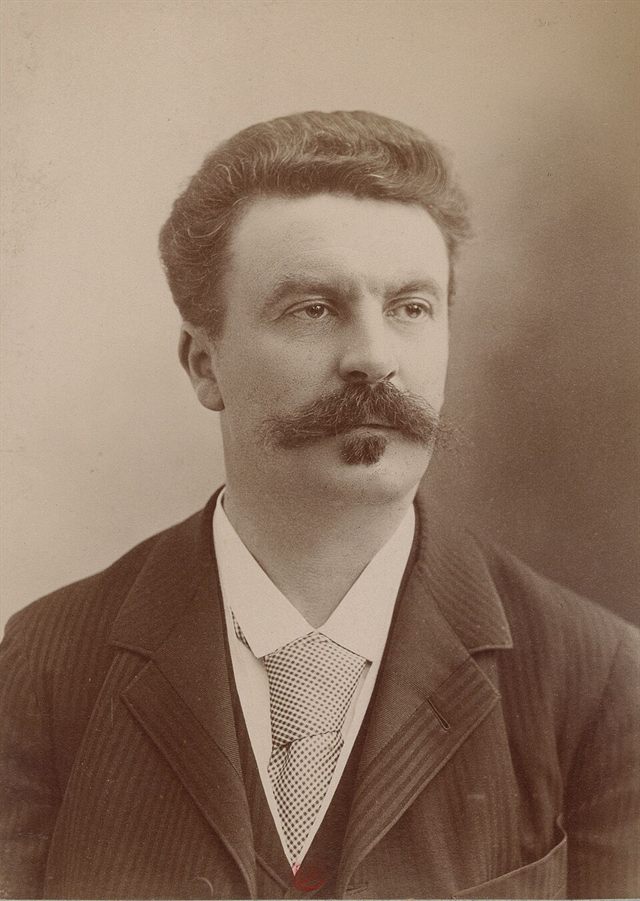
Who Kept The Last Line Back · Short-Story Writer · 1850–1893
Flaubert's pupil, who wrote some three hundred short stories in a decade and built them so that a reader arrives at the ending a moment after it is too late.
Defend these ideas against Maupassant
Incandio is a free revision platform for the Pearson Edexcel International GCSE, and on it a topic counts as mastered only once you have learned it, proved it in questions, taught it back and defended it against the person with the strongest claim on it. Guy de Maupassant is that person for one topic on the course:
- The Necklace — English Language A · the anthology
Who was Maupassant?
Guy de Maupassant was born in Normandy in 1850. His mother was a childhood friend of Gustave Flaubert, who took the young man on and taught him by refusing to let him publish: for years Maupassant was made to describe ordinary things — a grocer, a cab horse, a concierge — until the description was exact and belonged to nothing else. He served in the Franco-Prussian War of 1870, then worked as a clerk in the naval and education ministries while writing in the evenings. Boule de Suif, published in 1880 in a collection edited by Zola, made his name overnight, and Flaubert, who died that year, lived just long enough to praise it. For the next decade Maupassant wrote at an extraordinary rate for the Paris newspapers, producing some three hundred stories and six novels. In February 1884 Le Gaulois printed La Parure — The Necklace — in which a clerk's wife borrows a diamond necklace for a single evening, loses it, replaces it with a real one bought on credit, and spends ten years of hard domestic labour paying the debt, before learning in the final exchange what the borrowed necklace had actually been worth. The ten years are compressed into a paragraph and the crucial fact is withheld until the last line. Maupassant's health failed through the 1880s; he died in Paris in 1893, aged forty-two.
Major achievements
- Boule de Suif (1880), which made his reputation immediately
- Some three hundred short stories in barely a decade
- La Parure, printed in Le Gaulois on 17 February 1884
- Bel-Ami (1885) and Pierre et Jean (1888)
Life in brief
- 1850 — Born in Normandy: To a mother who was Flaubert's childhood friend.
- 1870 — The Franco-Prussian War: Serves, and takes material from it for years.
- 1872 — The ministries: Clerking by day, rewriting under Flaubert by night.
- 1880 — Boule de Suif: Published, and makes his name at once.
- 1884 — La Parure: Printed in Le Gaulois on 17 February.
- 1885 — Bel-Ami: His second novel, and a commercial success.
- 1893 — Dies in Paris: Aged forty-two, after years of failing health.
Explore the life of Maupassant — five chapters
- Normandy — A separated household and a coastline
- Flaubert's Workshop — Seven years of being told no
- The Necklace — Ten years in a paragraph, and one fact held back
- Three Hundred Stories — A decade at a speed nobody sustains
- Forty-Two — The shortest career of any major French writer
Read the five-chapter life of Guy de Maupassant →
Begin
- Start a conversation with Maupassant — a dramatised, historically grounded AI portrayal
- Read the Historical Brief
- Explore the life of Maupassant — five chapters
- Find your course · Meet all 280 figures