Explore Their Life · Pearson Edexcel International GCSE revision on Incandio
Guy de Maupassant: A Life in Five Chapters
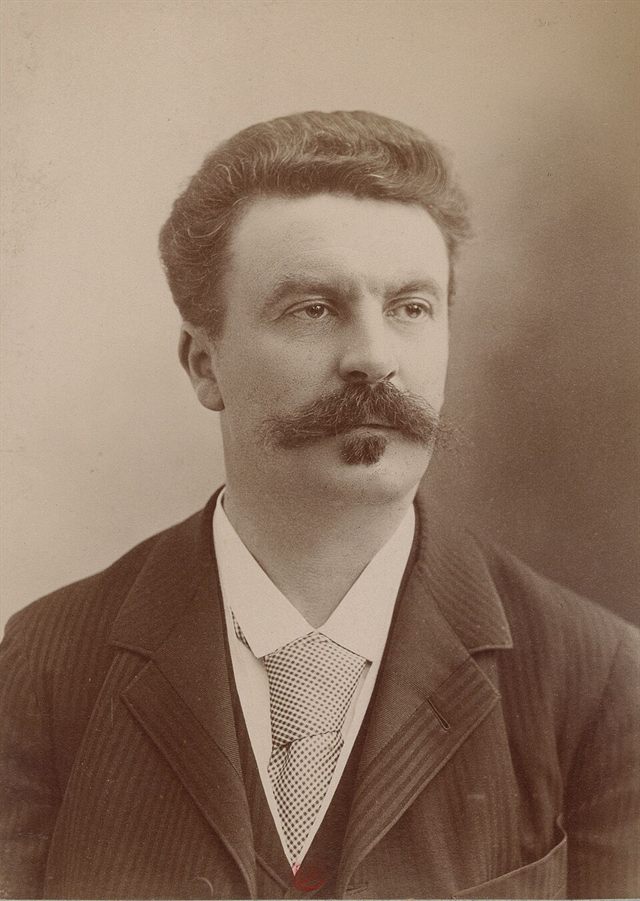
1850–1893
A ministry clerk who was forbidden to publish for years by the greatest prose stylist in France, and then wrote three hundred stories in a decade that used him up.
Maupassant learned to write by being corrected and refused, made his name overnight at thirty, and worked at a pace that no writer sustains. These five chapters follow the Norman childhood, Flaubert's workshop, the story that made him, the story most of the world knows him by, and the decade that ended at forty-two.
The five chapters
- Normandy — A separated household and a coastline
- Flaubert's Workshop — Seven years of being told no
- The Necklace — Ten years in a paragraph, and one fact held back
- Three Hundred Stories — A decade at a speed nobody sustains
- Forty-Two — The shortest career of any major French writer
Chapter 1 · Normandy
A separated household and a coastline
1850 – 1869 · Normandy · Étretat · Rouen
Guy de Maupassant was born in Normandy in 1850. His parents separated when he was about eleven — unusual and difficult in that society — and he was brought up largely by his mother, Laure, who was well read, strong-minded, and had been a close childhood friend of Gustave Flaubert.
He spent his boyhood outdoors on the Norman coast around Étretat, among fishermen, farmers and boats, and he was expelled from a seminary school, apparently with some relief on both sides. He finished his education at the lycée in Rouen, where Flaubert's friend the poet Louis Bouilhet took an interest in his verse.
The Norman material never left him. A very large proportion of his stories are set among exactly the people he grew up watching: small farmers, servants, boatmen, clerks, and provincial households where a reputation is the most valuable thing anybody owns and the easiest to lose. He wrote about them without either sentimentality or contempt, which was rarer than it sounds.
His mother's friendship with Flaubert is the hinge of the whole life. It was not a literary introduction of the ordinary kind; Flaubert took the young man on as a family obligation and then discovered he was worth the trouble.
Why this matters
Maupassant's subject — provincial people for whom reputation is capital — was in place before he had written anything, and it came from watching rather than from reading.
You have the coast and the separated household. What would you ask?
Ask Maupassant
- “What did your parents separating change for you?”
- “What did you learn from the fishermen and farmers around Étretat?”
- “Why were you expelled from the seminary?”
- “How much did your mother shape what you read?”
- “Why do so many of your stories turn on a reputation?”
Chapter 2 · Flaubert's Workshop
Seven years of being told no
1870 – 1880 · Paris · Croisset
Maupassant served in the Franco-Prussian War of 1870 and saw the retreat and the occupation at close range; the material turns up in his work for the rest of his life. Afterwards he took a clerk's post in the naval ministry, and later in education, and wrote in the evenings.
And he was made to wait. Flaubert's method was to set him exercises — describe a grocer sitting in his doorway, a cab horse in a rank, a concierge — and then to reject the description until it could not possibly be about any other grocer, horse or concierge in France. The principle was that a thing has one exact word and one exact angle, and that a writer's job is to find them rather than to reach for the nearest adjective. Praise was withheld. Publication was withheld, for the better part of a decade.
What that produced was a prose with almost no waste in it and a writer who thought about construction the way an engineer does: where a fact goes, how long a reader is kept from it, what a sentence is load-bearing.
In 1880 a group of younger writers around Émile Zola published a collection about the recent war, and Maupassant's contribution, Boule de Suif, was immediately recognised as the best thing in it. Flaubert wrote to him calling it a masterpiece and died a few weeks later.
Why this matters
Maupassant's precision was taught, slowly and by refusal, which is why his technique can be taught in turn rather than admired as a gift.
You have the exercises and the years of no. What would you ask?
Ask Maupassant
- “What did Flaubert actually make you write, over and over?”
- “Why would he not let you publish?”
- “What did the war of 1870 give you as a writer?”
- “What was it like to work in a ministry all day and write at night?”
- “What did Flaubert's letter about Boule de Suif mean to you?”
Chapter 3 · The Necklace
Ten years in a paragraph, and one fact held back
1884 · Paris
La Parure was printed in Le Gaulois on 17 February 1884. A clerk's wife, convinced that she was made for a better life than the one she has, is invited to a ministry ball. She borrows a diamond necklace from a wealthier friend, has one triumphant evening, and loses it on the way home. Rather than confess, she and her husband buy a replacement, borrowing ruinously to do it, and spend ten years in hard domestic labour paying the debt. At the end, aged by the work, she meets the friend and tells her the truth — and learns what the borrowed necklace had actually been worth.
The construction is the lesson. The ten years are compressed into a single paragraph, so that a decade of a life passes in the time it takes to read a description of the ball. The decisive fact — what the necklace was — is available to the friend all along and is withheld from the reader until the final exchange, at which point it reorganises everything that has happened. And Maupassant never comments. He does not say she was foolish, or unlucky, or wronged. He supplies every fact and none of the emphasis.
Students are often taught this as a story about vanity punished. It is at least as much a story about a woman who never asked a question she could easily have asked, and about how much of a life can turn on something nobody examined at the time.
“Oh, my poor Mathilde! But mine was false. It was worth at most five hundred francs!”
— Guy de Maupassant, 'La Parure', Le Gaulois, 17 February 1884, closing lines
Why this matters
The story is set on the anthology because every technique in it is visible and nameable: compression, withholding, and an ending that rewrites the story a reader has just finished.
You have the borrowed necklace and the last line. What would you ask?
Ask Maupassant
- “Why keep the truth about the necklace back until the last line?”
- “Why give ten years of her life only a paragraph?”
- “Is she foolish, or unlucky, or neither?”
- “Why not say anywhere what you think of her?”
- “What would be lost if the reader were told early that it was paste?”
Chapter 4 · Three Hundred Stories
A decade at a speed nobody sustains
1880 – 1890 · Paris · The Mediterranean
From 1880 Maupassant wrote for the Paris newspapers at a rate that is difficult to credit: some three hundred short stories in about ten years, along with six novels, travel books and journalism. He was paid by the piece and he wrote fast, and he was frank that this was a trade as well as an art.
The stories range much further than the anthology suggests. There are Norman farm comedies, savage pieces about the war, studies of clerks and servants, and a strand of frightening stories — Le Horla is the best known — about a mind that cannot trust its own reports. He also wrote a preface to Pierre et Jean setting out his position: that a writer selects, and that the illusion of complete truth is produced by choosing which facts to show, not by showing all of them.
He bought boats, travelled the Mediterranean, and kept his distance from literary society, which he found ridiculous. He refused honours. He was extremely successful and had, by the standards of the profession, an unusually short working life.
His health was failing throughout the decade. He knew it, and he did not slow down.
Why this matters
The volume matters to how the famous stories are read: Maupassant was a working professional writing to deadlines, and the economy of the technique is partly the economy of a man with a newspaper to fill.
You have the ten years and the three hundred stories. What would you ask?
Ask Maupassant
- “How did you write so many stories so quickly?”
- “What do you mean by selecting facts to create an illusion of truth?”
- “Why did you keep away from literary society?”
- “Are your frightening stories doing something different from the rest?”
- “Did writing for money change what you wrote?”
Chapter 5 · Forty-Two
The shortest career of any major French writer
1890 – 1893 · Cannes · Paris
Maupassant's health had been deteriorating for years, and by 1891 he could no longer work. He was admitted to a private clinic in Paris and died there in July 1893, at forty-two. He had been publishing for thirteen years.
What he left is a body of short fiction that has probably done more to shape the modern short story than any other single writer's. The specific inheritance is a technique rather than a subject: put every fact the reader needs on the page, place the decisive one so that it lands last, and say nothing about what any of it means. Chekhov admired him. Kate Chopin translated him and said openly what she had taken. The twentieth-century American short story is unimaginable without him.
It is also worth noticing what he is not. He is not a moralist, and the school reading of The Necklace as a lesson about vanity is a moral he declined to supply and would have found funny. He is not a stylist in the decorative sense; the prose is fast and plain because Flaubert spent seven years removing everything that was not doing work.
The most useful thing to hold about him is the shape of the career: seven years of being refused, ten years of enormous production, and then nothing. Almost everything he is read for was written by a man in his thirties working to newspaper deadlines.
Why this matters
Maupassant's inheritance is a portable technique rather than a style, which is why writers as different as Chekhov and Chopin could take it and use it directly.
You have the short career and the long influence. What would you ask?
Ask Maupassant
- “What did you want to write that you never got to?”
- “Does it annoy you that The Necklace is taught as a lesson about vanity?”
- “How much of your prose is really Flaubert's discipline?”
- “Which of your own stories do you think is the best made?”
- “What can a short story do that a novel cannot?”
What Maupassant changed
Maupassant fixed the shape of the modern short story: every fact supplied, the decisive one placed last, and no comment anywhere. 'The Necklace' is set on the Pearson Edexcel International GCSE English Anthology because it is the clearest example anywhere of that technique working — and because a student can point at the paragraph where ten years go by.
A debate that continues
Whether the enormous speed of his output was a cost or a condition of his achievement — whether writing three hundred stories to deadline sharpened the technique or exhausted a talent that had more in it — is a genuine and unresolved question.
Keep exploring — ask Maupassant
- “Is a story better for refusing to tell you what it means?”
- “Can a writer be trained into precision, or only into carefulness?”
- “What does a reader lose when a fact is placed early rather than late?”
Related lives
- Kate Chopin — Who Wrote The Hour And Not The Year
- Charles Dickens — The Inimitable · Chronicler of London
- George Eliot — Author of Middlemarch
Related themes
The short story · Realism in fiction · Apprenticeship and craft
Continue on Incandio
- Talk to Maupassant — every question on this page is one tap from being asked, and the same page carries the Historical Brief, the achievements and the timeline
- All 280 figures · Incandio — learn every idea, teach it, then defend it