Historical figure · Pearson Edexcel International GCSE revision on Incandio
Henri Becquerel
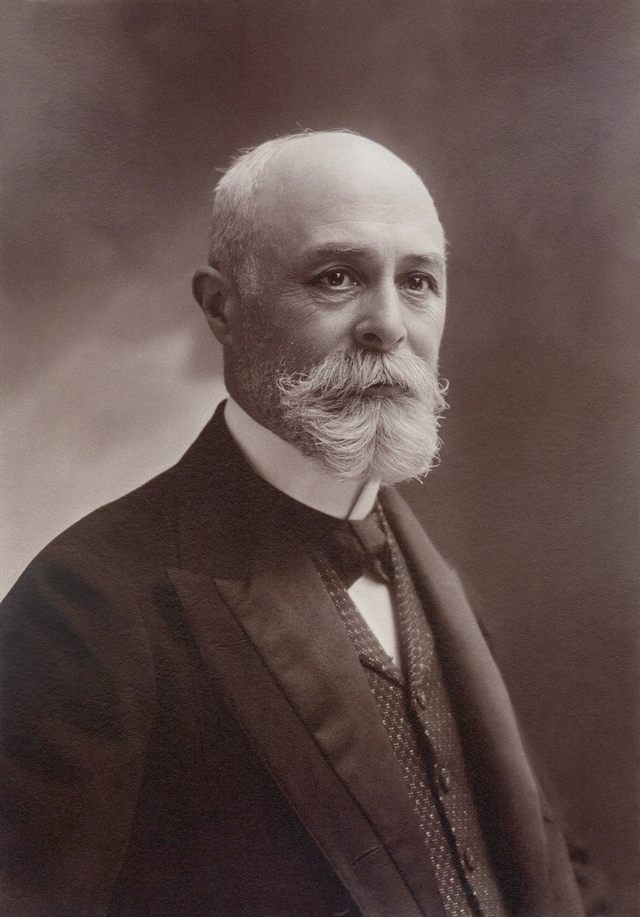
Who Developed the Plate Anyway · Physicist · 1852–1908
The third-generation Paris professor who wrapped a photographic plate in black paper, put uranium salts on it, shut it in a drawer because the sun would not come out — and developed it anyway.
Defend these ideas against Becquerel
Incandio is a free revision platform for the Pearson Edexcel International GCSE, and on it a topic counts as mastered only once you have learned it, proved it in questions, taught it back and defended it against the person with the strongest claim on it. Henri Becquerel is that person for 2 topics on the course:
- Detecting Radiation and Background — Physics
- Uses and Dangers of Radiation — Physics
Who was Becquerel?
Antoine Henri Becquerel was born in Paris in 1852 into a scientific dynasty: his grandfather and his father had held the same chair of physics at the Muséum, and his son would hold it after him. His father had worked on phosphorescence, and Henri inherited both the laboratory and its uranium salts. In 1896, after Röntgen announced X-rays, Becquerel set out to test whether substances made to phosphoresce by sunlight would emit a similar penetrating radiation. He wrapped photographic plates in thick black paper, laid uranium salts on top, and put them in the sun. Late February in Paris was overcast, so the arrangement went into a drawer to wait for better weather. Some days later he developed the plates regardless — and the images were not faint but strong, stronger than anything the sun had produced. The uranium had needed no excitation at all. It was emitting something continuously, entirely of its own accord, from nothing anybody had done to it. Becquerel had discovered radioactivity, though he was cautious about what it was; it was Marie Curie who named the phenomenon, showed it was a property of the atom itself, and isolated polonium and radium. They shared the 1903 Nobel Prize in Physics. Becquerel later carried a tube of radium in his waistcoat pocket for several hours and was burned by it — the first recorded observation of what these rays do to living tissue.
Major achievements
- Discovered radioactivity in 1896, from uranium salts fogging a wrapped plate in the dark
- Showed the emission was spontaneous and needed no sunlight or excitation
- Demonstrated that the radiation ionises air and can be measured electrically
- Shared the 1903 Nobel Prize in Physics with Marie and Pierre Curie
- Recorded the first radiation burn, from radium carried in his pocket
Life in brief
- 1852 — Born in Paris: Into the third generation of a scientific dynasty.
- 1895 — Röntgen announces X-rays: Which sets Becquerel testing phosphorescent substances.
- 1896 — The clouded February: The plate goes into a drawer, unexposed to any sun.
- 1896 — The plate developed anyway: Strong images: the uranium needed no excitation.
- 1899 — Deflection in a magnetic field: Shows part of the radiation is charged.
- 1901 — The radium burn: A tube carried in a waistcoat pocket burns his skin.
- 1903 — Nobel Prize in Physics: Shared with Marie and Pierre Curie.
- 1908 — Dies in Le Croisic: At fifty-five.
Explore the life of Becquerel — five chapters
- The Same Chair, Three Generations Running — A dynasty, a laboratory and a cupboard of uranium salts
- A Clouded Fortnight — The plates that went into a drawer
- Ruling Things Out — Not phosphorescence, not chemistry, not exhaustible
- What Marie Curie Did With It — The work that turned an observation into a field
- What It Turned Out to Be — Rutherford, Soddy and the answer to the energy question
Read the five-chapter life of Henri Becquerel →
Where Becquerel appears in your course
Henri Becquerel has a genuine claim on 2 lessons of the Pearson Edexcel International GCSE science course built into Incandio:
- Alpha, Beta and Gamma — Physics: Radioactivity was discovered by accident in 1896, and the accident is instructive. Becquerel expected uranium salts to emit something only after being made to phosphoresce in sunlight, so he wrapped photographic plates in black paper, laid the salts on top, and put them out in the sun. Late February in Paris was overcast, so the whole arrangement went into a drawer. He developed the plates anyway, days later, and found strong images — stronger than any sunlight had produced. The uranium had needed nothing done to it at all. He is the right person to ask why a spoiled experiment is still worth finishing, and how honest a scientist should be about not understanding their own result.
- Uses and Dangers of Radiation — Physics: The dangers on this page were discovered by accident, and Becquerel's was the first clear case. He carried a small tube of radium in his waistcoat pocket for a few hours while travelling, and some days later found a burn on the skin beneath it, in the shape of the tube. Pierre Curie deliberately repeated it on his own arm to time the effect. That burn is the beginning of radiobiology, and it also points directly to why radiotherapy works: if radiation kills healthy tissue, then aimed properly it will kill a tumour. He is the right figure to ask how a hazard and a treatment turn out to be the same fact.
Begin
- Start a conversation with Becquerel — a dramatised, historically grounded AI portrayal
- Read the Historical Brief
- Explore the life of Becquerel — five chapters
- Find your course · Meet all 280 figures