A Life in Five Chapters
Henri Becquerel
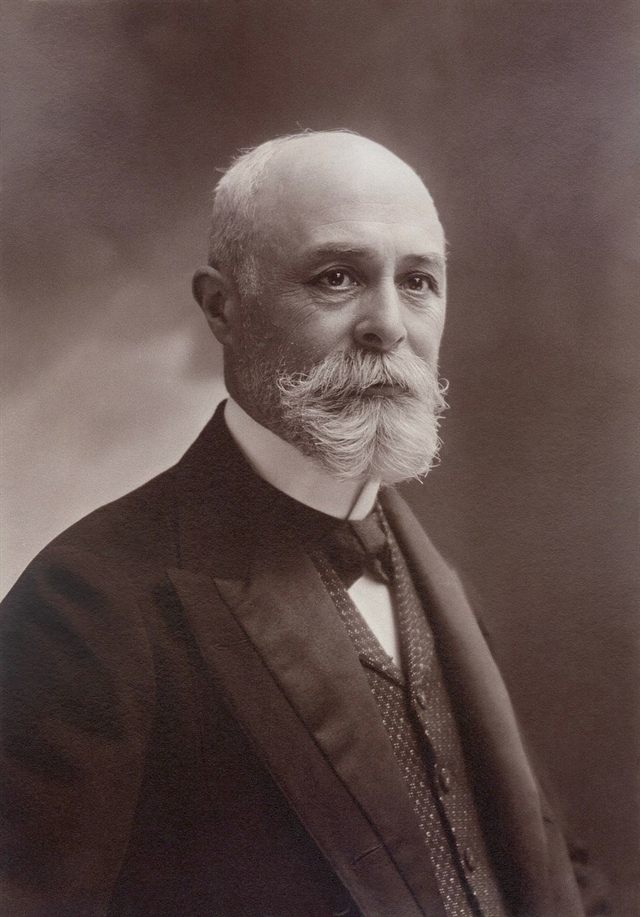
1852–1908
The third generation of a scientific dynasty, who set out to prove something that turned out to be false, was rescued by a fortnight of cloudy weather, and developed the plates anyway.
Becquerel expected uranium salts to emit penetrating rays after being excited by sunlight. The sun did not come out, the plates went in a drawer, and he developed them regardless. What was on them started nuclear physics. These five chapters follow an accident that required somebody to be paying attention.
The five chapters
- The Same Chair, Three Generations Running — A dynasty, a laboratory and a cupboard of uranium salts
- A Clouded Fortnight — The plates that went into a drawer
- Ruling Things Out — Not phosphorescence, not chemistry, not exhaustible
- What Marie Curie Did With It — The work that turned an observation into a field
- What It Turned Out to Be — Rutherford, Soddy and the answer to the energy question
Chapter 1 · The Same Chair, Three Generations Running
A dynasty, a laboratory and a cupboard of uranium salts
1852 – 1895 · Paris · The Muséum d'Histoire Naturelle
Antoine Henri Becquerel was born in Paris in December 1852, into a scientific dynasty of a kind that scarcely exists now.
His grandfather *Antoine César Becquerel* was a pioneer of electrochemistry and held the chair of physics at the *Muséum national d'Histoire naturelle*. His father *Alexandre Edmond Becquerel* held the same chair, and worked on *phosphorescence* and *luminescence* — substances that glow after being exposed to light — and on the photovoltaic effect. Henri held the same chair after him. His son *Jean* held it after that.
Four generations, one chair.
Henri trained at the École Polytechnique and the École des Ponts et Chaussées as an *engineer*, worked for the bridges and highways department, and did physics alongside it — teaching, and eventually inheriting his father's chair in 1892.
What he also inherited was the *laboratory* and its contents, and that turns out to matter enormously. Edmond Becquerel had spent decades studying phosphorescent substances, and the family collection included a set of *uranium salts* — particularly potassium uranyl sulphate, which phosphoresces strongly.
Henri had grown up around them and knew their behaviour.
In November 1895 *Wilhelm Röntgen* in Würzburg discovered *X-rays* — a penetrating radiation from a cathode-ray tube that passed through flesh and fogged photographic plates through opaque wrapping. The announcement in January 1896 caused an immediate sensation.
At the French Academy in January 1896, Henri Poincaré displayed the first radiographs and made a suggestion: the X-rays seemed to come from the part of the tube glass that was *glowing*, so perhaps *any* substance made to glow — any phosphorescent material — might emit similar penetrating rays.
Becquerel had a cupboard full of exactly the right substances.
“The phosphorescent substance in question emits radiations which pass through paper opaque to light.”
— Henri Becquerel, Comptes Rendus de l'Académie des Sciences (1896)
Why this matters
Becquerel inherited a laboratory stocked with uranium salts by a father who studied phosphorescence, which is why he had exactly the right materials to hand.
You have four generations and one chair. What would you ask him?
Ask Becquerel
- “What did you inherit besides the chair?”
- “What is phosphorescence, and what did your father find out about it?”
- “What did Röntgen's announcement do to Paris?”
- “What did Poincaré suggest at the Academy?”
- “Is it an advantage to inherit a laboratory?”
Chapter 2 · A Clouded Fortnight
The plates that went into a drawer
February and March 1896 · Paris
The experiment was straightforward and it was designed to test a specific hypothesis.
Wrap a photographic plate in *thick black paper* so that no light whatever can reach it. Lay a uranium salt on top. Put the whole thing in *sunlight* for several hours, so that the salt is excited into phosphorescence. Then develop the plate.
If phosphorescent substances emit penetrating rays, an image of the salt should appear on the plate.
On 24 February 1896 Becquerel reported to the Academy that he had done this and obtained a faint image.
That result was *real* but his interpretation was wrong, and he was about to be corrected by the weather.
He prepared more plates on 26 and 27 February, laying the salts on top and adding a metal screen cut in the shape of a cross between salt and plate, so that any image would carry a recognisable outline.
And *the sun did not come out*. Late February in Paris was overcast for several days running.
So the whole arrangement — plates, salts, screen, all wrapped — went into a *drawer* to wait for better weather.
On 1 March, still without sun, Becquerel developed the plates *anyway*.
He expected very faint images, if anything: the salts had received almost no light and could barely have phosphoresced at all.
The images were *strong*. Stronger than the ones obtained after hours in sunlight.
The uranium had needed *no excitation whatever*. It had been sitting in a dark drawer, wrapped in black paper, emitting something continuously and entirely of its own accord, from no source anybody had supplied.
He reported it to the Academy the following day.
Why this matters
The plates were stronger after days in a dark drawer than after hours in sunlight, which meant the uranium needed no excitation at all.
You have the cloudy fortnight and the drawer. What is your question?
Ask Becquerel
- “Why develop plates that had never been in the sun?”
- “What did you expect to see?”
- “Why put a metal cross between the salt and the plate?”
- “How long would it have taken if the sun had shone?”
- “Is this luck or attention?”
Chapter 3 · Ruling Things Out
Not phosphorescence, not chemistry, not exhaustible
1896 – 1897 · Paris
Becquerel spent the following months establishing what the emission was *not*, and this is careful work.
*Not phosphorescence*. He tested other phosphorescent substances — zinc sulphide, calcium sulphide — that glow far more brightly than uranium salts. None of them fogged a plate. So it is not a property of phosphorescence at all.
*Not dependent on the compound*. He tested uranium in many chemical forms — the sulphate, the nitrate, the oxide — and metallic uranium itself. All emitted. Metallic uranium, which does not phosphoresce, emitted *most strongly*.
So it is not a chemical property. It belongs to the *element uranium*, in whatever compound it happens to sit.
*Not exhaustible*, so far as he could tell. He kept samples in the dark for months and they went on emitting at apparently undiminished strength, with no chemical change and no source of energy anybody could identify.
That last point is genuinely troubling. Where is the energy coming from? A substance sitting in a drawer, doing nothing, changing in no visible way, continuously emitting penetrating radiation — that appeared to violate the conservation of energy, which was the most secure principle in physics.
He also showed the radiation *ionises air*, making it conduct electricity, so it could be measured *electrically* with an electrometer rather than by the slow business of exposing and developing plates. That gave a quantitative measure, and Marie Curie used exactly that method.
And in 1899 he showed that part of the radiation is *deflected by a magnetic field*, so part of it is electrically charged.
What he did *not* do was explain it. He did not know what the radiation was, where the energy came from, or what was happening in the uranium.
Why this matters
Uranium emitting continuously in a drawer with no chemical change and no visible source appeared to violate the conservation of energy.
You have the eliminations and the energy that came from nowhere. What would you ask?
Ask Becquerel
- “How did you rule out phosphorescence?”
- “Why does it matter that metallic uranium emits most strongly?”
- “Where did you think the energy was coming from?”
- “Why is measuring by ionisation better than by plates?”
- “How long can a substance emit before it must run out?”
Chapter 4 · What Marie Curie Did With It
The work that turned an observation into a field
1897 – 1903 · Paris
Becquerel's discovery was, for about a year, a curiosity. Röntgen's X-rays were far more exciting and could be used to photograph a hand; uranium rays were weak and hard to see.
*Marie Curie*, looking for a doctoral subject in 1897, chose them precisely because so little had been done.
What she did is a different order of work.
She used the *electrometer* method — measuring the ionisation of air — which is quantitative, and systematically surveyed *every* element and compound she could obtain. She found that *thorium* also emits, so it is not unique to uranium. She coined the word *radioactivity*.
She established that the emission is proportional to the *quantity of the element present*, and unaffected by chemical combination, physical state, temperature or light. From this she drew the conclusion Becquerel had not: radioactivity is a property of the *atom itself*, not of any arrangement of atoms.
That is the crucial theoretical step, and it is hers.
Then she found that *pitchblende* — a uranium ore — is *more* radioactive than its uranium content can account for. Something else in it must be more radioactive still.
She and Pierre Curie processed *tonnes* of pitchblende residue by hand, in a leaking shed, and isolated two new elements: *polonium*, named for her native Poland, and *radium*, which is around a million times more radioactive than uranium.
The 1903 Nobel Prize in Physics was awarded to Becquerel and to Pierre and Marie Curie.
Marie was nearly left out. The original nomination named Becquerel and Pierre Curie only. *Pierre Curie* was informed and wrote insisting that Marie be included, and the committee amended it. She became the first woman to receive a Nobel Prize.
Becquerel also recorded, in 1901, the *first radiation burn*. He carried a tube of radium given him by the Curies in his waistcoat pocket for some hours and developed a serious burn on the skin beneath. He published it, and it is the first documented observation of what these rays do to living tissue — the beginning of both radiation protection and radiotherapy.
Why this matters
Marie Curie established that radioactivity is a property of the atom itself rather than of any chemical arrangement, which is the theoretical step Becquerel did not take.
You have the shed, the tonnes of ore and the burn. What is your question?
Ask Becquerel
- “What did Marie Curie establish that you had not?”
- “How do you find a new element in a ton of ore?”
- “Marie was nearly left off the prize — what happened?”
- “What happened when you carried radium in your pocket?”
- “Why did nobody find this interesting at first?”
Chapter 5 · What It Turned Out to Be
Rutherford, Soddy and the answer to the energy question
1899 – 1908 and after · Paris · Montreal · Le Croisic
The explanation came from *Rutherford* and *Frederick Soddy* at McGill in 1902 and 1903, and it is startling.
Radioactivity is *transmutation*. An atom of one element *spontaneously changes* into an atom of a different element, emitting a particle in the process. Uranium becomes thorium becomes protactinium, through a long chain, ending at lead.
Atoms are not permanent. Elements are not fixed. This sounded like *alchemy* — Soddy is said to have exclaimed as much and Rutherford to have told him not to call it that, because they would be denounced as cranks.
And it answers the energy question. The energy is not coming from nowhere. It is coming from *inside the atom*, released as the nucleus rearranges into a more stable configuration. The quantities are enormous compared with chemical reactions because nuclear binding energies are enormous.
Rutherford also introduced *half-life* to describe the rate: the time in which half the atoms of a given sample decay, which is fixed and characteristic and cannot be altered by heat, pressure or chemistry.
So Becquerel's fogged plate opened directly onto the nuclear atom, the neutron, fission, nuclear power and nuclear weapons — none of which he saw.
He continued to work on the subject, was elected to the Academy and to the Royal Society, and received the 1903 Nobel Prize.
He died suddenly at Le Croisic in Brittany in August 1908, aged *fifty-five*, of a heart attack. There has been speculation that years of handling radioactive materials contributed; it cannot be established.
The SI unit of *radioactivity* — the *becquerel*, one decay per second — was named after him in 1975, sixty-seven years after his death.
His discovery is often described as an accident, and it is worth being precise about what kind. The weather was an accident. Developing the plates anyway was a *decision*. Testing every other phosphorescent substance, and metallic uranium, and finding what it was not, was *work*.
Why this matters
Radioactivity is one element spontaneously becoming another, which answered the energy question and destroyed the permanence of the elements.
You have the transmutation and the unit named for you. What would you ask?
Ask Becquerel
- “What did Rutherford and Soddy find the emission actually was?”
- “Where does the energy actually come from?”
- “What is a half-life?”
- “How much of your discovery was an accident?”
- “Did handling all that material shorten your life?”
What Becquerel changed
Radioactivity is the beginning of nuclear physics, and everything from the nuclear atom to medical imaging follows from that fogged plate. The becquerel — one decay per second — is the SI unit of activity. His accidental radiation burn in 1901 is the first documented observation of what these rays do to living tissue, and the beginning of both radiation protection and radiotherapy.
A debate that continues
Becquerel set out to confirm a hypothesis that was wrong and was rescued by cloudy weather; and the crucial step of establishing radioactivity as a property of the atom itself was Marie Curie's, not his.
Keep exploring — ask Becquerel
- “What else is sitting in a drawer waiting to be developed?”
- “Should credit follow the discovery or the explanation?”
- “How careful should you be with a substance you do not understand?”
Related lives
- Marie Curie — Two-Time Nobel Laureate
- Ernest Rutherford — Who Found the Atom Was Nearly Empty
- Lise Meitner — Who Did the Arithmetic in the Snow
- James Chadwick — Who Weighed a Particle With No Charge
Related themes
Radioactivity · Half-life and decay · Atomic structure
Where Becquerel appears in your course
Henri Becquerel has a genuine claim on 2 lessons of the Pearson Edexcel International GCSE science course built into Incandio:
- Alpha, Beta and Gamma — Physics: Radioactivity was discovered by accident in 1896, and the accident is instructive. Becquerel expected uranium salts to emit something only after being made to phosphoresce in sunlight, so he wrapped photographic plates in black paper, laid the salts on top, and put them out in the sun. Late February in Paris was overcast, so the whole arrangement went into a drawer. He developed the plates anyway, days later, and found strong images — stronger than any sunlight had produced. The uranium had needed nothing done to it at all. He is the right person to ask why a spoiled experiment is still worth finishing, and how honest a scientist should be about not understanding their own result.
- Uses and Dangers of Radiation — Physics: The dangers on this page were discovered by accident, and Becquerel's was the first clear case. He carried a small tube of radium in his waistcoat pocket for a few hours while travelling, and some days later found a burn on the skin beneath it, in the shape of the tube. Pierre Curie deliberately repeated it on his own arm to time the effect. That burn is the beginning of radiobiology, and it also points directly to why radiotherapy works: if radiation kills healthy tissue, then aimed properly it will kill a tumour. He is the right figure to ask how a hazard and a treatment turn out to be the same fact.
Continue on Incandio
- Talk to Becquerel — every question on this page is one tap from being asked, and the same page carries the Historical Brief, the achievements and the timeline
- All 208 figures · Incandio — learn every idea, teach it, then defend it