Historical figure · Pearson Edexcel International GCSE revision on Incandio
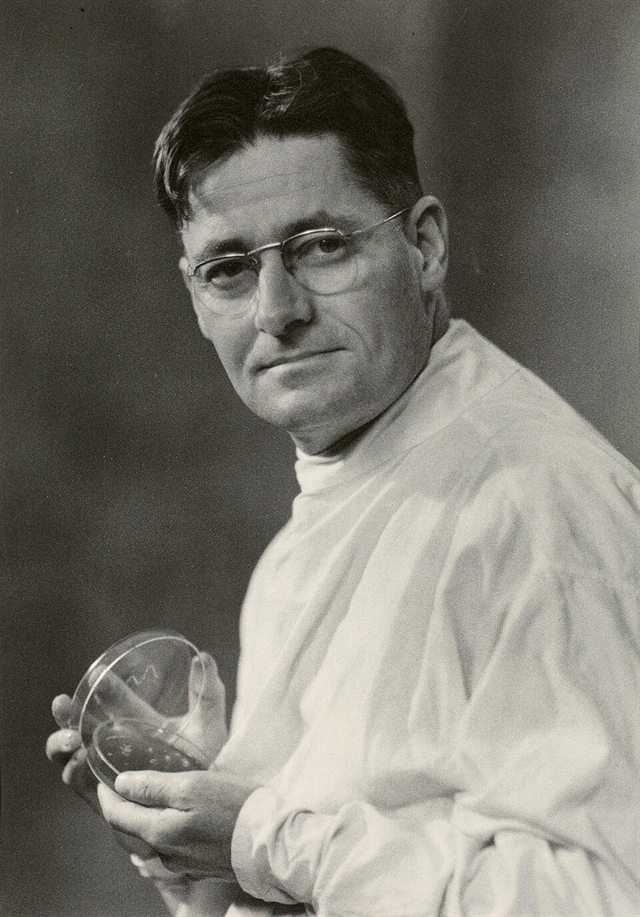
Howard Florey
Define 'Responsible For' Before You Answer · Pathologist · 1898–1968
The Australian pathologist whose Oxford team purified penicillin, treated the first patient in 1941, and obtained the American production that made it a war drug.
Defend these ideas against Florey
Incandio is a free revision platform for the Pearson Edexcel International GCSE, and on it a topic counts as mastered only once you have learned it, proved it in questions, taught it back and defended it against the person with the strongest claim on it. Howard Florey is that person for one topic on the course:
- The Second World War: skin grafts, blood and women in medicine — History · Changes in medicine, c1848–c1948
Who was Florey?
Born in Adelaide in 1898, Florey was a Rhodes scholar who became Professor of Pathology at Oxford. From 1938 he led the team — Ernst Chain, Norman Heatley and others — that purified penicillin from Fleming's mould. They tested it on mice in May 1940 and on a patient, the policeman Albert Alexander, in February 1941; he improved and then died when the supply ran out, the team having extracted the drug back out of his urine to re-use it. British industry was at war and could not produce it, so in July 1941 Florey and Heatley flew to the United States and obtained the deep-fermentation production that made penicillin available in quantity in time for the Normandy casualties. He shared the 1945 Nobel Prize with Fleming and Chain and declined to compete with Fleming in public.
Major achievements
- Led the team that purified penicillin and demonstrated it in mice and then in a patient
- Obtained American industrial production in 1941 when British industry could not supply it
- Shared the 1945 Nobel Prize in Physiology or Medicine
- Made the difference between an observation and a drug the central lesson of the story
Life in brief
- 1898 — Born in Adelaide: A Rhodes scholar to Oxford.
- 1938 — Begins work on penicillin: With Chain and Heatley at the Sir William Dunn School.
- 1940 — The mouse experiment: May: eight mice, four protected.
- 1941 — Albert Alexander: February: the first patient improves and then dies when supply runs out.
- 1941 — The American flight: July: deep-fermentation production is obtained in the United States.
- 1945 — Nobel Prize: Shared with Fleming and Chain.
Explore the life of Florey — five chapters
- Adelaide to Oxford — A Rhodes Scholar who wanted a laboratory
- The Forgotten Paper — A survey of antibacterial substances, and one from 1929
- Eight Mice — The experiment that took one night
- Albert Alexander — The first patient, and what ran out
- No Patent — A Nobel Prize shared, and a fame that went elsewhere
Read the five-chapter life of Howard Florey →
Begin
- Start a conversation with Florey — a dramatised, historically grounded AI portrayal
- Read the Historical Brief
- Explore the life of Florey — five chapters
- Find your course · Meet all 280 figures