Explore Their Life · Pearson Edexcel International GCSE revision on Incandio
Howard Florey: A Life in Five Chapters
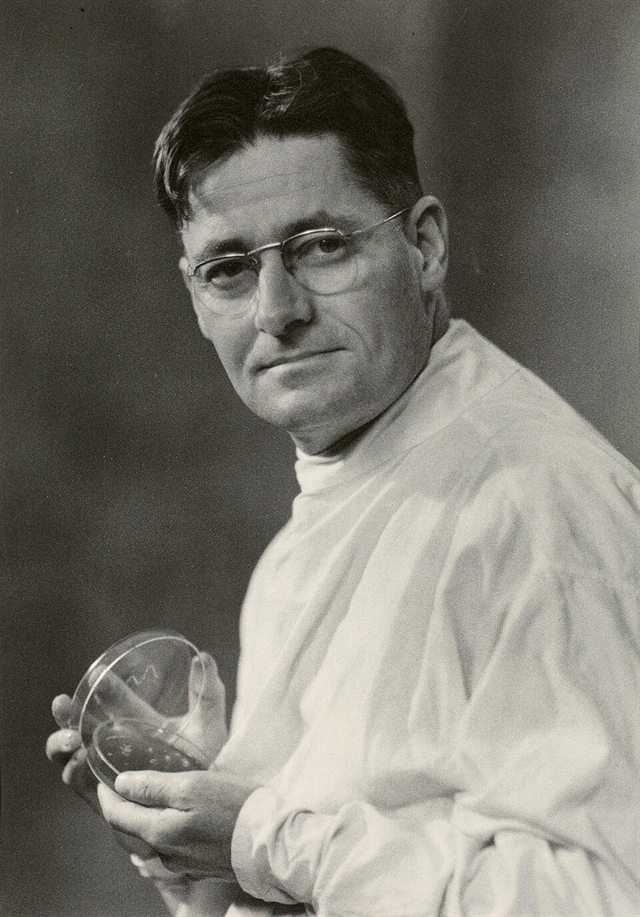
1898–1968
An Australian pathologist who took a forgotten paper from 1929, made penicillin work in mice and then in people, grew it in bedpans and biscuit tins, refused to patent it, and let somebody else become famous for it.
Fleming observed penicillin; Florey turned it into a medicine. These five chapters follow the Adelaide schoolboy, the Oxford laboratory, eight mice on a Saturday night, the first patient, and a decision about patents that cost Britain the drug it had made.
The five chapters
- Adelaide to Oxford — A Rhodes Scholar who wanted a laboratory
- The Forgotten Paper — A survey of antibacterial substances, and one from 1929
- Eight Mice — The experiment that took one night
- Albert Alexander — The first patient, and what ran out
- No Patent — A Nobel Prize shared, and a fame that went elsewhere
Chapter 1 · Adelaide to Oxford
A Rhodes Scholar who wanted a laboratory
1898 – 1935 · Adelaide · Oxford · Cambridge · Sheffield
Howard Florey was born in Adelaide in 1898, the son of an English bootmaker who had emigrated and built a shoe manufacturing business. He was educated at St Peter's College and the University of Adelaide, and won a Rhodes Scholarship to Oxford in 1921.
He was not interested in practising medicine. He wanted to do experimental physiology and pathology, and he was extremely good at it: precise, sceptical, uninterested in speculation, and brutally direct with people, which cost him allies throughout his career.
He worked at Cambridge, spent a year in the United States, held a chair at Sheffield, and in 1935 was appointed Professor of Pathology at Oxford and head of the Sir William Dunn School.
What he did there was build a department. He recruited chemists and biochemists into a pathology school, on the argument that the interesting questions in disease were chemical and that pathologists could not answer them alone. Among the people he brought in was Ernst Chain, a Jewish biochemist who had left Germany in 1933 with almost nothing.
That decision — a pathologist hiring a chemist — is why penicillin exists as a medicine, and it was made five years before anybody in the building had heard of it.
Why this matters
Florey built a laboratory that combined pathology and chemistry, which is the single reason penicillin could be purified when Fleming could not purify it.
A Rhodes Scholar who wanted a bench rather than a practice. What would you ask him?
Ask Florey
- “Why did you want research rather than medical practice?”
- “Why put chemists into a pathology department?”
- “What did Ernst Chain bring that you did not have?”
- “Did being Australian make a difference at Oxford?”
- “What did you look for when you recruited?”
Chapter 2 · The Forgotten Paper
A survey of antibacterial substances, and one from 1929
1938 – 1940 · Oxford
In 1938 Florey and Chain began a systematic survey of substances produced by micro-organisms that killed other micro-organisms. It was a general research programme, funded modestly and undertaken because it was scientifically interesting rather than because anybody expected a drug.
In the literature Chain found Alexander Fleming's paper of 1929, describing a mould of the genus Penicillium that had inhibited staphylococci on a culture plate. Fleming had observed it, named the substance penicillin, been unable to purify or stabilise it, and had largely stopped work on it. The paper had been read by very few people and acted on by none.
The Oxford team took it up. The work was almost entirely chemical: penicillin was present in tiny quantities, was extremely unstable, and lost its activity at the wrong pH or temperature. Norman Heatley designed a counter-current extraction apparatus out of laboratory glassware, milk churns, a doorbell and bookshelves, and got a usable concentrate.
They were doing this in 1939 and 1940, in a country at war, with no money for equipment and an expectation that Oxford might be bombed. They grew the mould in every vessel they could find, including hospital bedpans, and biscuit tins were used for storage; a set of ceramic vessels was eventually made to Heatley's design. And they rubbed spores into the linings of their coats so that if the laboratory were destroyed or the country invaded, whoever escaped could start again.
Why this matters
Fleming's paper sat unread for nine years, and what turned it into a medicine was a chemist, an extraction apparatus and a war.
A paper from 1929 and a doorbell in the apparatus. What would you ask him?
Ask Florey
- “Why had nobody followed up Fleming's paper for nine years?”
- “What made penicillin so difficult to purify?”
- “How did Heatley build the extraction apparatus?”
- “Why rub spores into your coat linings?”
- “Was the survey aimed at finding a drug?”
Chapter 3 · Eight Mice
The experiment that took one night
25 May 1940 · Oxford
On 25 May 1940, while the British Expeditionary Force was being evacuated from Dunkirk, Florey injected eight mice with a lethal dose of streptococci. Four were then given penicillin; four were not.
Heatley stayed in the laboratory overnight to record the results. By the early hours the four untreated mice were dead. The four treated mice were alive.
Florey's recorded reaction was that it looked like a miracle and that they had better be careful. Chain is said to have been considerably more excited. The team then repeated it in larger numbers before publishing in The Lancet in August 1940.
The arithmetic that followed was the real problem. A mouse is small. Treating one human being required something like three thousand times the quantity used on a mouse, sustained over days, and the yield from the mould was minuscule. Florey calculated that curing a single patient would take the entire output of the laboratory for weeks.
So the Dunn School became a factory. A team of six women — later known as the penicillin girls — was employed to tend the culture vessels, inoculating, harvesting and cleaning, and the extraction ran continuously. The urine of treated patients was collected and the penicillin recovered from it, because it passes through the body largely unchanged and was too precious to lose.
Why this matters
The mouse experiment proved the principle in a single night, and everything difficult about penicillin came afterwards, in the arithmetic of scale.
Four mice alive and four dead by morning. What would you ask him?
Ask Florey
- “What did you think when you saw the mice that morning?”
- “Why is treating a human three thousand times harder than treating a mouse?”
- “Who were the penicillin girls and what did they do?”
- “Why recover penicillin from patients' urine?”
- “Why repeat the experiment before publishing?”
Chapter 4 · Albert Alexander
The first patient, and what ran out
February 1941 · Oxford
The first patient was Albert Alexander, a policeman in his forties who had a septicaemia — the infection is usually recorded as having begun with a scratch, though accounts of its origin differ. By February 1941 it had spread to his face, his scalp, his eyes and his lungs; one eye had been removed; he was expected to die.
He was given penicillin on 12 February. Within a day the improvement was dramatic: the temperature fell, the discharge reduced, he began to eat, and by the fourth day he was visibly recovering.
The supply ran out. Despite recovering the drug from his urine, the laboratory could not make enough. The dose was reduced and then stopped, the infection returned, and Alexander died on 15 March 1941.
The result was scientifically decisive and personally terrible. It had been demonstrated that penicillin worked in a human being with an infection that would otherwise have killed him, and that the quantity available was the only obstacle.
Florey then made the decision that determined how the drug reached the world. British pharmaceutical firms were fully committed to the war and could not undertake development on the scale required. In July 1941 he and Heatley flew to the United States with samples of the mould, and the work was taken up at the Northern Regional Research Laboratory at Peoria, Illinois, where corn steep liquor was found to increase yields enormously and a more productive strain was found on a cantaloupe melon in a local market. American firms scaled it up, and there was enough penicillin for the Normandy landings in June 1944.
Why this matters
The first patient recovered and then died because the supply ran out, which proved both that penicillin worked and that only industrial production could deliver it.
A policeman who recovered and then died. What would you ask him?
Ask Florey
- “What did the first four days of Albert Alexander's treatment show?”
- “What was it like to run out?”
- “Why go to the United States rather than to British industry?”
- “What did corn steep liquor and a melon change?”
- “Was it right to treat a patient you could not supply?”
Chapter 5 · No Patent
A Nobel Prize shared, and a fame that went elsewhere
1941 – 1968 · Oxford · Stockholm · Canberra
Florey declined to patent penicillin. The reasoning, which was Chain's opponents' as much as his own, was that a medical discovery should not be owned, and that patenting it would be unethical for a doctor. Chain argued at the time that it was a mistake.
American companies patented the production processes. Britain, having made the discovery, paid royalties to American firms for the manufacture of penicillin for years afterwards. Florey later said that the decision had been wrong, and it is one of the standard cases in any discussion of intellectual property in medicine.
The fame went elsewhere too. When penicillin became public news in 1942 the press wanted a story, and Fleming — who was at St Mary's in London, was available, was charming and had made the original observation — became the discoverer of penicillin. St Mary's promoted him energetically. Florey refused to give interviews at all, on the grounds that publicity would interfere with the work and would raise expectations while supply was still short. The result was entirely predictable and he did not complain about it.
The Nobel Prize in 1945 was shared between Fleming, Florey and Chain, which is the accurate distribution.
Florey went on to run the Dunn School, became President of the Royal Society, was made a life peer, and was Provost of Queen's College Oxford. He worked on the founding of the Australian National University and cared a great deal about Australian science. He died in 1968.
His own estimate of the numbers of lives saved by penicillin has never been seriously challenged: it is in the tens of millions and rising.
Why this matters
Britain discovered penicillin, declined to patent it, and paid American royalties to manufacture it — and the man who made it a medicine refused to be interviewed.
No patent, no interviews, and a shared prize. What would you ask him?
Ask Florey
- “Why did you refuse to patent penicillin?”
- “Did you change your mind about it later?”
- “Why refuse to give interviews in 1942?”
- “Was it fair that Fleming became the discoverer?”
- “How should a discovery that saves millions be owned?”
What Florey changed
Florey took an observation that had sat unused since 1929 and turned it into a medicine: he assembled the team, drove the chemistry, ran the mouse experiment, treated the first patient, and took the mould to the United States when British industry could not scale it. Penicillin was available in quantity for the Normandy landings and has since saved lives in the tens of millions. He declined to patent it, refused to be interviewed, and let another man become the discoverer.
A debate that continues
Should Florey have patented penicillin? He came to think so; the counter-argument is that a patent would have slowed wartime production and that the ethical objection was real.
Keep exploring — ask Florey
- “Who discovers something — the person who sees it, or the person who makes it work?”
- “Should a life-saving medicine be patentable?”
- “Does refusing publicity have a cost that somebody else pays?”
Related lives
- Alexander Fleming — Discoverer of Penicillin
- Aneurin Bevan — I Stuffed Their Mouths With Gold
- Robert Koch — The Method Was The Argument
Related themes
Penicillin and antibiotics · Science and the Second World War · Medicine and intellectual property
Continue on Incandio
- Talk to Florey — every question on this page is one tap from being asked, and the same page carries the Historical Brief, the achievements and the timeline
- All 280 figures · Incandio — learn every idea, teach it, then defend it