Historical figure · Pearson Edexcel International GCSE revision on Incandio
Ibn Sina
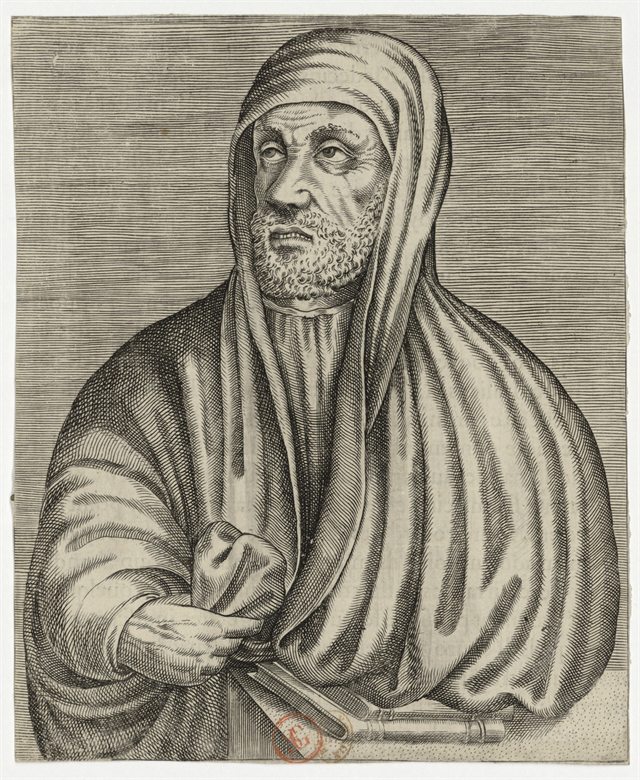
Author of the Canon of Medicine · Physician & Philosopher · 980–1037
The Persian physician and philosopher whose Canon of Medicine organised Greek and Islamic medicine into one ordered system and was used as a university textbook in Europe for some five hundred years.
Why Ibn Sina is on Incandio
Incandio is a free revision platform for the Pearson Edexcel International GCSE. Its historical figures are the people a student learns from, questions and — where a specification topic is theirs — defends an idea against. Ibn Sina can be questioned here in a dramatised, historically grounded portrayal, and the five-chapter life below is written to be read alongside the course.
Who was Ibn Sina?
Ibn Sina was born in 980 at Afshana near Bukhara, the son of a Samanid official. He was a prodigy who had memorised the Qur'an by ten, studied logic and mathematics, and taught himself medicine. In his teens he helped treat the emir Nuh ibn Mansur and was given access to the royal library. After the Samanid state fell, he moved between courts — Gurganj, Jurjan, Rayy, Hamadan and Isfahan — serving rulers as physician and sometimes vizier, and was at times in danger and in prison. He wrote some two hundred works, above all the Canon of Medicine, a five-book synthesis of Galen, Hippocrates and Aristotle with his own clinical observation, including rules for testing drugs, and the Book of Healing, a philosophical encyclopaedia. He died in 1037 at Hamadan, of an intestinal illness, while accompanying Ala al-Dawla on campaign. His student al-Juzjani completed the account of his life.
Major achievements
- Wrote the Canon of Medicine, organising the whole of medicine into a teachable system
- Set out conditions for testing whether a drug works
- Described the contagious nature of some diseases, such as tuberculosis, within the humoral framework
- Wrote the Book of Healing, one of the most influential works of medieval philosophy
- His Canon, translated into Latin in the 12th century, was taught in European universities into the 17th century
Life in brief
- 980 — Born near Bukhara: At Afshana, under the Samanids.
- c. 997 — Treats the emir Nuh ibn Mansur: Gains entry to the Samanid royal library.
- 1015–1022 — Physician and vizier at Hamadan: Serves Shams al-Dawla; faces mutiny and later imprisonment.
- c. 1025 — Completes the Canon of Medicine: Five books on the whole of medicine.
- c. 1024–1037 — At Isfahan: Under the protection of Ala al-Dawla.
- 1037 — Dies at Hamadan: Of an intestinal illness on campaign.
Explore the life of Ibn Sina — five chapters
- The Boy from Bukhara — A prodigy and a library
- From Court to Court — A scholar on the move in dangerous times
- The Canon of Medicine — All of medicine in five books
- Rules for Testing a Remedy — Reason, experience and the conditions of proof
- Isfahan, Hamadan and the Road to Europe — A death on campaign, a book that crossed a continent
Read the five-chapter life of Ibn Sina →
Begin
- Start a conversation with Ibn Sina — a dramatised, historically grounded AI portrayal
- Read the Historical Brief
- Explore the life of Ibn Sina — five chapters
- Find your course · Meet all 280 figures