Historical figure · Pearson Edexcel International GCSE revision on Incandio
J. J. Thomson
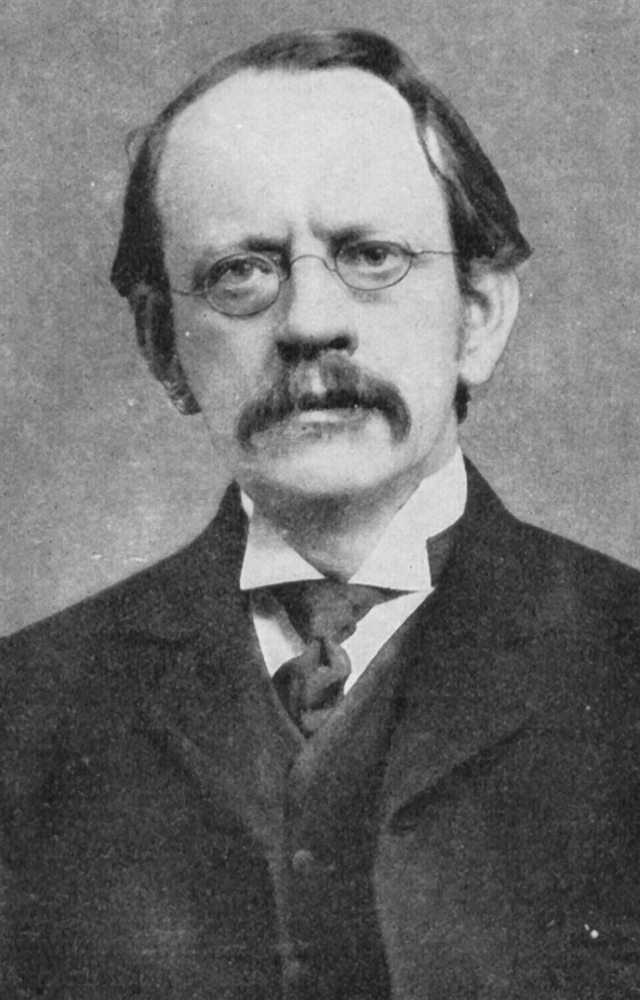
Who Weighed What Nobody Could See · Physicist · 1856–1940
Who ended a thirty-year argument about cathode rays by deflecting them two ways at once, got a number, and discovered that the atom has something smaller inside it.
Defend these ideas against Thomson
Incandio is a free revision platform for the Pearson Edexcel International GCSE, and on it a topic counts as mastered only once you have learned it, proved it in questions, taught it back and defended it against the person with the strongest claim on it. J. J. Thomson is that person for one topic on the course:
- Charge and Current — Physics
Who was Thomson?
Joseph John Thomson — J. J. to everybody — was born near Manchester in 1856 and became Cavendish Professor of Experimental Physics at Cambridge at twenty-eight. The nature of cathode rays had been disputed for three decades: German physicists held they were a disturbance in the ether, while British physicists suspected particles. In 1897 Thomson settled it. He deflected a beam of the rays with a magnetic field and with an electric field simultaneously, and from the two deflections obtained the ratio of the particles' charge to their mass. The figure was astonishing: a mass more than a thousand times smaller than that of hydrogen, the lightest thing then known. Because the rays were the same whatever the cathode was made of, the particles had to be a constituent of all matter — so the atom was not indivisible after all. He called them corpuscles; the name electron won out. He proposed that an atom consists of a sphere of positive charge with the corpuscles embedded in it, the so-called plum-pudding model, which his own former student Ernest Rutherford replaced in 1911 with a nuclear atom. Thomson was an indifferent experimenter with his own hands and an outstanding teacher: seven of his research assistants won Nobel Prizes, as did his son George, for showing that electrons behave as waves.
Major achievements
- Discovered the electron in 1897 by measuring its charge-to-mass ratio
- Settled the cathode-ray dispute by deflecting the beam magnetically and electrically at once
- Showed the particles are a constituent of all matter, so the atom is divisible
- Proposed the first serious model of atomic structure
- Began the work on positive rays that became mass spectrometry
Life in brief
- 1856 — Born near Manchester: Son of a bookseller; intended for engineering.
- 1884 — Cavendish Professor: Appointed at twenty-eight, to general surprise.
- 1897 — The electron: Two deflections, one ratio, and a particle smaller than an atom.
- 1904 — The plum-pudding atom: Corpuscles embedded in a sphere of positive charge.
- 1906 — Nobel Prize in Physics: For work on the conduction of electricity through gases.
- 1911 — Rutherford's nucleus: His own student replaces his model of the atom.
- 1937 — His son's Nobel Prize: For showing the electron behaves as a wave.
- 1940 — Dies at Cambridge: Buried in Westminster Abbey near Newton.
Explore the life of Thomson — five chapters
- The Cavendish at Twenty-Eight — A bookseller's son, and an appointment that surprised everyone
- Thirty Years of Arguing About a Glow — Waves in the ether, or particles?
- Two Deflections, One Ratio — 1897, and a mass a thousand times too small
- The Plum Pudding — A model that was serious, testable and wrong
- Seven Nobel Prizes Among the Assistants — A laboratory as an output
Read the five-chapter life of J. J. Thomson →
Begin
- Start a conversation with Thomson — a dramatised, historically grounded AI portrayal
- Read the Historical Brief
- Explore the life of Thomson — five chapters
- Find your course · Meet all 280 figures