Explore Their Life · Pearson Edexcel International GCSE revision on Incandio
J. J. Thomson: A Life in Five Chapters
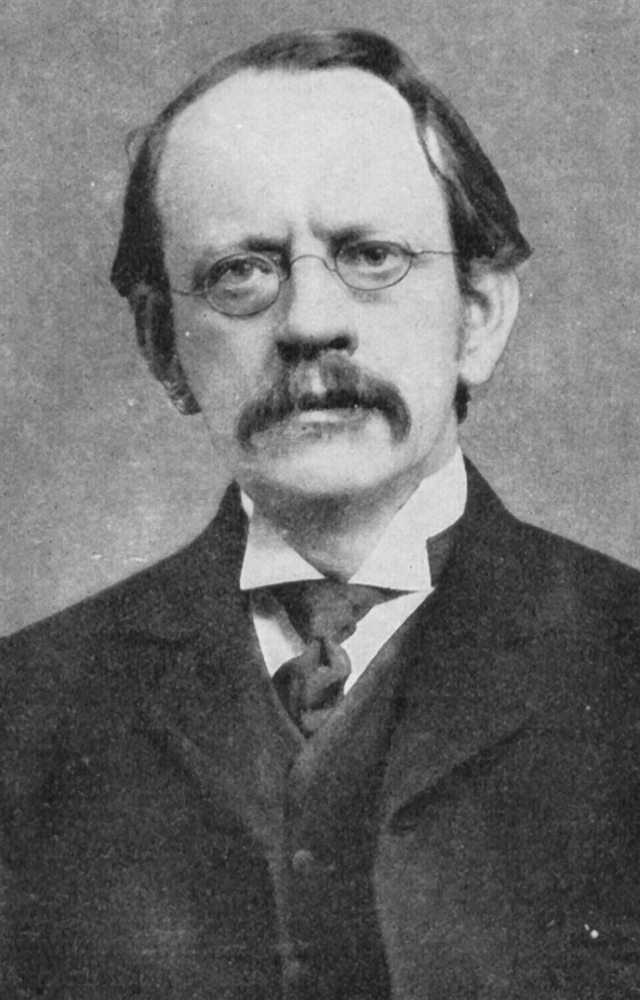
1856–1940
The Cavendish Professor who was famously clumsy with his own apparatus, measured something a thousand times lighter than the lightest atom, and destroyed the idea that atoms cannot be divided.
Thomson settled a thirty-year argument about cathode rays by deflecting them two ways at once and doing arithmetic. His model of the atom was overturned by his own student within fourteen years, and he regarded that as a success. Seven of his research assistants won Nobel Prizes. These five chapters follow the measurement and the laboratory.
The five chapters
- The Cavendish at Twenty-Eight — A bookseller's son, and an appointment that surprised everyone
- Thirty Years of Arguing About a Glow — Waves in the ether, or particles?
- Two Deflections, One Ratio — 1897, and a mass a thousand times too small
- The Plum Pudding — A model that was serious, testable and wrong
- Seven Nobel Prizes Among the Assistants — A laboratory as an output
Chapter 1 · The Cavendish at Twenty-Eight
A bookseller's son, and an appointment that surprised everyone
1856 – 1884 · Cheetham Hill · Manchester · Cambridge
Joseph John Thomson — *J. J.* to everybody, including his wife — was born at Cheetham Hill near Manchester in December 1856, the son of a bookseller.
He was intended for *engineering*, and was to be apprenticed to a locomotive works. His father died when he was sixteen and the family could not afford the apprenticeship premium, so he stayed at Owens College in Manchester, where he had been sent early, and read mathematics and physics instead.
That is the second time in this collection that a family's inability to pay redirected a career into physics.
He went to Trinity College, Cambridge, in 1876, was second wrangler in the Mathematical Tripos, and stayed.
In 1884 the *Cavendish Professorship of Experimental Physics* fell vacant on Lord Rayleigh's resignation. The chair had been held by *Maxwell* and then *Rayleigh* — the two most eminent physicists in Britain.
Thomson applied, and was elected, aged *twenty-eight*.
The reaction was disbelief. He was young, he was known as a mathematician rather than an experimenter, and he had done comparatively little. One correspondent wrote that things had come to a pretty pass when boys were made professors. Thomson himself said he felt like a fisherman who had cast a fly and hooked a whale.
He held the chair for *thirty-five years*.
And he was, by universal report, *extremely clumsy* with apparatus. His assistants developed a practice of steering him away from delicate glassware. His research assistant Ebenezer Everett did most of the actual manipulation, and Thomson's contribution was to know what to measure and what the numbers meant.
“Could anything at first sight seem more impractical than a body which is so small that its mass is an insignificant fraction of the mass of an atom of hydrogen?”
— J. J. Thomson, on the electron
Why this matters
Thomson was a poor experimenter with his own hands and one of the greatest experimental physicists of his era, because knowing what to measure is a different skill from measuring it.
You have the young professor and the steady hands of others. What would you ask?
Ask Thomson
- “Why were people appalled by your appointment?”
- “Is it true you could not be trusted with glassware?”
- “What does an experimenter contribute if not the hands?”
- “How did losing the engineering apprenticeship change things?”
- “What was it like following Maxwell and Rayleigh?”
Chapter 2 · Thirty Years of Arguing About a Glow
Waves in the ether, or particles?
1869 – 1897 · Cambridge · Germany
Pump most of the air out of a glass tube, put an electrode at each end, and apply a high voltage. Something streams from the *cathode* — the negative electrode — and makes the far end of the tube glow.
These were *cathode rays*, and physicists had argued about what they are since about 1869.
The *German school* — Goldstein, Hertz, Lenard — held they were a *disturbance in the ether*, a wave phenomenon like light. Their evidence: the rays travel in straight lines and cast sharp shadows, and Hertz had found that they *pass through* thin metal foil, which seemed impossible for particles.
The *British school* — Crookes, Varley — held they were *particles*, negatively charged. Their evidence: the rays are *deflected by a magnet*, and they carry momentum, appearing to turn a small paddle wheel.
There was a serious difficulty for the particle view. Hertz had tried to deflect the rays with an *electric field* and had found *no deflection*. Charged particles must be deflected by an electric field. That looked decisive against particles.
Thomson's insight was that Hertz's tubes had not been evacuated *well enough*. The remaining gas is *ionised* by the beam, and the resulting charged particles collect on the plates and *cancel the field* inside the tube.
With better vacuum technique — and vacuum technology had improved considerably by 1897 — Thomson evacuated his tube much further, applied the field, and the beam *deflected*.
That removed the objection. The rays are charged particles.
But knowing they are particles does not tell you *what* particles. Hydrogen ions? Atoms of some kind? Something new?
To find out, you have to measure something.
Why this matters
Hertz found no electric deflection because his vacuum was poor and residual gas cancelled the field — a technical limitation that had blocked the answer for a decade.
You have the glowing tube and thirty years of argument. What is your question?
Ask Thomson
- “What were the arguments on each side?”
- “Why did Hertz see no electric deflection?”
- “How much did better vacuum pumps matter?”
- “Why did rays passing through foil favour waves?”
- “Why is knowing they are particles not enough?”
Chapter 3 · Two Deflections, One Ratio
1897, and a mass a thousand times too small
1897 · Cambridge
The method is elegant and it is worth following.
A charged particle moving through a *magnetic field* is deflected, and the size of the deflection depends on its charge, its mass and its speed. A charged particle moving through an *electric field* is also deflected, and that deflection depends on the same three quantities in a *different combination*.
One measurement gives you one equation in three unknowns, which is useless. But *two* measurements give two equations, and you can eliminate the speed.
What survives is the *ratio of charge to mass*.
Thomson arranged both fields on the same beam, and used a further trick: he adjusted the two fields until they *cancelled* and the beam went straight through undeflected. At that balance point the electric and magnetic forces are equal, which gives the *speed* directly. Then switching off one field gives the ratio.
The result was astonishing.
The charge-to-mass ratio came out about *a thousand times larger* than that of the hydrogen ion — the smallest thing then known.
That means either the charge is enormously larger than a hydrogen ion's, or the *mass is enormously smaller*. Thomson argued for the second, and later work confirmed it: the particles are around *1,800 times lighter* than a hydrogen atom.
And then the crucial control. He *changed the cathode material* — aluminium, iron, platinum — and *changed the residual gas* — air, hydrogen, carbon dioxide.
The ratio came out *the same every time*.
So the particles are not characteristic of any particular substance. They are a *constituent of all matter*.
Which means the atom is *not indivisible*. It has parts, and one of them is very much smaller than the whole. The word *atom* means uncuttable, and it had just been cut.
Thomson called them *corpuscles*. The name *electron*, coined earlier by George Johnstone Stoney for the unit of charge, won out.
Why this matters
Changing the cathode and the gas and getting the same ratio every time is what proved the particles are in all matter — which is what makes the atom divisible.
You have the balanced fields and the impossible ratio. What would you ask?
Ask Thomson
- “Why do you need two deflections rather than one?”
- “Why balance the two fields against each other?”
- “Why change the cathode material and the gas?”
- “Why must the mass be small rather than the charge large?”
- “What did it feel like to cut the uncuttable?”
Chapter 4 · The Plum Pudding
A model that was serious, testable and wrong
1904 – 1911 · Cambridge · Manchester
If atoms contain electrons, and atoms are electrically neutral, there must be *positive charge* somewhere to balance them. Where?
Thomson proposed in 1904 that the atom is a *sphere of diffuse positive charge* — extending across the whole volume of the atom — with the electrons *embedded* within it, arranged in rings and rotating.
It is called the *plum pudding* model, and the name has done it a disservice by making it sound silly. It was not.
It was *quantitative*. Thomson calculated the stable arrangements electrons would adopt in such a sphere, and found they fall into rings with characteristic numbers — and he suggested, correctly in spirit, that this might explain the *periodic table*: elements with similar outer arrangements would have similar chemistry. That is genuinely the right kind of idea.
It was *testable*, and it was tested.
In 1909, at Manchester, *Ernest Rutherford* — Thomson's former student — set Hans Geiger and Ernest Marsden to fire alpha particles at thin gold foil. On the plum-pudding model the positive charge is spread thinly across the whole atom, so an alpha particle passing through should be deflected only slightly, by many small nudges.
Almost all of them were. But roughly *one in eight thousand* came *straight back*.
That cannot happen if the positive charge is diffuse. It requires an enormous force in a very small region — a *concentrated* positive charge.
Rutherford's *nuclear* atom, published in 1911, replaced Thomson's: a minute, dense, positively charged nucleus with the electrons somewhere around it and almost all of the atom empty.
Thomson's response is worth recording. He accepted it. He had said that being superseded by your own students is a success rather than a defeat, and he behaved accordingly.
Why this matters
The plum-pudding model was quantitative and testable and made a prediction that failed — which is what a good wrong model does.
You have the model and the student who replaced it. What is your question?
Ask Thomson
- “What made the plum-pudding model a serious proposal?”
- “Why can't a diffuse positive charge send an alpha particle back?”
- “Did you really try to explain the periodic table with it?”
- “How did you take being overturned by Rutherford?”
- “Is a wrong model worth having?”
Chapter 5 · Seven Nobel Prizes Among the Assistants
A laboratory as an output
1895 – 1940 · Cambridge
Thomson's other achievement is the *Cavendish Laboratory* itself.
In 1895 Cambridge changed its regulations to admit graduates of other universities as research students. Thomson used it, and the laboratory filled with able people from Britain, the Empire and abroad.
The count is remarkable. *Seven* of his research assistants went on to win *Nobel Prizes*: Ernest Rutherford, Charles Barkla, Charles Wilson, Francis Aston, Owen Richardson, Niels Bohr — who worked briefly under him — and William Lawrence Bragg. His *son* George Paget Thomson won one too.
His method was to give a research student a real problem, some apparatus, and considerable freedom, and to turn up regularly and ask what they had found. He was not a hands-on supervisor and he was an exceptional judge of a result.
He also insisted on training in *glassblowing and instrument-making*, on the principle that a physicist should be able to build their own apparatus — which is somewhat comic given his own reputation.
George Thomson's Nobel Prize contains a lovely irony. In 1927 he showed that a beam of *electrons* passing through a thin crystal produces a *diffraction pattern* — the signature of a *wave*.
So the father proved the electron is a particle, and the son proved it is a wave, and both were right. That is wave–particle duality, and it is at the centre of quantum mechanics.
Thomson also began the work on *positive rays* that led to *mass spectrometry*. He found that neon gave *two* parabolic traces on his detector, corresponding to atomic masses of about 20 and 22 — the first evidence for *isotopes* in a non-radioactive element. Francis Aston, his assistant, developed it into the mass spectrograph.
He received the Nobel Prize in Physics in 1906, was knighted in 1908, and became Master of Trinity in 1918.
He died in Cambridge in August 1940, aged eighty-three, and is buried in Westminster Abbey near Newton and Rutherford.
Why this matters
Thomson proved the electron is a particle and his son proved it is a wave, and both results are correct — which is wave-particle duality.
You have the laboratory, the students and the son's prize. What would you ask?
Ask Thomson
- “How did you supervise research students?”
- “What did you make of your son proving it is a wave?”
- “What were the two neon traces?”
- “Why insist students learn glassblowing?”
- “Is a laboratory's real output its people?”
What Thomson changed
The electron underlies the whole of chemistry, electronics and the modern account of matter, and Thomson's 1897 measurement is where it enters physics. His work on positive rays produced the first evidence for stable isotopes and became mass spectrometry. The Cavendish under him became the most productive laboratory in the world, and the research-school model it established is still the pattern.
A debate that continues
Thomson measured the ratio of charge to mass rather than either separately — the charge itself waited for Millikan in 1909 — and his plum-pudding atom was overturned by his own student within seven years, which he treated as a success.
Keep exploring — ask Thomson
- “Which of your students taught you most?”
- “What is an atom actually made of?”
- “How do you know when a model has failed?”
Related lives
- Ernest Rutherford — Who Found the Atom Was Nearly Empty
- Niels Bohr — Architect of the Quantum Atom
- James Clerk Maxwell — Who Bound Light to Electromagnetism
- Paul Drude — Who Made the Metal a Gas
Related themes
The electron · Atomic structure · Cathode rays
Continue on Incandio
- Talk to Thomson — every question on this page is one tap from being asked, and the same page carries the Historical Brief, the achievements and the timeline
- All 280 figures · Incandio — learn every idea, teach it, then defend it