Explore Their Life · Pearson Edexcel International GCSE revision on Incandio
Joseph Lister: A Life in Five Chapters
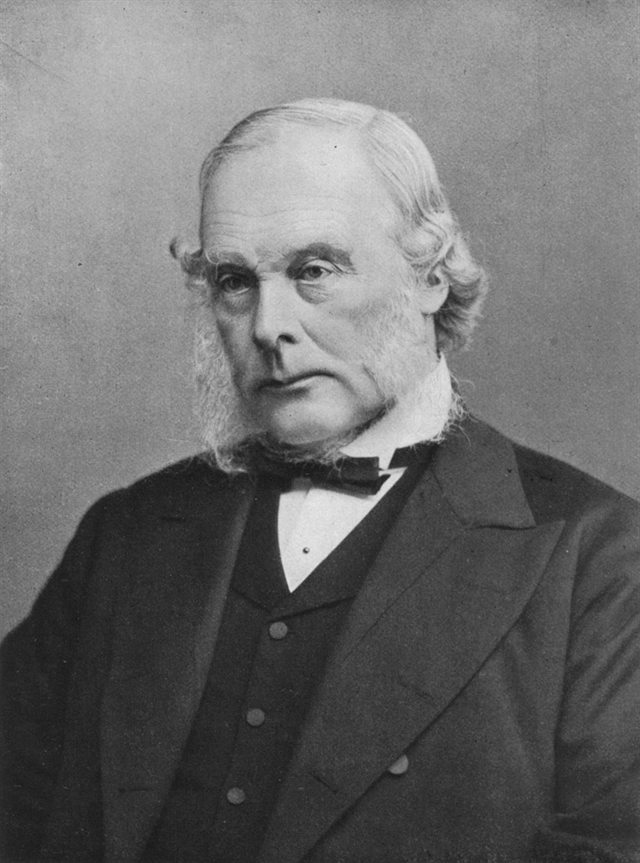
1827–1912
A Quaker whose father built a better microscope, who read a French chemist's paper on fermentation and worked out what was killing his patients, and who was resisted in London for a decade after Germany had accepted him.
Lister took an idea from a chemist who had never treated a patient and turned it into a surgical method. These five chapters follow the Quaker household with the lenses, the wards where half the amputations ended in death, the boy with the broken leg, the resistance, and the method that replaced his own.
The five chapters
- The Microscope — A Quaker family that made lenses
- Reading Pasteur — Fermentation, putrefaction, and one leap
- James Greenlees — A cart, a broken leg, and a boy who kept it
- The Resistance — Accepted in Munich, argued with in London
- Superseded, and Content To Be — From killing the germs to keeping them out
Chapter 1 · The Microscope
A Quaker family that made lenses
1827 – 1860 · Upton · London · Edinburgh
Joseph Lister was born in 1827 at Upton in Essex, into a Quaker family. His father, Joseph Jackson Lister, was a wine merchant and an amateur optician who solved the problem of chromatic aberration in the compound microscope — a genuine scientific contribution that transformed the instrument and made him a Fellow of the Royal Society.
So Lister grew up with a working microscope in the house at a time when very few doctors had one, and he was taught to use it properly.
Being a Quaker excluded him from Oxford and Cambridge, which were closed to Nonconformists, so he went to University College London, which had been founded for exactly that reason. He qualified in 1852, went to Edinburgh intending to stay a month, and remained for seven years as assistant to James Syme, the leading surgeon in Scotland, whose daughter Agnes he married. She worked with him on his experiments for the rest of her life and wrote up a great deal of his notes.
In 1860 he became Regius Professor of Surgery at Glasgow, and took charge of wards in the Glasgow Royal Infirmary where mortality after amputation was running at something close to half.
Why this matters
Lister came to surgery with a microscopist's training, which is why he could take a chemist's work on fermentation seriously when surgeons could not.
A father who improved the microscope, and wards where half the amputations died. What would you ask him?
Ask Lister
- “What did growing up with a microscope give you?”
- “How did being a Quaker shape your career?”
- “What was Agnes's part in the work?”
- “What did the Glasgow wards look like when you arrived?”
- “What did surgeons think was causing the deaths?”
Chapter 2 · Reading Pasteur
Fermentation, putrefaction, and one leap
1864 – 1865 · Glasgow
The central problem was this. Wounds that were closed — a simple fracture, where the skin was unbroken — healed. Wounds that were open — a compound fracture, where bone had come through the skin — went septic, and the standard treatment was amputation, which itself killed something like half the patients.
Surgeons explained this by oxygen in the air acting on the exposed tissue, and their remedies followed: exclude the air with plasters and dressings.
In 1864 a colleague drew Lister's attention to the work of Louis Pasteur, a chemist in Lille who had shown that fermentation and putrefaction were caused by living micro-organisms rather than by any property of air itself. Pasteur was working on wine and on silkworms and had no interest in surgery.
Lister made the connection: if putrefaction in a flask is caused by living organisms, then putrefaction in a wound is too, and what has to be excluded is not air but what the air carries. That is the single most important inference in nineteenth-century surgery, and it was made by a man reading outside his field.
He needed a substance that would kill the organisms without destroying tissue. He learned that carbolic acid was being used to treat sewage in Carlisle, apparently reducing disease in cattle grazed on the treated fields, and he began experimenting with it.
Why this matters
Lister's contribution was an inference from a chemist's work on wine to the wards of a hospital, made because he was reading outside surgery.
A paper about fermentation, and a leap to a wound. What would you ask him?
Ask Lister
- “Why did open wounds go septic when closed ones did not?”
- “What did Pasteur's work on fermentation let you conclude?”
- “Why carbolic acid rather than anything else?”
- “How did surgeons explain wound infection before you?”
- “Should a surgeon be reading chemistry?”
Chapter 3 · James Greenlees
A cart, a broken leg, and a boy who kept it
August 1865 · Glasgow Royal Infirmary
In August 1865 an eleven-year-old boy named James Greenlees was brought into the Glasgow Royal Infirmary. A cart had run over his leg and broken the tibia, and the bone had come through the skin.
Under the practice of the time this was a compound fracture and the leg would very probably have been amputated, with a substantial chance that the boy would die of the amputation.
Lister cleaned the wound, dressed it with lint soaked in carbolic acid, covered it and left it. He changed the dressing carefully and watched. There was no suppuration. The bone knitted. Six weeks later the boy walked out of the hospital with both legs.
Lister repeated the method on a series of compound fractures and published the results in The Lancet in 1867, reporting a fall in mortality in his male accident ward from around 45 per cent to around 15 per cent over three years.
The method as he first practised it was cruder than what came later: instruments, hands, dressings and the air of the theatre itself were treated with carbolic, and for a period he used a spray that filled the room with a fine carbolic mist. It cracked the skin of everyone in the theatre, irritated eyes and lungs, and damaged the tissue it was meant to protect. He abandoned the spray in the 1880s, saying he was ashamed of having ever used it.
Why this matters
The proof was a boy who kept his leg, and the mortality figures Lister published in 1867 are the evidence surgeons could not argue with.
A boy who walked out with both legs. What would you ask him?
Ask Lister
- “What would have happened to James Greenlees without the carbolic?”
- “What did your ward's mortality figures show?”
- “Why did you use a carbolic spray, and why stop?”
- “How did the nurses and dressers react to working in carbolic?”
- “Was one boy enough to convince you?”
Chapter 4 · The Resistance
Accepted in Munich, argued with in London
1867 – 1880 · Glasgow · Edinburgh · London · Munich
The method was not adopted quickly in Britain, and the reasons are worth setting out because they were not all stupid.
Some surgeons tried it, applied it inconsistently — carbolic on the dressing but not on the hands, or a spray and unwashed instruments — got poor results and concluded it did not work. Some rejected the germ theory it rested on, which in the 1860s was a live scientific question rather than a settled fact. Simpson in Edinburgh opposed it and promoted acupressure instead. Others objected to the time it took and the discomfort it caused. And a considerable number of surgeons of the period took a professional pride in the state of their coats, which were stiff with the accumulated blood of previous operations, and in operating fast; a method that required them to wash was an insult to a craft.
Germany accepted it far faster, and the surgeons of the Franco-Prussian War of 1870 used it. When Lister lectured in Munich the wards had already adopted his methods and their mortality had fallen sharply.
He moved to King's College Hospital in London in 1877 specifically to convert the profession at its centre, and had to give demonstrations to hostile audiences. The turning point in Britain came in the 1870s and early 1880s, and by the time Queen Victoria's surgeons used carbolic on an abscess she had — Lister among them — the argument was substantially over.
Why this matters
Antisepsis was accepted in Germany years before Britain, and the reasons for British resistance included professional pride as well as scientific doubt.
Accepted abroad, argued with at home. What would you ask him?
Ask Lister
- “Why did surgeons who tried your method get worse results than you?”
- “Why did Germany accept it faster than Britain?”
- “What did the state of a surgeon's coat mean to him?”
- “Was rejecting germ theory in 1867 unreasonable?”
- “Why move to London when Glasgow was working?”
Chapter 5 · Superseded, and Content To Be
From killing the germs to keeping them out
1880 – 1912 · London · Walmer
By the 1880s the logic of Lister's own argument had moved past his method. If organisms cause infection, the better answer is not to kill them in the wound but to prevent them reaching it: sterilise the instruments and the dressings with steam, keep the theatre clean, and cover the hands.
That is asepsis, and it developed largely in Germany. Rubber gloves came into surgical use in the 1890s; masks, caps and gowns followed. Lister accepted it. He had never claimed that carbolic was the point, only that the organisms were, and he said so.
His honours accumulated: a baronetcy, the presidency of the Royal Society, and in 1897 a peerage — the first British doctor ever raised to it. He was one of the twelve original members of the Order of Merit in 1902. Agnes died in 1893 while they were travelling in Italy, and he did very little work afterwards.
He died in 1912 at Walmer in Kent, aged eighty-four, and declined a funeral in Westminster Abbey; there was a service there, and he was buried beside Agnes in Hampstead.
The scale of what he changed is easy to state. Before 1865 an operation inside the abdomen, the chest or the skull was effectively a death sentence, and surgery was confined to the surface and to amputation. Once infection could be prevented, surgeons could open the body. Every operation performed since rests on it.
Why this matters
Lister's method was replaced within twenty years by a better one that followed from his own argument, and he said so himself.
A method superseded by its own logic. What would you ask him?
Ask Lister
- “How did you feel about asepsis replacing your method?”
- “What became possible in surgery that had not been before?”
- “What did you owe Pasteur?”
- “Why decline burial in Westminster Abbey?”
- “What should a scientist do when their own idea outgrows their method?”
What Lister changed
Lister applied Pasteur's germ theory to surgical wounds and reduced the mortality of his own accident ward from roughly forty-five to fifteen per cent, and in doing so made it possible to operate inside the body at all. The specific method he used — carbolic acid, and for a period a carbolic spray — was superseded within twenty years by aseptic technique, which followed from his own reasoning and which he accepted without complaint.
A debate that continues
Was British resistance to antisepsis a reasonable scientific caution about an unproved theory, or professional conservatism dressed as caution? Both are documented and historians weigh them differently.
Keep exploring — ask Lister
- “How long is it reasonable to resist a new idea?”
- “Why did a chemist's work on wine change surgery?”
- “Should a scientist mind being superseded?”
Related lives
- Louis Pasteur — Father of Germ Theory
- James Young Simpson — They Woke Up On The Dining Room Floor
- Robert Koch — The Method Was The Argument
Related themes
Germ theory · Antiseptic and aseptic surgery · Hospital infection
Continue on Incandio
- Talk to Lister — every question on this page is one tap from being asked, and the same page carries the Historical Brief, the achievements and the timeline
- All 280 figures · Incandio — learn every idea, teach it, then defend it