Historical figure · Pearson Edexcel International GCSE revision on Incandio
Lord Kelvin
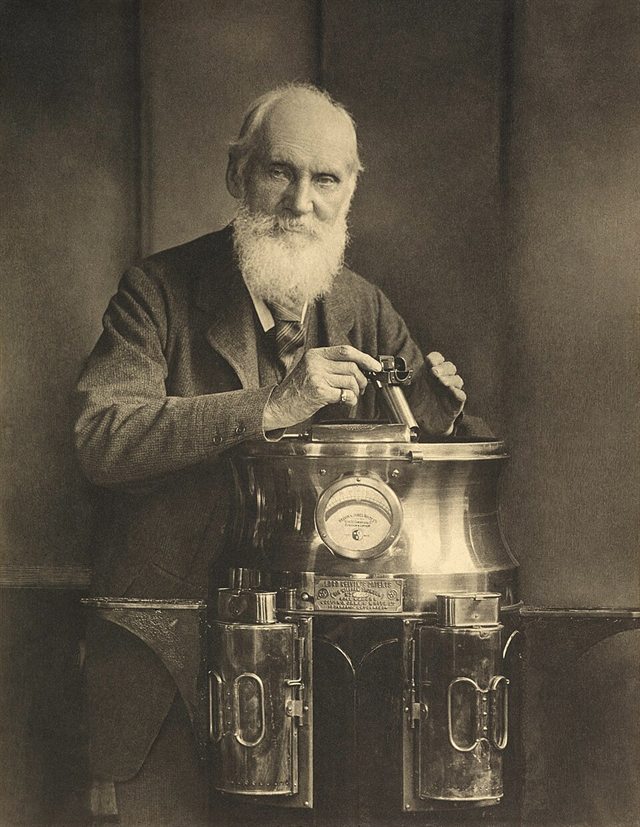
Who Found The Bottom Of The Scale · Physicist · 1824–1907
Who objected that every gas thermometer disagrees with every other, and proposed instead a scale of temperature that does not depend on what the instrument is filled with — a scale with a genuine bottom to it.
Defend these ideas against Kelvin
Incandio is a free revision platform for the Pearson Edexcel International GCSE, and on it a topic counts as mastered only once you have learned it, proved it in questions, taught it back and defended it against the person with the strongest claim on it. Lord Kelvin is that person for one topic on the course:
- Gas Pressure and Absolute Zero — Physics
Who was Kelvin?
William Thomson was born at Belfast in 1824, entered Glasgow University at ten, and was appointed professor of natural philosophy there at twenty-two, holding the chair for fifty-three years and founding the first teaching physics laboratory in Britain. In 1848 he published his objection to the thermometry of the day: a scale defined by the expansion of a particular gas is a property of that gas, and different gases disagree, so the scale is a convention rather than a measurement of anything. Sadi Carnot's theory of the motive power of heat gave him a better footing — define temperature by the work an ideal engine can extract in letting heat fall from one temperature to another, and the scale becomes independent of any working substance. On such a scale there is a real zero, a temperature below which nothing can go because there is no heat left to fall. The gas experiments pointed to the same place: a gas at constant pressure contracts by about a two hundred and seventy-third part of its volume for each degree of cooling, so continuing the line gives a vanishing volume at about minus two hundred and seventy-three. He worked with Joule on the cooling of expanding gases, formulated the dissipation of energy, turned Faraday's lines of force into mathematics, and made a fortune from submarine telegraphy: he laid the Atlantic cable when the electricians said the thing could not be done, and invented the mirror galvanometer and siphon recorder that read it. He was also confidently and lastingly wrong about the age of the Earth, having no knowledge of radioactivity, and about the future of heavier-than-air flight.
Major achievements
- Proposed the absolute thermodynamic scale of temperature in 1848, independent of any working substance
- Identified absolute zero as a real physical limit rather than an extrapolation
- Formulated the dissipation of energy, one route to the second law of thermodynamics
- Discovered, with Joule, the cooling of a gas on expansion
- Laid the first successful Atlantic telegraph cable and invented the instruments that read it
Life in brief
- 1824 — Born at Belfast: The family moves to Glasgow when he is eight.
- 1846 — Professor at Glasgow: At twenty-two; he holds the chair for fifty-three years.
- 1848 — The absolute scale: A temperature not defined by any particular gas.
- 1852 — The Joule–Thomson effect: A gas cooling as it expands.
- 1866 — The Atlantic cable: Laid at last; a knighthood follows.
- 1892 — Baron Kelvin of Largs: Named for the river past his laboratory.
- 1907 — Dies at Largs: Radioactivity has already destroyed his age of the Earth.
Explore the life of Kelvin — five chapters
- Glasgow at Ten, a Chair at Twenty-Two — A prodigy, and the first teaching laboratory in Britain
- A Scale That Is Not a Property of a Thermometer — Absolute temperature, 1848
- The Dissipation of Energy — Why energy is conserved and still runs out
- The Atlantic Cable — Physics that had to work, or a fortune was on the seabed
- The Age of the Earth — Confidently, aggressively wrong for forty years
Read the five-chapter life of Lord Kelvin →
Begin
- Start a conversation with Kelvin — a dramatised, historically grounded AI portrayal
- Read the Historical Brief
- Explore the life of Kelvin — five chapters
- Find your course · Meet all 280 figures