Explore Their Life · Pearson Edexcel International GCSE revision on Incandio
Lord Kelvin: A Life in Five Chapters
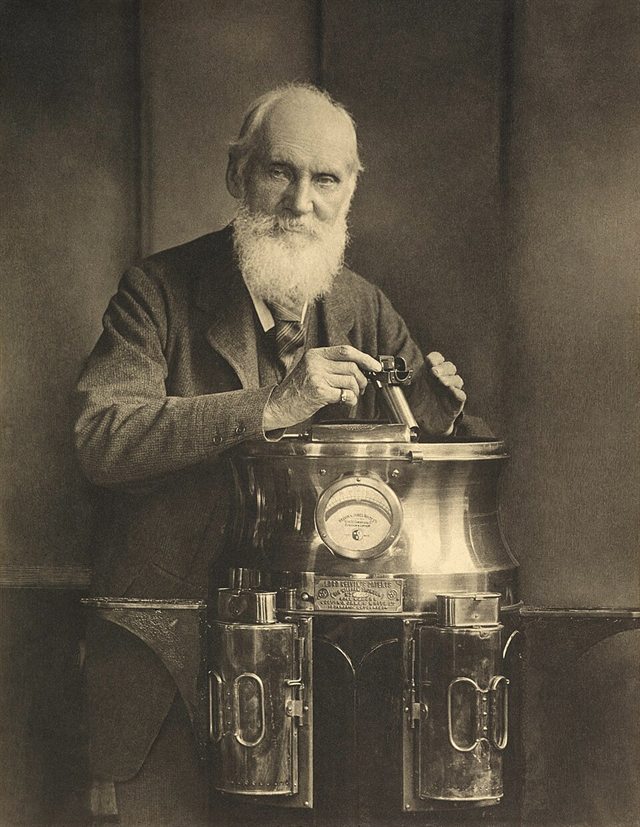
1824–1907
The professor at twenty-two who defined a temperature scale that does not depend on any thermometer, laid the Atlantic cable when the electricians said it could not be done, and told the geologists the Earth was far younger than it is.
Kelvin gave physics absolute temperature, the dissipation of energy, and a fortune's worth of telegraph patents. He also spent decades wrong about the age of the Earth, defended it aggressively, and conceded badly. These five chapters follow the scale, the cable and the error.
The five chapters
- Glasgow at Ten, a Chair at Twenty-Two — A prodigy, and the first teaching laboratory in Britain
- A Scale That Is Not a Property of a Thermometer — Absolute temperature, 1848
- The Dissipation of Energy — Why energy is conserved and still runs out
- The Atlantic Cable — Physics that had to work, or a fortune was on the seabed
- The Age of the Earth — Confidently, aggressively wrong for forty years
Chapter 1 · Glasgow at Ten, a Chair at Twenty-Two
A prodigy, and the first teaching laboratory in Britain
1824 – 1846 · Belfast · Glasgow · Cambridge · Paris
William Thomson was born at Belfast in June 1824. His father James was a mathematics teacher who moved to a chair at Glasgow when the boy was eight, and who taught his sons himself.
William matriculated at the *University of Glasgow at ten* — which was less extraordinary then than it sounds, since the university took very young students, but he was doing serious mathematics by his mid-teens. At fifteen he won a prize for an essay on the figure of the Earth that he was still referring to fifty years later.
He went to Cambridge, was second wrangler, and then spent time in *Paris* in the laboratory of Henri Victor Regnault, doing precise experimental work on the thermal properties of steam and gases.
That combination is the key to him: British mathematical training plus French experimental precision.
In Paris he also read *Sadi Carnot's* Réflexions sur la puissance motrice du feu — an 1824 pamphlet on the theory of heat engines that almost nobody had noticed. It shaped everything he did in thermodynamics.
In 1846, aged *twenty-two*, he was appointed Professor of Natural Philosophy at Glasgow, largely through his father's energetic campaigning on his behalf.
He held the chair for *fifty-three years*.
And he did something no British university had done: he founded a *teaching physics laboratory*, in which students did experiments themselves rather than watching demonstrations. Physics teaching in Britain had been lectures and demonstrations; Kelvin put students to work on real measurements, often on problems from his own research.
“When you can measure what you are speaking about, and express it in numbers, you know something about it.”
— William Thomson, Lord Kelvin, lecture on Electrical Units of Measurement (1883)
Why this matters
Kelvin founded the first teaching physics laboratory in Britain, putting students to work on real measurements rather than watching demonstrations.
You have the chair at twenty-two and the new laboratory. What would you ask?
Ask Kelvin
- “What did you learn in Regnault's laboratory in Paris?”
- “Why start a teaching laboratory?”
- “What did you find in Carnot's pamphlet?”
- “How much did your father's campaigning get you the chair?”
- “What is it like to hold one post for fifty-three years?”
Chapter 2 · A Scale That Is Not a Property of a Thermometer
Absolute temperature, 1848
1848 · Glasgow
Kelvin's objection to the thermometry of his day is precise and it is worth following.
A temperature scale defined by the *expansion of mercury* is a scale of how mercury expands. A scale defined by the expansion of *air* is a scale of how air expands. And the two *do not agree* except at the fixed points where they are forced to. Different gases disagree with each other too, slightly.
So when you say something is at fifty degrees, you are reporting a property of your *instrument* as much as of the thing measured. The scale is a *convention*, not a measurement of anything real.
Carnot's theory gave him a way out.
Carnot had analysed an ideal heat engine: heat falls from a hot reservoir to a cold one and work is extracted in the process, and the *maximum* work obtainable depends only on the two temperatures, not on the working substance — not on whether the engine uses steam, air or anything else.
So: define temperature by *the work an ideal engine can extract in letting a given quantity of heat fall between two temperatures*.
That definition mentions no substance whatever. It is *absolute*.
And it has a consequence. If temperature is defined by how much work can be got out of heat falling to it, then there is a temperature at which *no more work can be extracted* — where the heat has nowhere further to fall. That is a *real physical limit*, not an extrapolation.
The gas measurements pointed to the same place from a different direction. A gas at constant pressure contracts by about a two hundred and seventy-third part of its volume for each degree Celsius of cooling. Continue the line and the volume vanishes at about *minus 273 degrees*.
Two entirely independent arguments, one thermodynamic and one from gas behaviour, converging on the same point. That convergence is why absolute zero is taken seriously as a physical limit rather than a mathematical artefact.
The unit is the *kelvin*.
Why this matters
Absolute temperature is defined by the work an ideal engine can extract, which mentions no substance at all — so the scale is a property of nature rather than of a thermometer.
You have the ideal engine and the real zero. What is your question?
Ask Kelvin
- “What is wrong with a mercury thermometer as a definition?”
- “How does an ideal engine define a temperature?”
- “Why is absolute zero a real limit rather than an extrapolation?”
- “What happens to a gas as you approach it?”
- “Can anything actually reach absolute zero?”
Chapter 3 · The Dissipation of Energy
Why energy is conserved and still runs out
1851 – 1852 · Glasgow
Kelvin had a problem to resolve, and resolving it produced one of his best pieces of work.
*Carnot's* theory assumed heat is a conserved substance — caloric — that falls from hot to cold like water down a millwheel, driving the engine but not being consumed.
*Joule* had shown heat is not conserved as a substance; it can be created from work at a fixed rate.
Both theories worked. They could not both be right as stated.
Kelvin was sceptical of Joule at first and then took him seriously, and the reconciliation — reached alongside Rudolf Clausius in Germany — is that *two* principles operate, not one.
The *first*: energy is conserved. Joule is right.
The *second*: heat does not spontaneously flow from a colder body to a hotter one, and no process can convert heat *entirely* into work. Carnot's insight about the limit on engine efficiency is right.
In 1852 Kelvin published *On a Universal Tendency in Nature to the Dissipation of Mechanical Energy*, and the word *dissipation* is doing careful work.
Energy is never destroyed. But it becomes progressively *less available*. Concentrated, useful energy — a raised weight, a hot boiler, a charged battery — spreads out into diffuse, low-temperature heat from which no work can be extracted. The total is unchanged; the *usefulness* is not.
That is the *second law of thermodynamics*, and it is the reason time has a direction. A hot cup of tea cools; a cool cup does not spontaneously heat itself, though energy conservation would permit it.
Kelvin drew a cosmological conclusion: the universe is running down toward a uniform temperature at which no work is possible — later called the *heat death*. It caused considerable disquiet, and it was one of the first scientific claims about the ultimate fate of everything.
Why this matters
Energy is conserved but becomes less available, which is why a hot cup of tea cools and never spontaneously reheats — and why time has a direction.
You have conservation and dissipation together. What would you ask?
Ask Kelvin
- “How can energy be conserved and still run out?”
- “Why did Carnot and Joule seem to contradict each other?”
- “Why does a cup of tea never reheat itself?”
- “What did you mean by the universe running down?”
- “Does the second law give time a direction?”
Chapter 4 · The Atlantic Cable
Physics that had to work, or a fortune was on the seabed
1856 – 1866 · Valentia · Newfoundland · The Atlantic
Kelvin's engineering career is as important as his physics, and it made him rich.
In the 1850s a consortium proposed laying a *telegraph cable across the Atlantic* — some two thousand miles of cable on the ocean floor, between Ireland and Newfoundland.
The electrical problem is severe. A long submarine cable is effectively an enormous *capacitor*: a conductor surrounded by insulation surrounded by conducting seawater. A sharp pulse sent in at one end arrives at the other *smeared out* over a long period, because the cable's capacitance has to charge and discharge through its own resistance. Kelvin analysed this mathematically and produced the *law of squares*: the delay increases as the *square* of the cable's length.
That is a serious result. Double the length and the signalling rate falls to a quarter.
The chief electrician of the first attempt, *Wildman Whitehouse*, disagreed. He believed the answer was *higher voltage*, and used induction coils generating around two thousand volts to force signals through.
The 1858 cable worked briefly — Queen Victoria and President Buchanan exchanged messages, taking about sixteen hours for ninety-eight words — and then *failed* after about three weeks. Whitehouse's high voltages had destroyed the insulation.
Kelvin's approach was the opposite: *very small* currents, and an instrument sensitive enough to detect them.
His *mirror galvanometer* has a tiny magnet with a mirror attached, suspended by a silk fibre in a coil. A beam of light reflects off the mirror onto a scale; a minute rotation moves the light spot a long way. It can detect currents far too small to move any pointer.
He followed it with the *siphon recorder*, which writes the signal in ink on a moving paper tape.
The 1866 cable, using his methods, worked, and the 1865 cable was recovered from the seabed and completed as well.
He was knighted, and made a great deal of money from patents on the instruments.
Why this matters
Kelvin's law of squares meant a long cable needed tiny currents and a sensitive detector, not high voltages — and the man who tried high voltages destroyed the first cable.
You have the smeared signal and the mirror galvanometer. What is your question?
Ask Kelvin
- “Why does a signal smear out in a long submarine cable?”
- “What does the law of squares mean for a cable's length?”
- “How does the mirror galvanometer detect so little current?”
- “What did Whitehouse get wrong?”
- “Should a physicist be laying cables at all?”
Chapter 5 · The Age of the Earth
Confidently, aggressively wrong for forty years
1862 – 1907 · Glasgow · Largs
Kelvin's most famous error is worth understanding properly, because the reasoning was excellent and the conclusion was badly wrong.
He argued from *cooling*. If the Earth began molten and has been losing heat ever since, then from the present temperature gradient in the crust — how fast temperature rises as you go down a mine — and the thermal conductivity of rock, you can calculate how long it has been cooling.
He did the calculation in 1862 and got between twenty and four hundred million years, and narrowed it over the years, eventually settling around *twenty to forty million*.
He made a similar argument for the Sun, which on any chemical or gravitational source of energy could not have shone for more than tens of millions of years.
And he used it *against the geologists and against Darwin*. Darwin's natural selection needs vast time — hundreds of millions of years — and Lyell's geology assumed effectively unlimited time. Kelvin said physics forbids it, and pressed hard.
Darwin was genuinely troubled. He called Kelvin an odious spectre and regarded the objection as the most serious against his theory.
The mathematics was right and the calculation was right *given the assumptions*. The assumptions were incomplete in a way nobody could have known.
*Radioactivity* was discovered in 1896. Radioactive decay in the Earth's interior generates heat continuously, so the planet is not simply cooling from an initial store. And *nuclear fusion*, understood in the 1920s and 1930s, powers the Sun for billions of years.
The Earth is about *4.5 billion* years old — a hundred times Kelvin's figure.
His conduct is the criticism. He was aggressive, dismissive of geologists as unmathematical, and did not concede gracefully. Ernest Rutherford described lecturing on radioactivity with Kelvin asleep in the audience, waking at the crucial moment, and saving himself by saying Kelvin had limited the age *provided no new source of heat was discovered* — and that this evening we are considering that new source. Kelvin, Rutherford said, beamed.
He is also said to have declared heavier-than-air flying machines impossible, and to have said there was nothing new to be discovered in physics.
He was ennobled as *Baron Kelvin of Largs* in 1892, after the river past his laboratory. He died at Largs in December 1907, aged eighty-three, and is buried in Westminster Abbey near Newton.
Why this matters
Kelvin's calculation was correct given his assumptions, and radioactivity — undiscovered until 1896 — made those assumptions wrong by a factor of a hundred.
You have the calculation, the argument with Darwin and radioactivity. What would you ask?
Ask Kelvin
- “How did you calculate the age of the Earth?”
- “What did radioactivity do to your answer?”
- “Were you fair to Darwin and the geologists?”
- “How should a scientist concede an error?”
- “Did you really say there was nothing new left in physics?”
What Kelvin changed
The absolute scale of temperature is the scale of modern physics and its unit carries his title. The dissipation of energy is one route to the second law of thermodynamics, and the Joule–Thomson effect underlies refrigeration and gas liquefaction. The Atlantic cable made him rich and famous, and the age of the Earth made him a standing lesson in how confident a great physicist can be while missing something enormous.
A debate that continues
Kelvin's age of the Earth was wrong by roughly a factor of a hundred because radioactivity was undiscovered, and he pressed the argument aggressively against Darwin and the geologists and conceded it with very poor grace.
Keep exploring — ask Kelvin
- “What are you most confident about that might be wrong?”
- “Should physics overrule geology?”
- “Which of your instruments was the best made?”
Related lives
- James Prescott Joule — Who Weighed Heat Against Work
- James Clerk Maxwell — Who Bound Light to Electromagnetism
- Charles Darwin — Author of On the Origin of Species
- Ernest Rutherford — Who Found the Atom Was Nearly Empty
Related themes
Absolute temperature · The second law of thermodynamics · Telegraphy and signals
Continue on Incandio
- Talk to Kelvin — every question on this page is one tap from being asked, and the same page carries the Historical Brief, the achievements and the timeline
- All 280 figures · Incandio — learn every idea, teach it, then defend it