Historical figure · Pearson Edexcel International GCSE revision on Incandio
Luca Pacioli
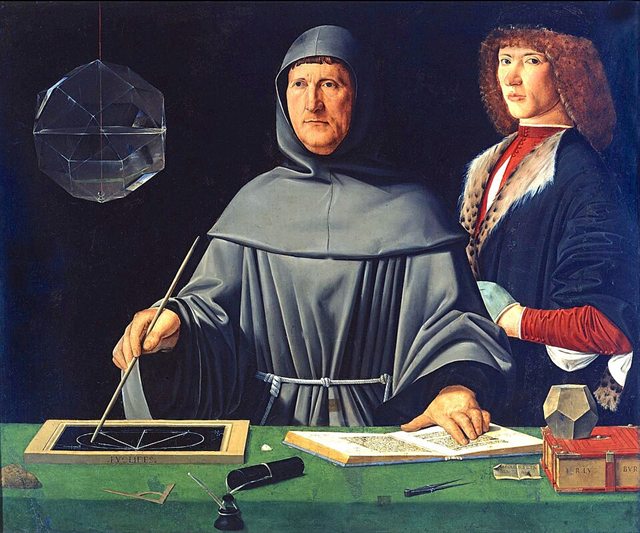
Who Printed The Merchant's Arithmetic · Friar & Master of Reckoning · c. 1447–1517
The Franciscan whose printed Summa of 1494 gave Renaissance Europe its commercial arithmetic — and set down the Venetian method of double-entry bookkeeping that is still in use.
Defend these ideas against Pacioli
Incandio is a free revision platform for the Pearson Edexcel International GCSE, and on it a topic counts as mastered only once you have learned it, proved it in questions, taught it back and defended it against the person with the strongest claim on it. Luca Pacioli is that person for one topic on the course:
- Percentage Basics — Mathematics
Who was Pacioli?
Luca Pacioli was born at Sansepolcro in Tuscany around 1447, in the same town as the painter Piero della Francesca, whose geometry he studied. He worked as a tutor to a Venetian merchant's sons, took Franciscan orders, and taught mathematics at Perugia, Naples, Milan, Pisa, Bologna and Rome. In 1494 he published at Venice the Summa de arithmetica, geometria, proportioni et proportionalità: some six hundred printed pages gathering the mathematics a merchant, a surveyor or a student would need. Crucially it is in Italian rather than Latin, which is why it was used rather than admired. Most of it is commercial arithmetic — exchange between the currencies and weights of different cities, the rule of three, tare and tret, brokerage, partnership, and interest reckoned in parts of a hundred. One section, of thirty-six chapters, describes the method of keeping accounts used by the merchants of Venice: every transaction entered twice, once as a debit and once as a credit, so that the two sides of the ledger must agree or something has gone astray. Pacioli did not invent this. He says so. What he did was print it, and it became the standard for European commerce and remains the basis of accounting today. In 1509 he published De divina proportione, on the ratio that divides a line in extreme and mean, with the regular solids drawn by Leonardo da Vinci, who had lodged with him at the court of Ludovico Sforza in Milan and learned his mathematics from him. In the same year he published a Latin edition of Euclid's Elements. The Summa also contains the problem of the interrupted game: two players are partway through a match for a stake when they must stop, and the question is how the stake should be divided. Pacioli divided it in proportion to the rounds already won. That answer is wrong — it takes no account of how many rounds each player still needs — and the problem was not properly solved until Pascal and Fermat corresponded about it in 1654, a hundred and sixty years later.
Major achievements
- Published the Summa of 1494, six hundred printed pages of practical mathematics in Italian
- Set down the Venetian method of double-entry bookkeeping, still the basis of accounting
- Taught mathematics to Leonardo da Vinci at the Milanese court
- Published De divina proportione in 1509, with Leonardo's drawings of the regular solids
- Published a Latin edition of Euclid's Elements in 1509
Life in brief
- c. 1447 — Born at Sansepolcro: In Tuscany, the town of Piero della Francesca.
- c. 1470s — Franciscan orders: After tutoring a Venetian merchant's sons in reckoning.
- 1494 — The Summa: Printed at Venice in Italian, including the thirty-six chapters on Venetian bookkeeping.
- 1496–1499 — Milan: At Ludovico Sforza's court, lodging with and teaching Leonardo da Vinci.
- 1509 — De divina proportione: With Leonardo's solids; and a Latin Euclid the same year.
- 1517 — Died: At Sansepolcro.
Explore the life of Pacioli — five chapters
- Sansepolcro to Venice — A merchant's tutor who took orders
- The Summa of 1494 — Printed, and in Italian
- Thirty-Six Chapters on Keeping Books — The method he printed and did not invent
- Milan, and Leonardo — The divine proportion and sixty solids
- The Interrupted Game — A problem he set, and answered wrongly
Read the five-chapter life of Luca Pacioli →
Begin
- Start a conversation with Pacioli — a dramatised, historically grounded AI portrayal
- Read the Historical Brief
- Explore the life of Pacioli — five chapters
- Find your course · Meet all 280 figures