Explore Their Life · Pearson Edexcel International GCSE revision on Incandio
Luca Pacioli: A Life in Five Chapters
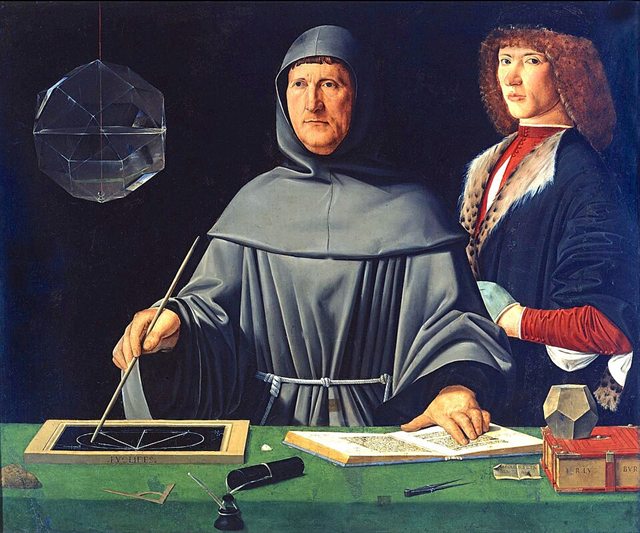
c. 1447–1517
A Franciscan friar printed six hundred pages of merchants' arithmetic in the language merchants actually spoke — and in thirty-six of those chapters, set down the accounting system the world still uses.
Almost nothing in Pacioli's great book was his own discovery, and it may be the most consequential mathematics book of the Renaissance. These five chapters follow the friar, the Summa of 1494, the bookkeeping chapters, his friendship with Leonardo da Vinci, and the one famous problem he got wrong.
The five chapters
- Sansepolcro to Venice — A merchant's tutor who took orders
- The Summa of 1494 — Printed, and in Italian
- Thirty-Six Chapters on Keeping Books — The method he printed and did not invent
- Milan, and Leonardo — The divine proportion and sixty solids
- The Interrupted Game — A problem he set, and answered wrongly
Chapter 1 · Sansepolcro to Venice
A merchant's tutor who took orders
c. 1447 – c. 1475 · Sansepolcro · Venice · Rome
Luca Pacioli was born around 1447 at Sansepolcro, a small town in Tuscany. It was also the town of the painter Piero della Francesca, who was both a great artist and a serious mathematician, and whose work on perspective and on the regular solids Pacioli studied closely as a young man.
He went to Venice as a young man to tutor the three sons of a merchant, Antonio Rompiasi, and this is the formative fact of his life. He was not educated in a university faculty arguing about Aristotle. He was educated in a counting-house, teaching boys the arithmetic they would need to trade: how to exchange one city's currency for another's, how to convert between weights that differed in every port, how to split a profit between partners who had put in different sums at different times.
This kind of mathematics had its own institution — the abbaco school, where merchants' sons went instead of to grammar school — and its own literature of manuscript handbooks going back to Fibonacci. It was practical, respectable, entirely separate from university mathematics, and largely invisible to it.
In the 1470s he took Franciscan orders. That gave him a settled position and the freedom to travel between universities, and he went on to teach mathematics at Perugia, Naples, Milan, Pisa, Bologna and Rome. He spent his working life moving between the two worlds — the counting-house and the lecture room — and his great book is what happens when somebody who knows both decides to write everything down.
Why this matters
Renaissance mathematics had two separate traditions, the university's and the merchant's, and Pacioli is the man who stood in both.
A friar trained in a counting-house. What would you ask him?
Ask Pacioli
- “What did you actually teach a merchant's sons?”
- “How different was merchant arithmetic from university mathematics?”
- “What did you learn from Piero della Francesca?”
- “Why become a Franciscan?”
- “Why did exchange between cities need so much arithmetic?”
Chapter 2 · The Summa of 1494
Printed, and in Italian
1494 · Venice
In 1494 Pacioli published at Venice the Summa de arithmetica, geometria, proportioni et proportionalità. It runs to some six hundred printed pages and it gathers, in one place, essentially the whole of the practical mathematics then in use.
Two decisions made it matter. The first is that it was printed. Printing was about forty years old, and a printed book could reach a thousand readers where a manuscript reached ten. The second, and the braver one, is that it is written in Italian rather than Latin. Latin was the language of learning; Italian was the language of the people who were going to use the book. Pacioli chose the users.
Most of the contents are commercial. Exchange between currencies. The rule of three, which is the workhorse of all proportional reasoning. Tare and tret, the allowances made for the weight of packaging. Brokerage. Partnership, and the division of profit. Interest reckoned in parts of a hundred, which is where the arithmetic of percentages lives — and in the Summa a rate is always a rate ON a particular sum, entered against a particular consignment, never a bare number floating free.
He also includes geometry, square roots, and the algebra of the al-Khwarizmi tradition as it had reached Italy, with a famous remark that solving the cubic was as impossible as squaring the circle. He was wrong about that, and within forty years Italian mathematicians had done it — partly because his book had given them the ground to stand on.
Why this matters
A printed book in the vernacular reached the people who needed it, and that decision mattered more than any theorem in it.
Six hundred pages, printed, in the language people actually spoke. What would you ask him?
Ask Pacioli
- “Why write six hundred pages in Italian rather than Latin?”
- “What is the rule of three, and why is it everywhere in your book?”
- “When you reckon in parts of a hundred, a part of WHAT?”
- “What difference did printing make to a book like yours?”
- “You said the cubic could never be solved. What happened?”
Chapter 3 · Thirty-Six Chapters on Keeping Books
The method he printed and did not invent
1494 · Venice
Inside the Summa is a section of thirty-six chapters describing the way merchants of Venice kept their accounts. It is the first printed account of double-entry bookkeeping, and it is why Pacioli is known outside the history of mathematics.
The idea is simple and relentless. Every transaction is entered twice, in two different places: once as what has been received, once as what has been given. Buy cloth for cash and the cloth account gains what the cash account loses. Because every entry appears on both sides, the two sides of the whole ledger must come to the same total. If they do not, something has been missed, and you know it before your creditors do.
What makes this powerful is that the balance is a TEST. An arithmetic system that merely records is only as good as the person recording. A system in which every fact is entered twice checks itself, and a disagreement is not a nuisance but information: it tells you an error exists and roughly where to look.
Pacioli did not invent this. Venetian merchants had been using it for well over a century, and he says so plainly in the text — he is describing the method of Venice, not proposing one of his own. What he did was write it down clearly, in a language merchants read, in a book that was printed and sold across Europe. Within a century it was the standard across the continent, and it remains the basis of accounting today. Being the person who writes something down properly is a real contribution, and this is the clearest example of it in the history of mathematics.
Why this matters
Double entry is still the world's accounting system, and it spread because somebody printed it in a language merchants could read.
A method he described rather than discovered, still in use five centuries later. What would you ask him?
Ask Pacioli
- “Why must every transaction be entered twice?”
- “What does it tell you when the two sides do not agree?”
- “Did you invent double-entry bookkeeping, or print it?”
- “Is writing something down properly a real contribution?”
- “What happens to a merchant whose books do not balance?”
Chapter 4 · Milan, and Leonardo
The divine proportion and sixty solids
1496 – 1509 · Milan · Venice
In 1496 Pacioli went to Milan, to the court of Ludovico Sforza, and there he met Leonardo da Vinci. They lodged in the same household for about three years, and Leonardo — who was in his forties and largely self-taught — learned his mathematics from Pacioli. Leonardo's notebooks from these years fill with geometry, proportion and problems of measurement.
Out of the friendship came De divina proportione, written at Milan and printed at Venice in 1509. Its subject is the ratio produced when a line is divided so that the whole stands to the larger part as the larger part stands to the smaller — a ratio the Greeks had studied and to which Pacioli, being a friar, attributes a series of divine attributes. Leonardo drew the illustrations: sixty regular and semi-regular solids, rendered both solid and as open frameworks of edges, so that you can see through them to the far side. They are the finest mathematical illustrations of the Renaissance and they are unlike anything drawn before.
In 1499 the French took Milan and both men left. Pacioli went on to teach elsewhere and, in the same year as the Divina proportione, published a Latin edition of Euclid's Elements.
His reputation has one lasting stain from this period. Vasari, writing decades later, accused him of taking Piero della Francesca's work — particularly on the regular solids — and publishing it as his own. The charge is not baseless: Pacioli's debt to Piero is very large, and by the standards of any period his acknowledgement is thin. It is also true that the two men came from the same small town, that Piero was dead, and that attitudes to attribution were not ours.
Why this matters
The most famous mathematical illustrations of the Renaissance came from a friendship between a friar and a painter who needed each other's subject.
Three years in the same house as Leonardo da Vinci. What would you ask him?
Ask Pacioli
- “What was Leonardo like as a pupil?”
- “How did he draw solids you can see through?”
- “What is divine about the divine proportion?”
- “How much of the solids work was Piero della Francesca's?”
- “What did a mathematician gain from a court like Milan?”
Chapter 5 · The Interrupted Game
A problem he set, and answered wrongly
1494 – 1654 · Venice · Paris
The Summa contains a problem that turned out to matter far more than Pacioli realised. Two players are partway through a series of games for a stake. They are forced to stop before either has won. How should the stake be divided?
Pacioli's answer is to divide it in proportion to the games already won. If the match is to five and the score is four to three, he gives the stake in the ratio four to three.
It is wrong, and the reason is worth understanding. The question is not how much of the match has been played but how much of it remains. A player who needs one more game to win is in an enormously stronger position than one who needs two, and the ratio four to three does not capture that at all. Pacioli's rule looks backwards; the situation depends on what would have happened next.
The problem sat unresolved for a hundred and sixty years, until Pascal and Fermat exchanged letters about it in 1654 and worked out that the stake must be divided according to the chances each player has of eventually winning from where they stand. That correspondence is generally taken as the beginning of the mathematical theory of probability, and Pacioli's problem — with his wrong answer attached — is what set it going.
He died at Sansepolcro in 1517. He had discovered very little. He had made available a very great deal, and he had asked, without knowing it, one of the most productive questions in the history of mathematics.
Why this matters
A wrong answer, printed clearly enough to be argued with, started the mathematics of probability a century and a half later.
A problem he set, answered wrongly, and left for Pascal. What would you ask him?
Ask Pacioli
- “How did you divide the stake, and why that way?”
- “Why does it matter how many games each player still needs?”
- “Does it trouble you that Pascal proved you wrong?”
- “Is asking a good question worth as much as answering one?”
- “You discovered little and changed a great deal. How do you weigh that?”
What Pacioli changed
Pacioli's Summa of 1494 was the mathematical education of Europe's commercial class for a century, and the thirty-six chapters inside it on the Venetian method of keeping books put double-entry accounting into print for the first time — it remains the basis of accounting worldwide. De divina proportione, with Leonardo's drawings of sixty solids, is the finest mathematical illustration of the Renaissance. And the problem of the interrupted game, which he set and answered wrongly, led directly to Pascal and Fermat's correspondence of 1654 and the beginnings of probability.
A debate that continues
Vasari accused him of appropriating Piero della Francesca's work on the regular solids, and his acknowledgement of that debt is undeniably thin. He also declared the solution of the cubic impossible, and was contradicted within forty years. Almost nothing in the Summa was his own discovery, which raises a genuine question about how his contribution should be weighed.
Keep exploring — ask Pacioli
- “Is making knowledge available as valuable as discovering it?”
- “How much credit does a compiler owe the people compiled?”
- “Why did a wrong answer to a gambling problem turn out to be so productive?”
Related lives
- Leonardo Fibonacci — Who Brought Europe The Nine Figures
- Leonardo da Vinci — Painter · Engineer · Philosopher of Nature
- William Playfair — Whatever The Eye Takes In
Related themes
Percentages and commercial arithmetic · Double-entry bookkeeping · The beginnings of probability
Continue on Incandio
- Talk to Pacioli — every question on this page is one tap from being asked, and the same page carries the Historical Brief, the achievements and the timeline
- All 280 figures · Incandio — learn every idea, teach it, then defend it