Historical figure · Pearson Edexcel International GCSE revision on Incandio
Niccolò Machiavelli
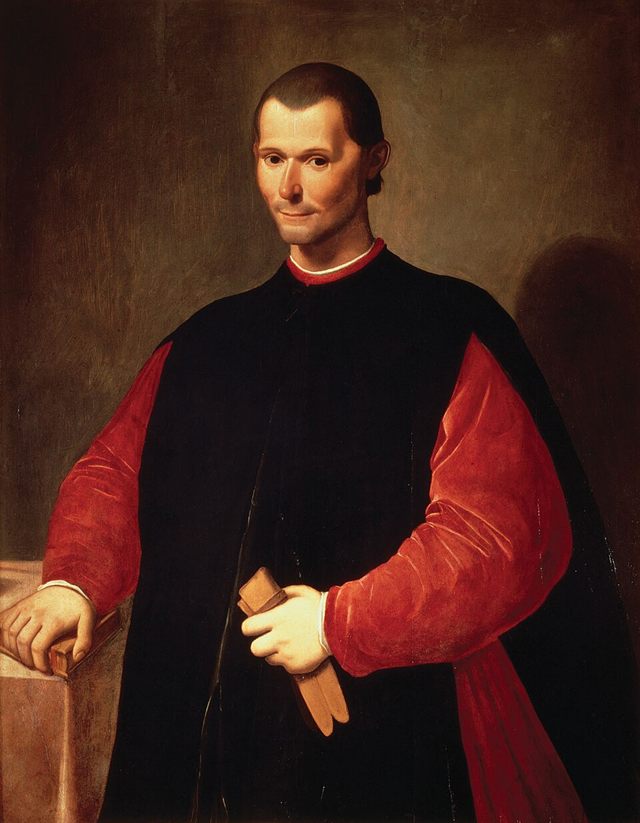
Who Wrote Down What Rulers Actually Do · Diplomat & Political Writer · 1469–1527
The Florentine secretary who organised a citizen militia, watched it fail, was tortured by the incoming regime, and then wrote the most misquoted book in politics — a republican's handbook for a prince.
Defend these ideas against Niccolò
Incandio is a free revision platform for the Pearson Edexcel International GCSE, and on it a topic counts as mastered only once you have learned it, proved it in questions, taught it back and defended it against the person with the strongest claim on it. Niccolò Machiavelli is that person for one topic on the course:
- Conflict and war — Religious Studies · Buddhism
Who was Niccolò?
Niccolò Machiavelli was born at Florence in 1469, the son of a lawyer of modest means who owned an unusually good library. He enters the record in 1498, weeks after Savonarola was burned in the Piazza della Signoria, when the restored Republic made him second chancellor at twenty-nine and secretary to the Ten — the committee that ran war and foreign affairs. He held it for fourteen years and spent much of them on the road: to Louis XII in France, to the Emperor Maximilian, to Pope Julius II, and in 1502 to Cesare Borgia, where he watched Borgia invite his mutinous captains to Senigallia and have them strangled. What he took from those years was a practical conviction rather than a theory: hired soldiers lose battles they have no reason to win. From 1506 he argued for and built a Florentine citizen militia. In 1512 it broke at Prato, the Republic fell, and the Medici came back. He was dismissed; in February 1513 he was named in a conspiracy, imprisoned and given six drops of the strappado; he was released in the amnesty when Giovanni de' Medici became Pope Leo X. He retired to a small farm at Sant'Andrea in Percussina and described his days there in a letter to Francesco Vettori in December 1513 — digging in the morning, cards in the tavern with a miller and a butcher, and in the evening changing into court dress to read the ancient historians. In that year he wrote The Prince. He also wrote the Discourses on Livy, a much longer book about republics, which he preferred and which is the reason he cannot honestly be read as a simple apologist for tyranny. The Art of War was the only political work published in his lifetime; the comedy Mandragola was a popular success; the Florentine Histories were commissioned by a Medici cardinal. The Prince appeared in 1532, five years after he died. He never got his office back.
Major achievements
- Second Chancellor of the Florentine Republic and secretary to the Ten, 1498–1512
- Raised and organised a Florentine citizen militia from 1506, against the mercenary system
- The Prince (written 1513, published 1532)
- The Discourses on Livy, the longer and more republican of the two political books
Life in brief
- 1469 — Born at Florence: Son of a lawyer with more books than money.
- 1498 — Second Chancellor: Appointed weeks after Savonarola's execution.
- 1502 — Sent to Cesare Borgia: Present in the weeks around Senigallia.
- 1506 — The militia: Argues for citizen soldiers against hired ones, and organises them.
- 1512 — Prato, and the fall: The militia breaks; the Republic ends; he is dismissed.
- 1513 — Prison and the farm: Tortured, released, and writing The Prince by December.
- 1521 — The Art of War: The only political work printed while he lived.
- 1527 — Dies at Florence: Passed over for his old post one last time.
Explore the life of Niccolò — five chapters
- A Job That Should Not Have Been His — Florence, weeks after the burning
- Watching From the Corner of the Room — France, the Emperor, the Pope, and Cesare Borgia
- His Own Idea, and What It Cost — Citizen soldiers against hired ones
- Six Drops, and a Letter About Trousers — 1513
- The Longer Book, Which Nobody Quotes — A republican's Discourses
Read the five-chapter life of Niccolò Machiavelli →
Begin
- Start a conversation with Niccolò — a dramatised, historically grounded AI portrayal
- Read the Historical Brief
- Explore the life of Niccolò — five chapters
- Find your course · Meet all 280 figures