Explore Their Life · Pearson Edexcel International GCSE revision on Incandio
Niccolò Machiavelli: A Life in Five Chapters
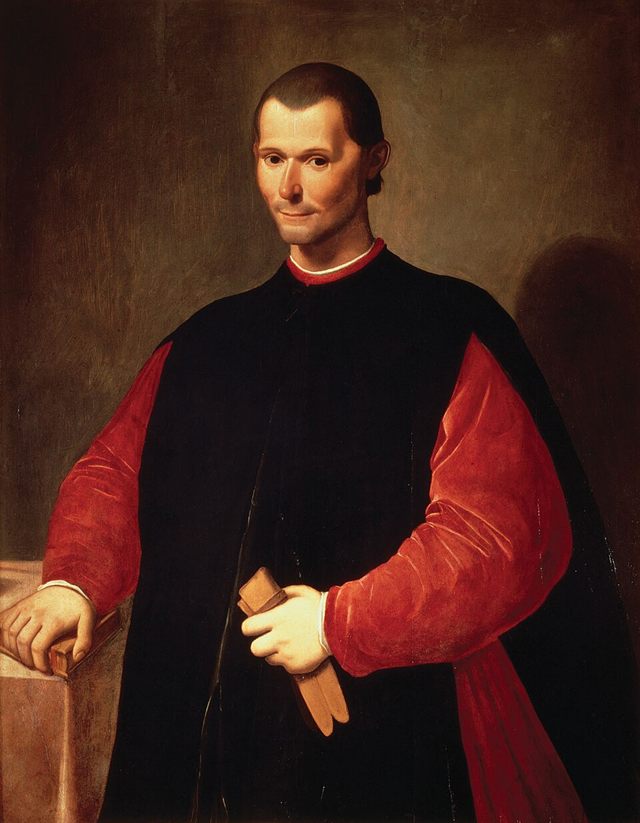
1469–1527
He ran a republic's war office for fourteen years, argued that a state should be defended by its own citizens, watched that militia break, was tortured by the men who replaced him — and then wrote a short book for them that has been used as an insult ever since.
Almost everything people know about Machiavelli comes from one book he wrote in a few months while unemployed and never saw printed. These five chapters follow the clerk who got the job by being in the right city at the right moment, the diplomat who watched a strangling at close range, the militia he built and lost, the year of the rope and the farm, and the longer book about republics that complicates every easy reading of the shorter one.
The five chapters
- A Job That Should Not Have Been His — Florence, weeks after the burning
- Watching From the Corner of the Room — France, the Emperor, the Pope, and Cesare Borgia
- His Own Idea, and What It Cost — Citizen soldiers against hired ones
- Six Drops, and a Letter About Trousers — 1513
- The Longer Book, Which Nobody Quotes — A republican's Discourses
Chapter 1 · A Job That Should Not Have Been His
Florence, weeks after the burning
1469 – 1500 · Florence
Machiavelli was born at Florence in 1469. His father Bernardo was a lawyer without much money and with an unusually good library, and that library is more or less the whole of his son's recorded education — no university, no patron, no distinguished name to trade on.
He appears in the record abruptly in 1498. Girolamo Savonarola, the friar who had governed Florence's conscience for four years, had just been hanged and burned in the Piazza della Signoria, and the restored Republic needed people who had not been too close to him. Machiavelli, aged twenty-nine and hitherto invisible, was made second chancellor and then secretary to the Ten — the committee that handled war and foreign affairs.
It was a working job rather than a grand one. He wrote dispatches, argued about money for troops, and was sent out on the road whenever somebody more senior did not want to go. He held it for fourteen years, and every idea he is now famous for came out of what he saw while doing it.
Why this matters
Machiavelli is not a philosopher who took an interest in politics. He is an official who wrote up what he had watched, which is why his examples are so specific and his generalisations so few.
You have a clerk with a good library and no connections, in a city that has just burned a prophet. What would you ask him?
Ask Niccolò
- “How did somebody with no name get the chancery?”
- “What was Florence like just after Savonarola?”
- “What did your father's library actually give you?”
- “What did a secretary to the Ten actually do all day?”
- “Did you expect the Republic to last?”
Chapter 2 · Watching From the Corner of the Room
France, the Emperor, the Pope, and Cesare Borgia
1500 – 1503 · France · Imola · Senigallia · Rome
The legations are where his education actually happened. He was sent to Louis XII in France and discovered how a small republic looks from a large monarchy — which is to say, like something to be used. He was sent to the Emperor Maximilian, and to Pope Julius II, who conducted his own wars in person.
And in 1502 he was sent to Cesare Borgia, and stayed for months. Borgia's captains had mutinied against him. He negotiated, appeared to forgive them, and invited them to Senigallia at the end of December, where they were seized and strangled. Machiavelli was there in the days around it and wrote it up for Florence in the flat prose of a man filing a report.
He is constantly accused of admiring Borgia. What the dispatches show is closer to fascinated study — a man watching a technique work, and noting that it worked, and noting later that Borgia lost everything anyway when his father died and his own illness struck at the wrong moment. That second half is usually left out by people quoting the first.
Why this matters
The Senigallia episode is the origin of his most notorious pages, and the thing he actually concluded from it was about fortune and timing rather than about cruelty.
You have a young secretary in the room while a man arranges a murder. What would you ask?
Ask Niccolò
- “What did you actually see at Senigallia?”
- “Did you admire Borgia, or study him?”
- “How does a small republic look from the French court?”
- “What did Julius II teach you that the others did not?”
- “Why did Borgia lose everything in the end?”
Chapter 3 · His Own Idea, and What It Cost
Citizen soldiers against hired ones
1506 – 1512 · Florence · Pisa · Prato
The militia is the one thing that was unmistakably his. Italian states fought with mercenaries, and Machiavelli had spent years watching them arrive late, leave early, and decline to press an advantage that would end the contract. From 1506 he argued that Florence should raise soldiers from its own territory and organised it himself, riding round the countryside enrolling men.
It is worth being clear that this is not a cynical proposal. It rests on a straightforwardly moral premise about incentives: a man defending his own city has a reason to stand that a man being paid does not.
In 1512 a Spanish army came for Florence on behalf of the Medici. The militia held Prato for a short time and then broke, and the sack that followed was severe. The Republic fell within days. Machiavelli's own project had failed in the most public way available, and he never stopped believing it had been right — the argument reappears years later in The Art of War, which is the only political book he saw printed.
Why this matters
The militia shows him as an official with a policy rather than a writer with a theory, and its failure is the event that produced everything he wrote afterwards.
You have a man who built an army out of farmers and watched it break. What would you ask?
Ask Niccolò
- “Why did you care so much about who carries the weapons?”
- “What was wrong with the mercenary system?”
- “What happened at Prato?”
- “Did the defeat change your mind about citizen soldiers?”
- “What was it like enrolling men in the villages?”
Chapter 4 · Six Drops, and a Letter About Trousers
1513
1513 · Florence · Sant'Andrea in Percussina
The Medici returned and Machiavelli was dismissed. In February 1513 his name was found on a list belonging to a conspiracy against them. He was arrested and given six drops of the strappado — hands tied behind the back, hauled up, dropped. He seems not to have said anything, because there was nothing to say. He was released in the general amnesty when Giovanni de' Medici was elected pope.
He went out to a small farm at Sant'Andrea in Percussina, seven miles from the city, and in December wrote to his friend Francesco Vettori the letter that is the best-known thing he ever wrote after The Prince. He describes catching thrushes, arguing in the tavern over cards with a miller, a butcher and two bakers — and then coming home in the evening, taking off the mud-stained clothes and putting on court dress, in order to enter the courts of the ancient men and ask them why they did what they did.
At the end of the letter, almost in passing, he mentions that he has composed a small work on principalities.
The Prince was written that year, dedicated to the family that had tortured him, and offered in the hope of a job. He did not get one, and the book was not printed until 1532, five years after his death.
Why this matters
The Prince is the work of an unemployed official trying to demonstrate his usefulness, written months after being tortured by its dedicatee — which is context most readings of it leave out entirely.
You have a tortured man in court dress, alone, reading Livy. What would you ask?
Ask Niccolò
- “Why write a book for the family that tortured you?”
- “What did the court dress in the evening actually mean to you?”
- “What were they trying to get out of you in February?”
- “Did you expect The Prince to get you the job?”
- “What was the tavern like after fourteen years in the chancery?”
Chapter 5 · The Longer Book, Which Nobody Quotes
A republican's Discourses
1513 – 1527 · Sant'Andrea in Percussina · Florence
While The Prince was being copied among friends, Machiavelli was writing something several times longer: the Discourses on Livy, a book about republics, built on the first ten books of Livy's Roman history.
Its arguments are not the ones his name is used for. A republic is more durable than a principality. The conflict between the common people and the senate did not weaken Rome — it was the source of its strength, because each side checked the other. A people is a better guardian of liberty than a prince. It is the work of a man who spent fourteen years serving a republic and wanted one back.
The two books are not a contradiction so much as two halves of one job: the Discourses describe what he thinks a state should be, and The Prince describes what somebody has to do to hold one when it is not that. Whether that is an honest division of labour or a convenient one is exactly the question a reader has to answer.
The Art of War came out in 1521, the only political work printed in his lifetime, and it argues the militia case all over again. The Florentine Histories were commissioned by a Medici cardinal. His comedy Mandragola was performed to great success — he was funny, which people who use his name as an adjective rarely notice.
In 1527 the Medici fell again and the Republic was restored. Machiavelli applied for his old post. It went to somebody else, on the grounds that he had spent too long writing for the Medici. He died a few weeks later, in June 1527.
Why this matters
Almost every argument about whether Machiavelli endorsed what he described turns on whether the Discourses are read alongside The Prince — and most readers never open them.
You have two books that seem to want different things, by the same man in the same years. What would you ask?
Ask Niccolò
- “Which is the real book — The Prince or the Discourses?”
- “Why did you think conflict made Rome stronger?”
- “What does it mean that fortune governs half?”
- “Is describing what rulers do the same as recommending it?”
- “How did it feel to be passed over in 1527?”
What Niccolò changed
Machiavelli separated the question of what a ruler should do from the question of what is virtuous, and did it so plainly that his name became an adjective for the separation. What is usually lost is that he did it as a working official of a republic, from notes taken in the room, and that his longer book argues for popular government. He is the point at which political writing stopped describing ideal princes and started describing real ones.
A debate that continues
Whether The Prince is advice, satire, a job application or a description with no recommendation attached has been argued since it was printed, and the Discourses are the evidence both sides use.
Keep exploring — ask Niccolò
- “Is describing how power works the same as approving of it?”
- “Can a state be defended by people who are paid to defend it?”
- “How much of what happens to a country is anybody's decision?”
Related lives
- Michelangelo — Il Divino · Sculptor of the Sistine
- Elizabeth I — Queen of England · The Virgin Queen
- Leonardo da Vinci — Painter · Engineer · Philosopher of Nature
Related themes
Power and legitimacy · Conflict and war · Republics and liberty
Continue on Incandio
- Talk to Niccolò — every question on this page is one tap from being asked, and the same page carries the Historical Brief, the achievements and the timeline
- All 280 figures · Incandio — learn every idea, teach it, then defend it